
Free Safe Operating Procedure (Turf Divot Repair) Template
Ensure safe turf maintenance with our free Safe Operating Procedure for turf divot repair. Download the customisable DOCX and PDF template for your workplace.
Free Safe Operating Procedure (Turf Divot Repair) Template
DOCX • 126 KB + PDF
Updated Oct 2026
No signup required
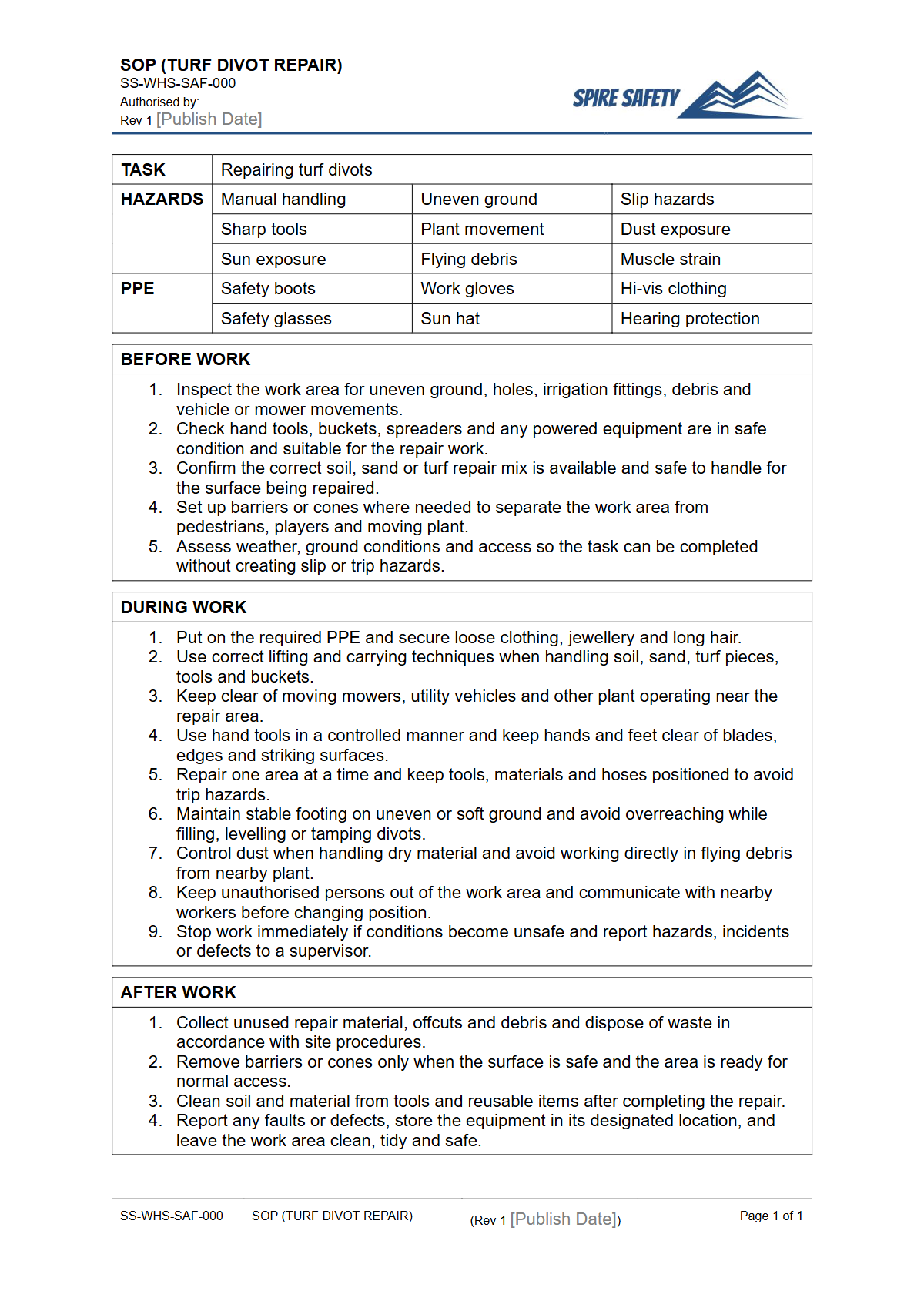
Purpose of the Free Safe Operating Procedure (Turf Divot Repair) Template
Maintaining pristine turf on golf courses, sporting ovals, and public parks involves more than just mowing. Tasks like divot repair, while seemingly simple, carry inherent risks that must be managed.
This Free Safe Operating Procedure (Turf Divot Repair) Template provides a structured framework to help organisations document a safe system of work for this common groundskeeping task. Its primary purpose is to guide workers through the process step-by-step, minimising exposure to hazards and ensuring consistent, safe outcomes.
A well-developed SOP for turf divot repair helps control risks such as musculoskeletal injuries from repetitive bending and lifting, cuts or lacerations from hand tools, and exposure to biological hazards in soil or chemicals in repair mixes. By clearly outlining the required personal protective equipment (PPE), pre-operational checks, and correct techniques, the SOP serves as a vital tool for training and supervision.
It forms a key component of your overall WHS management system, demonstrating a proactive approach to safety for routine but potentially hazardous activities.
Video walkthrough
How to use the Free Safe Operating Procedure (Turf Divot Repair) Template
This document is a starting point designed for customisation. To make it effective, you must adapt it to the specific context of your workplace, including the equipment, materials, and environment your team works with.
For example, your procedure should detail the safe use of specific equipment, which might require a dedicated spreader SOP if motorised spreaders are used for applying topdressing mix.
Follow these steps to implement the template:
- Download: Select the DOCX format for easy editing.
- Consult: Involve the groundskeepers and workers who perform the task. Their firsthand experience is invaluable for identifying practical hazards and effective controls.
- Customise: Modify the template to include your site-specific details. Add company names, specific roles, and list the exact tools, machinery, and divot repair mixes used. Detail your emergency procedures and reporting processes.
- Review and Approve: Have a competent person, such as a WHS manager or supervisor, review and approve the final document.
- Train and Implement: Train all relevant workers on the finalised SOP. Ensure they understand the steps and have an opportunity to ask questions before the procedure is formally implemented. Store the SOP where it is easily accessible to all staff.
It is crucial to recognise that this template is a guide. As we have not assessed your specific site, tools, or materials, you are responsible for ensuring the final, customised document is accurate and adequate for your operational needs.
For expert assistance in this process, consider engaging professional WHS consulting services.
When to use a Turf Divot Repair SOP
A Safe Operating Procedure for turf divot repair should be used as a primary reference document for the task. It is not meant to be filed away and forgotten.
Use it during worker inductions to train new team members on the established safe method for repairing turf. It should also be a central part of regular refresher training to reinforce safe work habits and communicate any updates to the procedure.
Furthermore, the SOP is a critical tool during incident investigations. If an injury occurs while a worker is repairing a divot, the procedure can be reviewed to determine if it was followed and whether it needs improvement.
Regular reviews, perhaps as part of a scheduled WHS compliance audit, ensure the SOP remains relevant as equipment, materials, or industry best practices evolve.
Who should use this Safe Operating Procedure
This SOP is intended for use by multiple roles within an organisation responsible for grounds maintenance. This includes:
- Persons Conducting a Business or Undertaking (PCBUs): To meet their primary duty of care to provide and maintain a safe system of work.
- Managers and Supervisors: To train, supervise, and monitor workers, ensuring they adhere to the documented safe procedures.
- Workers: Greenkeepers, grounds staff, and maintenance personnel must use the SOP to understand and follow the correct, safe steps for performing their duties.
- WHS Representatives and Committees: To assist in the development, review, and promotion of safety documents within the workplace.
Essentially, anyone involved in the lifecycle of the task—from planning and supervision to execution—should be familiar with the SOP. This ensures everyone shares a common understanding of the risks and the agreed-upon controls.
Similar principles apply to other specialised groundskeeping tasks, such as those covered in our free Planter SOP template, which outlines procedures for mechanised planting.
Common mistakes
Common mistakes to avoid
- Using incorrect or poorly maintained tools, leading to poor repairs or injury.
- Failing to wear appropriate PPE, especially gloves and safety footwear, when handling soil and tools.
- Not properly preparing the divot area (e.g., trimming edges), resulting in the repair failing to establish.
- Neglecting to communicate hazards to others, such as not marking freshly repaired and watered areas which can be a slip hazard.
Legal references
Legal considerations
The following legal requirements may be relevant to this type of work.
- Work Health and Safety Act (Harmonised) — Provides the primary duties for protecting workers and other people from work health and safety risks.
- Work Health and Safety Regulations (Harmonised) — Sets out requirements supporting the management of workplace hazards and risks.
The following codes may be relevant to this type of work.
- Managing WHS Risks Code of Practice — Provides practical guidance on identifying hazards, assessing risks and applying effective controls.
- Work Health and Safety Consultation, Cooperation and Coordination Code of Practice — Provides practical guidance on consulting workers and coordinating with other duty holders.
- Managing the Work Environment and Facilities Code of Practice — Provides practical guidance on safe work environments, workplace facilities and related controls.
Did you know
Divot Mix Science
A good divot repair mix isn't just sand. It often includes soil and specific grass seeds, balanced to provide stability for new roots while allowing water drainage and promoting quick germination.
Manual Task Risk
According to Safe Work Australia, hazardous manual tasks are a leading cause of workplace injury. The repetitive bending, lifting, and carrying involved in divot repair place it firmly in this high-risk category.
FAQ
Frequently asked questions
01Is a Safe Operating Procedure legally required for turf repair in Australia?
02What are the main hazards in turf divot repair?
03How often should we review our Turf Divot Repair SOP?
04Can I use this template for repairing synthetic turf?
Share this resource
Free Safe Operating Procedure (Turf Divot Repair) Template
Browse Categories
How To Use It
- 1Download and open in Word or PDF.
- 2Replace the placeholders with your business details.
- 3Get it reviewed by a WHS specialist before rollout.
Need it customised?
Our WHS consultants can adapt this template to your site, run a gap analysis, or audit what you already have in place.
Book a Free Consultation WHS consulting servicesor call 1300 156 382
Related templates
- Free Safe Operating Procedure (Turf Moisture Check) Template
- Free Safe Operating Procedure (Turf Roll Handling) Template
- Free Safe Operating Procedure (Turnstile Cleaning) Template
- Free Safe Operating Procedure (Turnstile Operation) Template
- Free Safe Operating Procedure (Turret Punch) Template
- Free Safe Operating Procedure (Tyre Changer) Template