
Free Safe Operating Procedure (Tube Notcher) Template
Effectively manage workshop hazards with our free Safe Operating Procedure (Tube Notcher) template. Download your customisable DOCX or PDF file today.
Free Safe Operating Procedure (Tube Notcher) Template
DOCX • 126 KB + PDF
Updated Oct 2026
No signup required
Purpose of the Free Safe Operating Procedure (Tube Notcher) Template
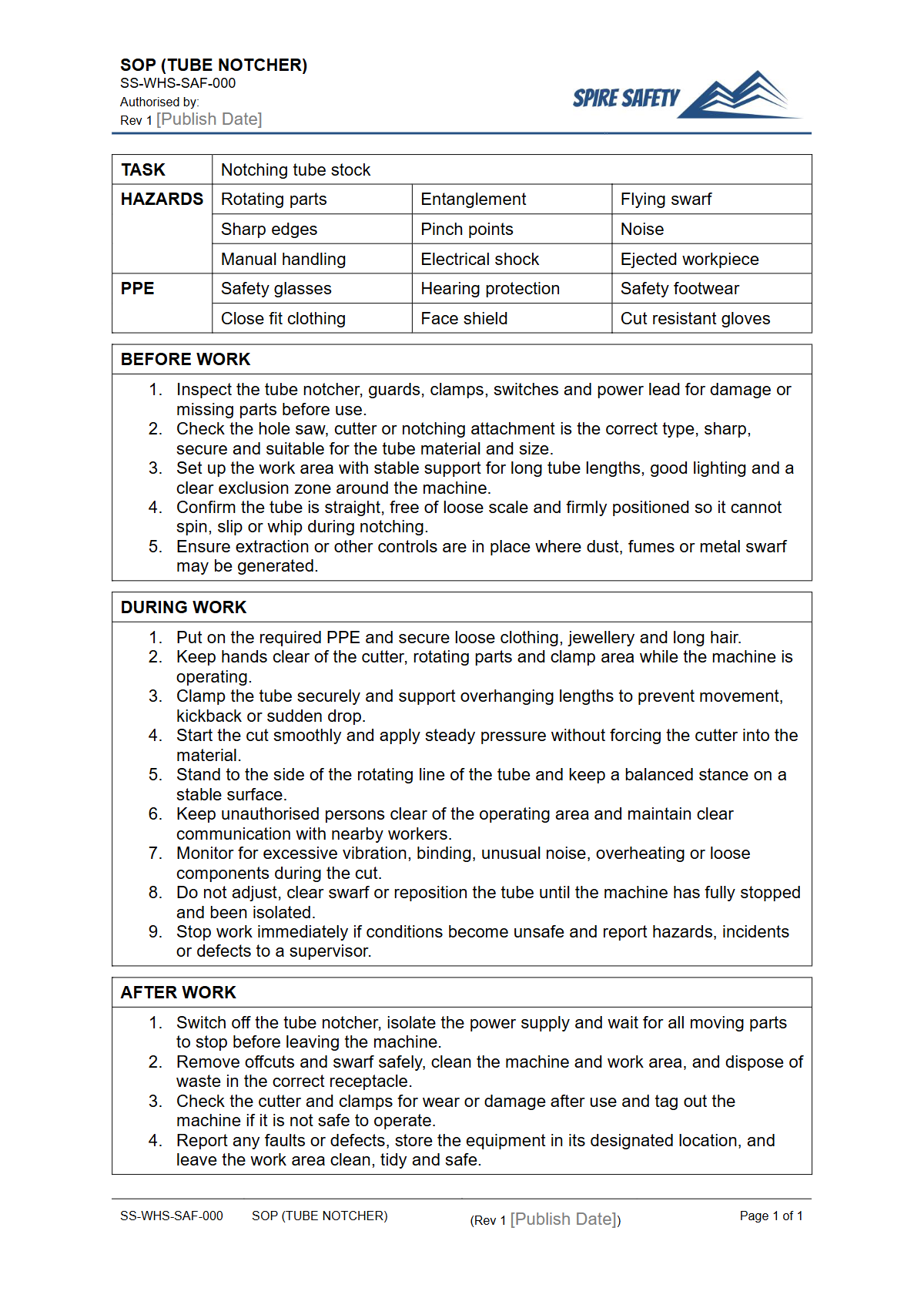
Our Free Safe Operating Procedure (Tube Notcher) Template provides a structured foundation for documenting the safe use of tube notchers in your workshop. This customisable document is designed to help you outline key safety requirements, from pre-operational checks to emergency procedures, aligning with Australian WHS principles.
The primary purpose of this SOP is to provide a clear, step-by-step guide for operators to follow, minimising the risk of injury. Tube notchers present several hazards, including entanglement with rotating parts, lacerations from sharp cutters, and eye injuries from metal swarf.
A documented SOP is a critical administrative control measure that standardises safe work practices, assists in training new operators, and demonstrates due diligence in managing workplace risks. Implementing robust SOPs is a cornerstone of effective WHS management systems, ensuring that safety is a planned and systematic process.
Video walkthrough
How to use the Free Safe Operating Procedure (Tube Notcher) Template
This template is provided in both DOCX and PDF formats for your convenience. To use it effectively, download the DOCX file and customise it to reflect the specific tube notcher models, materials, and processes used in your workplace.
It is crucial to conduct a site-specific risk assessment and incorporate its findings into the SOP. Please note: This is a template, not a finished document. We have created it as a starting point, and you must adapt its contents to suit your specific operational context, legal obligations, and equipment. A generic procedure is not sufficient for compliance.
Your finalised SOP should be reviewed and approved by a competent person before being issued to workers. If you require assistance with this customisation process or a broader review of your workplace procedures, our WHS consulting team offers expert guidance.
When to use it
A Safe Operating Procedure for a tube notcher should be used as a primary reference document in several key situations. It forms the basis of operator training and competency assessments.
It must be readily available in the work area for quick reference during operation. Furthermore, the SOP should be reviewed whenever there is a change to the equipment or process, after any incident or near-miss, or as part of a scheduled periodic review. Regular safety reviews and checks are vital for maintaining a safe workplace, a process that can be formalised through WHS compliance auditing.
Who should use it
This Safe Operating Procedure is intended for all personnel involved with the tube notcher. This includes:
- Operators: Who must follow the procedure to perform their tasks safely.
- Supervisors and Managers: Who are responsible for ensuring operators are trained and adhering to the SOP.
- WHS Representatives and Officers: Who use the SOP as part of workplace inspections, risk assessments, and incident investigations.
- Maintenance Personnel: Who may need to refer to lockout/tagout procedures within the SOP before servicing the equipment.
Integrating SOPs into Your Safety Framework
A standalone SOP is useful, but its effectiveness is magnified when integrated into a comprehensive safety framework. This means linking your SOPs to your risk register, training records, and maintenance schedules.
For organisations aiming for best practice, aligning your procedures with a recognised standard can provide structure and credibility. Our ISO 45001 consulting services can guide you in developing an OHS management system that systematically embeds safety into every aspect of your operation, moving beyond basic compliance to create a proactive safety culture.
Related Fabrication Processes
Tube notching is often a preparatory step for welding and fabrication. It's vital that the safety procedures for these connected tasks are also clearly documented and understood.
For instance, processes involving gas cutting require their own specific controls, which you can document using our FREE Oxy Acetylene SOP. Ensuring a holistic view of safety across all interconnected tasks is key to preventing incidents in a fabrication environment.
Key Sections in the Template
Our template prompts you to detail essential safety information. You will find dedicated sections for:
- Required Personal Protective Equipment (PPE)
- Pre-operational safety checks
- A step-by-step guide for the notching task
- Post-operational procedures and cleanup
- Emergency shutdown and response instructions
- Associated risks and control measures
You can explore our complete free WHS resources library for more templates and guides to support your safety efforts.
Common mistakes
Common mistakes to avoid
- Failing to securely clamp the workpiece, leading to it spinning violently.
- Using a dull or damaged cutting tool (hole saw), which increases force required and the risk of catastrophic failure.
- Neglecting to wear appropriate PPE, especially industrial-rated safety glasses or a face shield.
- Attempting to clear swarf or make adjustments while the machine is still running.
Legal references
Legal considerations
The following legal requirements may be relevant to this type of work.
- Work Health and Safety Act (Harmonised) — Provides the primary duties for protecting workers and other people from work health and safety risks.
- Work Health and Safety Regulations (Harmonised) — Sets out requirements supporting the management of workplace hazards and risks.
The following codes may be relevant to this type of work.
- Managing WHS Risks Code of Practice — Provides practical guidance on identifying hazards, assessing risks and applying effective controls.
- Work Health and Safety Consultation, Cooperation and Coordination Code of Practice — Provides practical guidance on consulting workers and coordinating with other duty holders.
- Managing the Work Environment and Facilities Code of Practice — Provides practical guidance on safe work environments, workplace facilities and related controls.
Did you know
A Perfect Fit
Tube notchers create precise, coped ends on tubing, allowing for tight-fitting joints before welding. This precision is critical for the structural integrity of components like roll cages, chassis, and handrails.
Fabrication Injuries
According to Safe Work Australia data, the manufacturing industry, which includes metal fabrication, has one of the highest rates of serious workplace injury claims. Lacerations and crushing injuries are common.
FAQ
Frequently asked questions
01What is a Safe Operating Procedure for a tube notcher?
02Is this tube notcher SOP template ready to use?
03What hazards are associated with using a tube notcher?
04How often should a tube notcher SOP be reviewed?
Share this resource
Free Safe Operating Procedure (Tube Notcher) Template
Browse Categories
How To Use It
- 1Download and open in Word or PDF.
- 2Replace the placeholders with your business details.
- 3Get it reviewed by a WHS specialist before rollout.
Need it customised?
Our WHS consultants can adapt this template to your site, run a gap analysis, or audit what you already have in place.
Book a Free Consultation WHS consulting servicesor call 1300 156 382
Related templates
- Free Safe Operating Procedure (Turbidity Meter) Template
- Free Safe Operating Procedure (Turf Divot Repair) Template
- Free Safe Operating Procedure (Turf Moisture Check) Template
- Free Safe Operating Procedure (Turf Roll Handling) Template
- Free Safe Operating Procedure (Turnstile Cleaning) Template
- Free Safe Operating Procedure (Turnstile Operation) Template