
Free Safe Operating Procedure (Truck Wash) Template
Download our free Safe Operating Procedure (Truck Wash) Template to document safe work practices. Get started with a structured DOCX or PDF for your workplace.
Free Safe Operating Procedure (Truck Wash) Template
DOCX • 126 KB + PDF
Updated Oct 2026
No signup required
Purpose of the Free Safe Operating Procedure (Truck Wash) Template
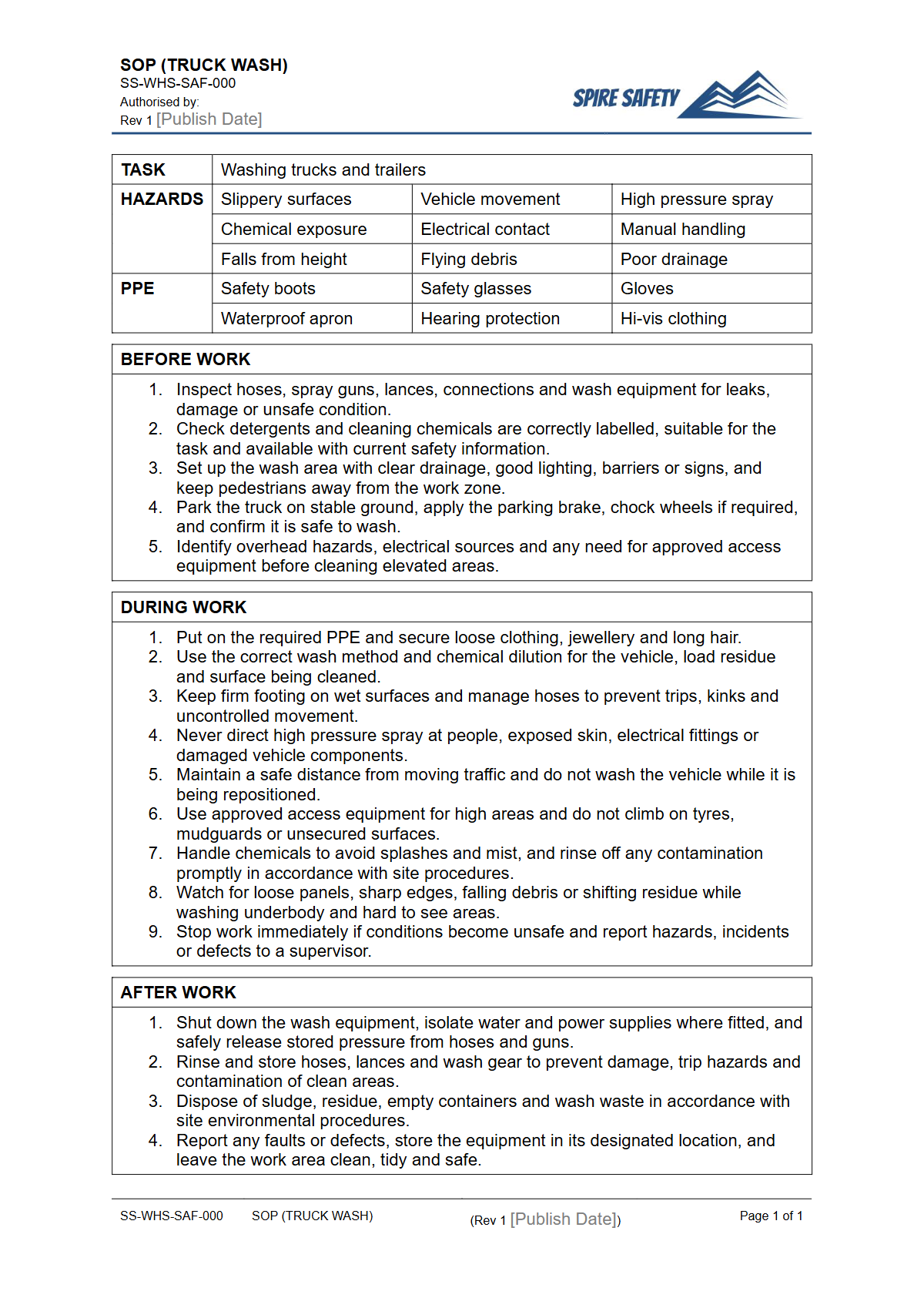
Operating a truck wash facility involves multiple hazards that must be effectively managed to ensure worker safety. This Free Safe Operating Procedure (Truck Wash) Template provides a structured starting point for documenting the required safety controls and work steps for your specific operations.
It helps your organisation demonstrate its commitment to safety by outlining a consistent, safe method for washing heavy vehicles, minimising risks to personnel and equipment.
A comprehensive Safe Operating Procedure (SOP) is a critical tool for risk management. It addresses common truck wash hazards such as slips, trips, and falls on wet surfaces, exposure to hazardous chemicals, electrical risks from high-pressure water near power sources, and the movement of heavy vehicles within the wash bay.
By formally documenting these procedures, you create a clear reference for training, supervision, and operational consistency.
Video walkthrough
How to use the Free Safe Operating Procedure (Truck Wash) Template
This template is provided in both DOCX and PDF formats for your convenience. The DOCX file is fully editable, allowing you to tailor the content to the specific equipment, chemicals, and layout of your workplace.
A well-developed SOP forms a key component of your overall WHS management systems, ensuring that documented procedures align with on-the-ground practices.
Important: This is a template only. For it to be effective, you must customise it to reflect the unique environment and processes of your business.
We recommend a consultation process involving the workers who actually perform the task, as they can provide invaluable insight into the practical risks and controls. Before finalising, cross-reference the procedure with your existing risk assessments for the task.
Key Sections to Customise
When adapting this template, pay close attention to the following sections:
- Personal Protective Equipment (PPE): Specify the exact type of PPE required, such as chemical-resistant gloves, non-slip waterproof boots, safety glasses or face shields, and any required respiratory protection based on the cleaning agents used.
- Pre-Operational Checks: Detail the specific checks required before starting work. This should include inspecting hoses for leaks, checking electrical connections, ensuring emergency stops are functional, and verifying chemical levels and dilutions. Many facilities also require a specific procedure for driving vehicles into the wash bay, which could be referenced in a FREE Heavy Combination Truck SOP (Safe Operating Procedure) Template.
- Step-by-Step Procedure: Write a clear, sequential list of actions for completing the truck wash safely. Include steps for vehicle positioning, applying detergents, high-pressure washing techniques, rinsing, and moving the vehicle out of the bay.
- Emergency Procedures: Outline the specific actions to take in an emergency, such as chemical spills, electric shock, or personal injury. Include locations of first aid kits, emergency showers, eye wash stations, and fire extinguishers.
When to use a Safe Operating Procedure for a Truck Wash
An SOP for truck washing should be a living document, integrated into your daily operations. It is essential for new worker inductions and task-specific training to ensure everyone understands the established safe method from day one.
It also serves as a benchmark during routine supervision and performance observations. To ensure ongoing effectiveness, regular WHS compliance auditing can help verify that the documented procedures are being consistently followed.
The document should be formally reviewed on a regular basis (e.g., annually), or whenever there is a change in equipment, chemicals, or work processes. It is also a crucial reference tool following any incident or near miss, helping to identify gaps in the procedure that may need to be addressed. The procedure is not just for the wash itself but also for safely managing vehicles on-site, a process that can be further detailed in a FREE Body Truck SOP (Safe Operating Procedure) Template.
Who should use this document
This Safe Operating Procedure should be used by all personnel involved in truck washing activities. This includes:
- Operators/Workers: To understand and follow the approved, safe method for performing their duties.
- Supervisors and Managers: To use as a tool for training, monitoring performance, and enforcing safety standards.
- WHS Managers and Personnel: To integrate into the broader safety management system and use as a basis for risk assessments and incident investigations.
- Business Owners (PCBUs): To help fulfil their primary duty of care under WHS legislation by providing and maintaining a safe system of work.
It's also important to have SOPs for ancillary equipment used in the process. For example, if compressed air is used for drying parts of the truck, a separate Free Air Compressor SOP (Safe Operating Procedure) Template should be developed and referenced.
You can find more templates like this in our complete free WHS resources library to build a comprehensive set of workplace procedures.
Common mistakes
Common mistakes to avoid
- Using a generic SOP without customising it for site-specific vehicles, chemicals, and equipment.
- Failing to consult with the workers who perform the task when drafting or reviewing the procedure.
- Neglecting to provide practical, hands-on training on the finalised SOP.
- Not reviewing and updating the SOP after a near miss, incident, or change in the work environment.
Legal references
Legal considerations
The following legal requirements may be relevant to this type of work.
- Work Health and Safety Act (Harmonised) — Provides the primary duties for protecting workers and other people from work health and safety risks.
- Work Health and Safety Regulations (Harmonised) — Sets out requirements supporting the management of workplace hazards and risks.
The following codes may be relevant to this type of work.
- Managing WHS Risks Code of Practice — Provides practical guidance on identifying hazards, assessing risks and applying effective controls.
- Work Health and Safety Consultation, Cooperation and Coordination Code of Practice — Provides practical guidance on consulting workers and coordinating with other duty holders.
- Managing the Work Environment and Facilities Code of Practice — Provides practical guidance on safe work environments, workplace facilities and related controls.
Did you know
Wet Work Risks
Slips, trips, and falls are a leading cause of serious workplace injuries in Australia, with wet and slippery surfaces being a major contributing factor in industries like transport and logistics.
Pressure Injection Injury
The high-pressure water streams used in truck washes can be powerful enough to penetrate the skin, causing a serious medical emergency known as a hydraulic injection injury.
FAQ
Frequently asked questions
01What are the main hazards in a truck wash facility?
02Does this SOP template cover automated or gantry truck washes?
03How often should a Truck Wash SOP be reviewed?
04Who is responsible for implementing the Safe Operating Procedure?
Share this resource
Free Safe Operating Procedure (Truck Wash) Template
Browse Categories
How To Use It
- 1Download and open in Word or PDF.
- 2Replace the placeholders with your business details.
- 3Get it reviewed by a WHS specialist before rollout.
Need it customised?
Our WHS consultants can adapt this template to your site, run a gap analysis, or audit what you already have in place.
Book a Free Consultation WHS consulting servicesor call 1300 156 382
Related templates
- Free Safe Operating Procedure (Tube Bender) Template
- Free Safe Operating Procedure (Tube Notcher) Template
- Free Safe Operating Procedure (Turbidity Meter) Template
- Free Safe Operating Procedure (Turf Divot Repair) Template
- Free Safe Operating Procedure (Turf Moisture Check) Template
- Free Safe Operating Procedure (Turf Roll Handling) Template