
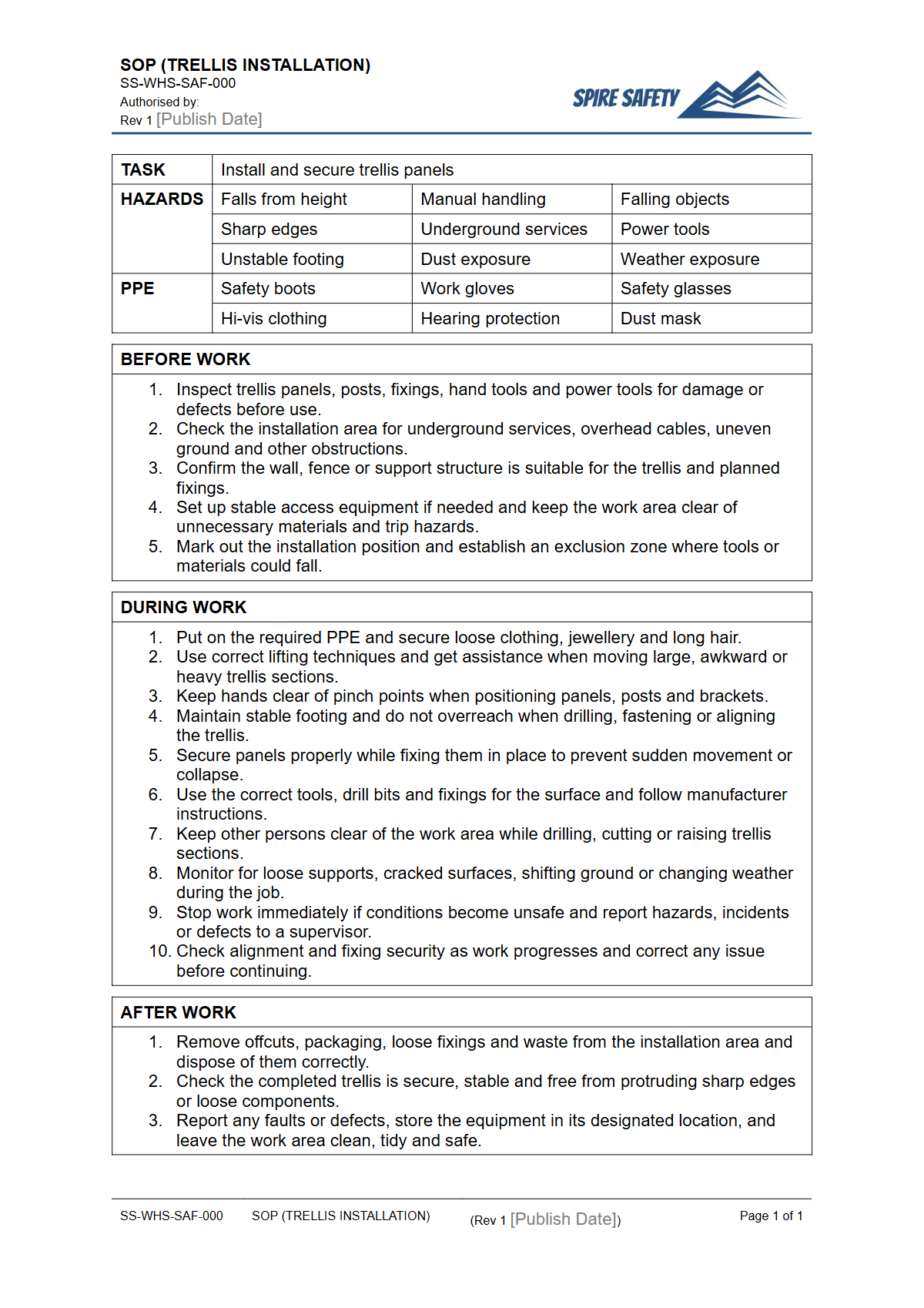
Free Safe Operating Procedure (Trellis Installation) Template
Download our free Safe Operating Procedure (Trellis Installation) Template to formalise safety processes. Get your customisable DOCX and PDF template today.
Free Safe Operating Procedure (Trellis Installation) Template
DOCX • 126 KB + PDF
Updated Oct 2026
No signup required
Purpose of the Free Safe Operating Procedure (Trellis Installation) Template
This free Safe Operating Procedure (Trellis Installation) Template provides a structured framework for documenting the risks and controls associated with installing trellis systems in agricultural, landscaping, or construction settings. Properly documented procedures are essential for ensuring tasks are performed safely and consistently, helping to meet your duty of care under Australian WHS laws.
This SOP template guides you in outlining step-by-step instructions, identifying hazards like manual handling, working at heights, and tool use, and specifying the required personal protective equipment (PPE) and control measures.
Using a standardised template helps ensure all critical safety aspects are considered before work begins. It serves as a vital training tool for new and existing workers, promoting a clear understanding of safe work expectations.
Formalising your processes is a cornerstone of effective WHS management systems, demonstrating a proactive approach to workplace safety.
Video walkthrough
How to use the Free Safe Operating Procedure (Trellis Installation) Template
To use this Safe Operating Procedure for trellis installation, download the file in your preferred format (DOCX for easy editing or PDF). The document is structured to guide you through the process, with sections for task description, required equipment, potential hazards, and safety controls.
You should complete each section with information that is specific to your worksite, the type of trellis being installed, and the tools being used.
Important: This document is a template and must be customised to be effective. We strongly advise you to consult with the workers who will be performing the task, as their direct experience is invaluable for identifying practical risks and effective controls.
Once customised, the SOP should be reviewed, approved by a competent person within your organisation, and used as part of worker training and inductions.
When to use a Safe Operating Procedure for Trellis Installation
An SOP for trellis installation should be used whenever the task presents risks that need to be managed. This is particularly important for commercial, agricultural, or large-scale residential projects. Key situations include:
- When installing heavy or large trellis panels that require specific manual handling techniques or mechanical aids.
- If the installation involves working at heights, such as on ladders or platforms.
- Whenever power tools are required for cutting, drilling, or fastening. Your SOP should clearly reference hazards associated with specific equipment, such as those covered in our circular saw SOP template.
- In agricultural settings where trellises for vines or crops are being installed over large areas, potentially involving specialised machinery.
- When installation requires ground penetration, where risks like striking underground services must be managed.
For large-scale agricultural or commercial projects, the use of heavy machinery to prepare the site must be addressed. For example, if digging footings for large posts, you may require procedures similar to those in our FREE Trencher SOP Template.
Who should use this Trellis Installation SOP
This template is designed for use by any Person Conducting a Business or Undertaking (PCBU) whose workers perform trellis installation tasks. This includes:
- Business Owners and Managers: To establish and implement a formal, safe system of work.
- WHS Managers and Safety Officers: To integrate the task into the broader safety management system and ensure a structured approach to risk assessment.
- Team Leaders and Supervisors: To train their teams, supervise the work, and ensure procedures are followed correctly on-site.
- Workers: As a reference guide to understand the correct, safe method for performing their tasks and to participate in consultation during the SOP's development and review.
The effective implementation of this SOP, once customised, can be verified through practical observation and process confirmation. A periodic review as part of a formal WHS compliance auditing program helps ensure the procedure remains relevant and effective. You can explore many other procedural documents in our comprehensive free WHS resources library.
Common mistakes
Common mistakes to avoid
- Failing to customise the template with site-specific conditions and equipment.
- Neglecting to assess ground stability and scan for underground services before digging post holes.
- Using incorrect manual handling techniques for heavy panels, posts, or bags of concrete.
- Not providing adequate training and instruction on the finalised SOP to all relevant workers.
Legal references
Legal considerations
The following legal requirements may be relevant to this type of work.
- Work Health and Safety Act (Harmonised) — Provides the primary duties for protecting workers and other people from work health and safety risks.
- Work Health and Safety Regulations (Harmonised) — Sets out requirements supporting the management of workplace hazards and risks.
The following codes may be relevant to this type of work.
- Managing WHS Risks Code of Practice — Provides practical guidance on identifying hazards, assessing risks and applying effective controls.
- Work Health and Safety Consultation, Cooperation and Coordination Code of Practice — Provides practical guidance on consulting workers and coordinating with other duty holders.
- Managing the Work Environment and Facilities Code of Practice — Provides practical guidance on safe work environments, workplace facilities and related controls.
Did you know
Manual Handling Risk
Musculoskeletal disorders resulting from hazardous manual tasks are a leading cause of workplace injury claims in Australia. Planning tasks like lifting and positioning trellis panels is a critical control measure.
Duty of Care
Under Australian model WHS laws, a Person Conducting a Business or Undertaking (PCBU) must ensure, so far as is reasonably practicable, the health and safety of their workers.
FAQ
Frequently asked questions
01What should be included in an SOP for trellis installation?
02Is an SOP a legal requirement for installing a trellis in Australia?
03How often should a Safe Operating Procedure be reviewed?
04Can this template be used for different types of trellises?
Share this resource
Free Safe Operating Procedure (Trellis Installation) Template
Browse Categories
How To Use It
- 1Download and open in Word or PDF.
- 2Replace the placeholders with your business details.
- 3Get it reviewed by a WHS specialist before rollout.
Need it customised?
Our WHS consultants can adapt this template to your site, run a gap analysis, or audit what you already have in place.
Book a Free Consultation WHS consulting servicesor call 1300 156 382
Related templates
- Free Safe Operating Procedure (Trellis Maintenance) Template
- Free Safe Operating Procedure (Trestle Platform) Template
- Free Safe Operating Procedure (Trommel Screen) Template
- Free Safe Operating Procedure (Truck Queue Control) Template
- Free Safe Operating Procedure (Truck Tail Lift) Template
- Free Safe Operating Procedure (Truck Wash) Template