
Free Safe Operating Procedure (Trommel Screen) Template
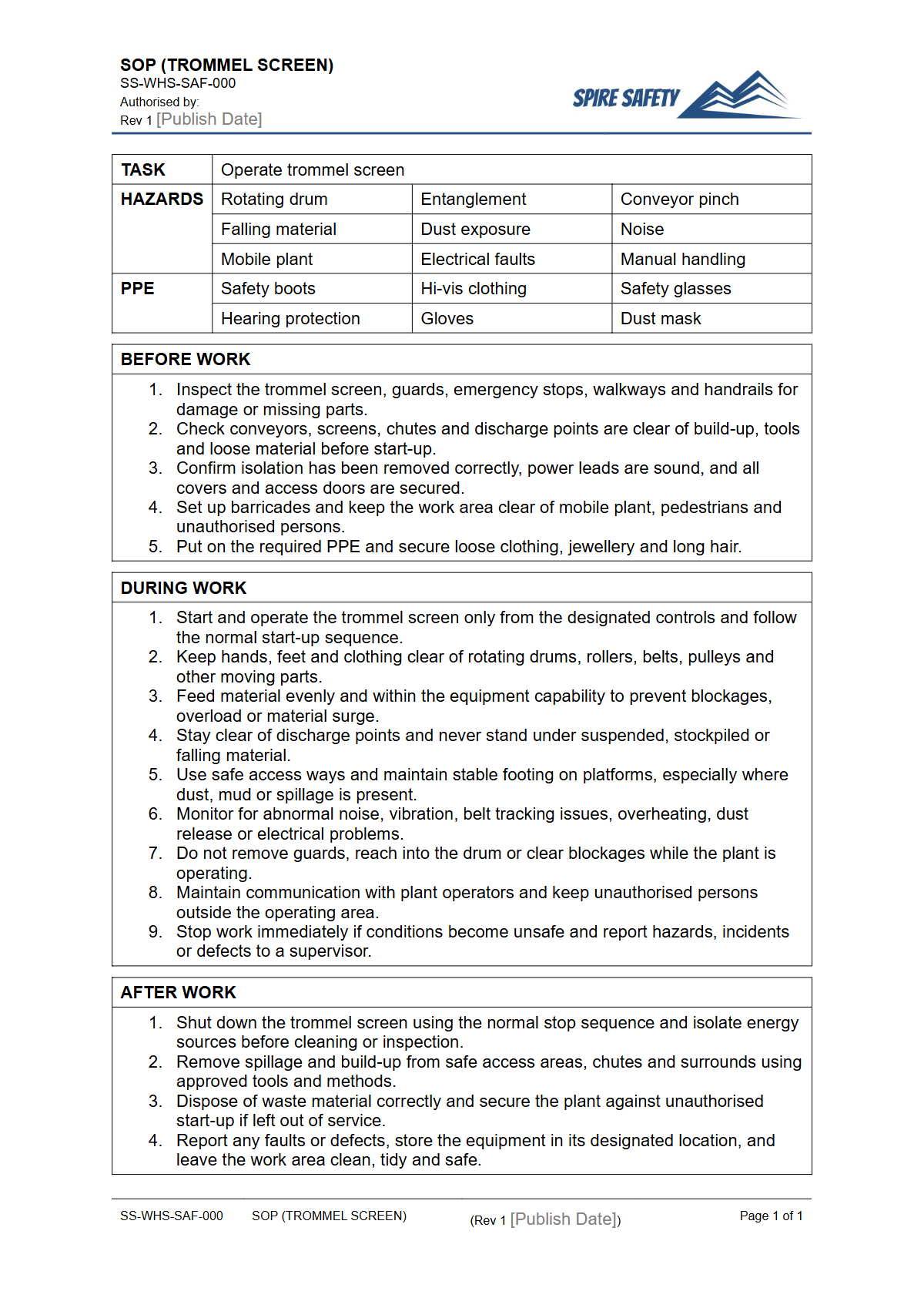
Download our free Safe Operating Procedure (Trommel Screen) Template to manage risks associated with this plant.
Free Safe Operating Procedure (Trommel Screen) Template
DOCX • 126 KB + PDF
Updated Oct 2026
No signup required
Purpose of the Free Safe Operating Procedure (Trommel Screen) Template
Trommel screens are essential equipment in waste management, recycling, and mining industries for separating materials by size. However, their operation involves significant risks, including mechanical entanglement, noise, dust exposure, and interaction with mobile plant.
This Free Safe Operating Procedure (Trommel Screen) Template provides a structured framework for documenting safe work methods to manage these hazards effectively. Using a standardised SOP helps ensure that all workers follow a consistent, safe process, minimising the risk of incidents and injuries.
A comprehensive SOP is a key administrative control measure. It formalises the steps required for pre-start checks, safe operation, shutdown protocols, and emergency procedures.
By clearly outlining these steps, you create a safer working environment and demonstrate a commitment to fulfilling your WHS obligations. Because trommels are often part of a larger processing line, it is vital to integrate their procedures with other equipment, such as the processes outlined in our free Conveyer System SOP.
Video walkthrough
How to use the Free Safe Operating Procedure (Trommel Screen) Template
This template is designed to be a starting point, not a final document. After downloading the DOCX or PDF file, you must customise it to reflect the specific conditions of your workplace.
This involves incorporating details about the make and model of your trommel screen, the types of materials being processed, and the unique environmental factors of your site. Effective procedures are not created in isolation; they require consultation with the people who use the equipment daily.
To ensure the SOP is practical and effective, involve your machine operators, supervisors, and WHS personnel in the drafting and review process. Their hands-on experience is invaluable for identifying real-world hazards and effective control measures.
Please note: we have provided a structured foundation based on Australian WHS principles, but it is your responsibility to ensure the final document is tailored to your specific operations. A well-developed set of SOPs is a cornerstone of effective WHS management systems, helping to embed safety into your organisation's culture.
When to use a Trommel Screen SOP
A Safe Operating Procedure for a trommel screen should be a living document used throughout the lifecycle of the plant and its operation. It is essential for inducting new employees and training them on the specific hazards and controls for the machine.
It also serves as a benchmark for conducting Verification of Competency (VOC) assessments to ensure operators maintain their skills.
Furthermore, the SOP should be a reference tool during daily operations and toolbox talks to reinforce correct procedures. In the unfortunate event of an incident or near-miss, the SOP is a critical document for investigation, helping to identify whether procedures were followed and if they need improvement.
Similar to other high-risk plant procedures like our Scraper SOP template, regular review and consistent application are key to its effectiveness.
Who should use this Safe Operating Procedure
This SOP is intended for use by multiple roles within an organisation. A Person Conducting a Business or Undertaking (PCBU) has the primary duty of care and is responsible for ensuring safe systems of work are implemented, making this template a vital tool for meeting that obligation.
Supervisors and managers must use the SOP to train, monitor, and guide workers, ensuring procedures are consistently followed on site.
Operators are the primary end-users of the SOP. It provides them with clear, step-by-step instructions to perform their tasks safely.
Finally, WHS managers and safety representatives will use the document to assist with risk assessments, training development, and incident investigations. Regular checks that procedures are being correctly followed are a key part of any WHS compliance auditing program, helping to verify that documented systems are working in practice.
By defining tasks and responsibilities, the SOP ensures everyone understands their role in maintaining a safe workplace. For more templates covering a wide range of plant and equipment, browse our complete free WHS resources library.
Common mistakes
Common mistakes to avoid
- Operating the machine without all guards in place, especially around the drum, feed hopper, and discharge conveyors.
- Failing to implement and follow a strict lock-out tag-out (LOTO) procedure before cleaning, maintenance, or clearing blockages.
- Neglecting to use appropriate Personal Protective Equipment (PPE), such as hearing protection, P2/N95 respiratory masks, and high-visibility clothing.
- Overloading the machine or feeding it with materials larger than its specified capacity, leading to blockages and mechanical stress.
Legal references
Legal considerations
The following legal requirements may be relevant to this type of work.
- Work Health and Safety Act (Harmonised) — Provides the primary duties for protecting workers and other people from work health and safety risks.
- Work Health and Safety Regulations (Harmonised) — Sets out requirements supporting the management of workplace hazards and risks.
The following codes may be relevant to this type of work.
- Managing WHS Risks Code of Practice — Provides practical guidance on identifying hazards, assessing risks and applying effective controls.
- Work Health and Safety Consultation, Cooperation and Coordination Code of Practice — Provides practical guidance on consulting workers and coordinating with other duty holders.
- Managing the Work Environment and Facilities Code of Practice — Provides practical guidance on safe work environments, workplace facilities and related controls.
Did you know
Screening Efficiency
A trommel screen's efficiency is heavily influenced by its rotational speed, angle of inclination, and the size and shape of the screen apertures. Incorrect setup can dramatically reduce output and increase mechanical wear.
Historical Roots
The concept of the trommel screen dates back to the 19th century, where early, manually-cranked versions were used in mining operations to classify ores and minerals.
FAQ
Frequently asked questions
01What are the main hazards of a trommel screen?
02Is a Safe Operating Procedure a legal requirement for a trommel screen?
03How often should a trommel screen SOP be reviewed?
04Can I use a generic SOP for all our trommel screens?
Share this resource
Free Safe Operating Procedure (Trommel Screen) Template
Browse Categories
How To Use It
- 1Download and open in Word or PDF.
- 2Replace the placeholders with your business details.
- 3Get it reviewed by a WHS specialist before rollout.
Need it customised?
Our WHS consultants can adapt this template to your site, run a gap analysis, or audit what you already have in place.
Book a Free Consultation WHS consulting servicesor call 1300 156 382
Related templates
- Free Safe Operating Procedure (Truck Queue Control) Template
- Free Safe Operating Procedure (Truck Tail Lift) Template
- Free Safe Operating Procedure (Truck Wash) Template
- Free Safe Operating Procedure (Tube Bender) Template
- Free Safe Operating Procedure (Tube Notcher) Template
- Free Safe Operating Procedure (Turbidity Meter) Template