
Free Safe Operating Procedure (Truck Queue Control) Template
Manage traffic flow and minimise risks with our free Safe Operating Procedure (Truck Queue Control) Template. Download your customisable DOCX or PDF today.
Free Safe Operating Procedure (Truck Queue Control) Template
DOCX • 126 KB + PDF
Updated Oct 2026
No signup required
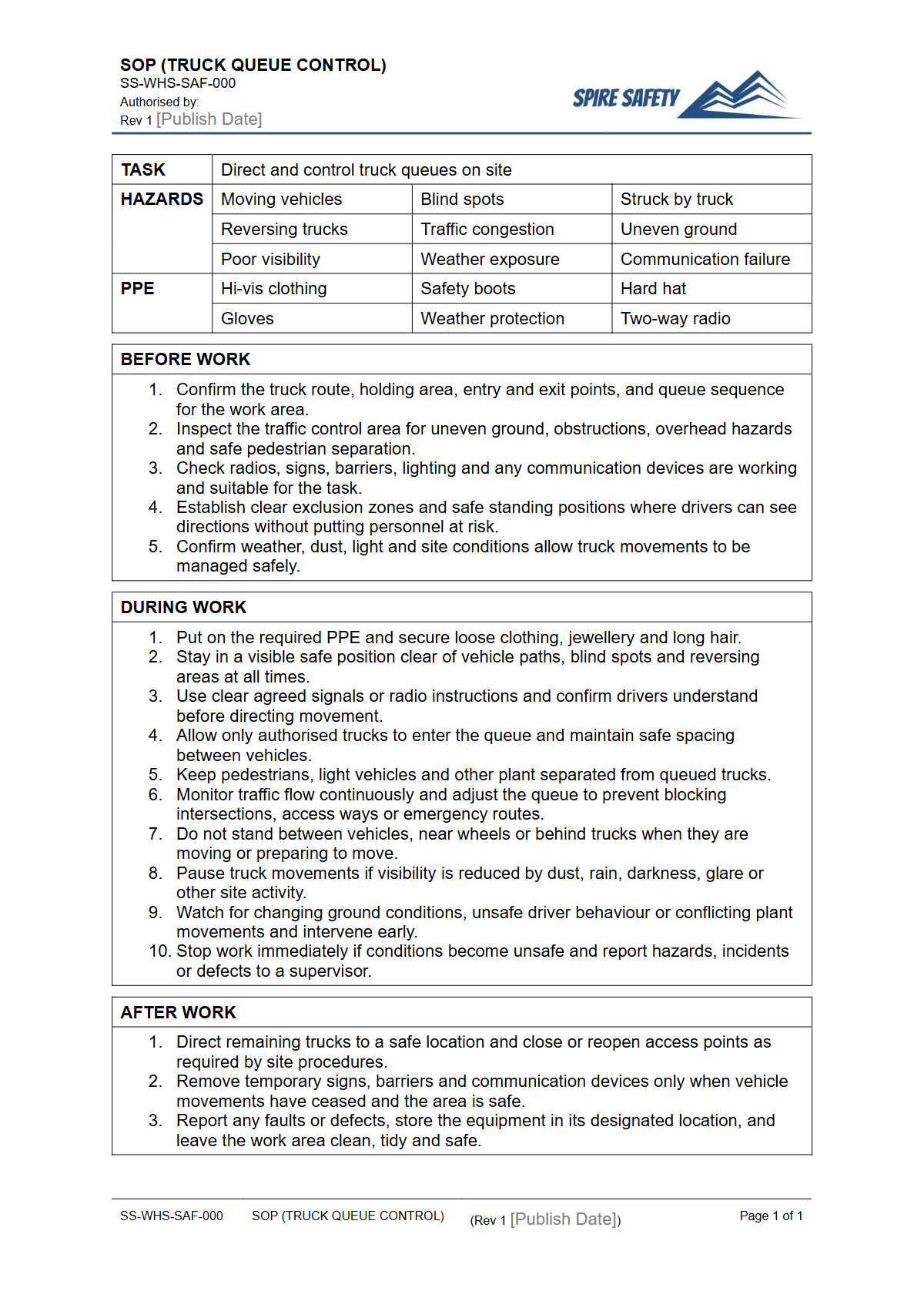
Purpose of the Free Safe Operating Procedure (Truck Queue Control) Template
Effectively managing vehicle movement is a critical safety function for any site that receives regular truck deliveries or dispatches goods. This free Safe Operating Procedure (Truck Queue Control) Template provides a structured framework for controlling the risks associated with vehicles queueing, waiting, and manoeuvring in and around your workplace.
The primary goal is to prevent incidents such as collisions between vehicles, interactions between vehicles and pedestrians, and other hazards like falls from vehicles or exposure to exhaust fumes. A documented procedure ensures that all personnel, including visiting drivers, understand the rules for safe entry, positioning, and exit.
By implementing a clear SOP, you establish standardised practices that define communication methods, designate waiting areas, and outline the responsibilities of key personnel like spotters, yard managers, and drivers. This formalised approach is a key element in demonstrating proactive risk management and forms an integral part of broader comprehensive WHS management systems that protect your workers and site visitors.
Video walkthrough
How to use the Free Safe Operating Procedure (Truck Queue Control) Template
This document is provided as a starting point in both DOCX and PDF formats. To make it effective, it must be adapted to the unique conditions of your workplace.
Download the file and begin by conducting a thorough review of your site's layout, existing traffic flow, and the specific types of vehicles you manage. Consult with your workers, including drivers, forklift operators, and yard staff, to ensure the procedure reflects practical, on-the-ground realities.
It is vital that you customise this template to reflect the specific layout of your site, the types of trucks you service, your traffic management plan, and your specific communication protocols. We have provided a solid framework, but only you can ensure it accurately reflects your operational reality.
Fill in the required fields, add site-specific details like maps or diagrams, and remove any information that is not relevant to your operation. Consider using it alongside other specific procedures like a body truck SOP to build a complete safety portfolio for your vehicle operations.
When to use a Safe Operating Procedure for Truck Queue Control
This SOP should be implemented in any workplace where multiple trucks arrive and must wait to be loaded or unloaded. Common environments include:
- Warehouses and distribution centres
- Manufacturing and processing plants
- Construction sites
- Port and container terminals
- Agricultural facilities and grain silos
- Large retail and wholesale operations
The procedure should be used as a training tool during worker and contractor induction, referenced in toolbox talks, and be readily available in key locations such as gatehouses, loading docks, and site offices. It is a live document that should be reviewed and updated following any incident or when changes are made to the site or its processes. It's particularly important when managing different vehicle types, as the process for a rigid truck may differ from an SOP for heavy combination trucks.
Who should use this Safe Operating Procedure
This procedure is intended for a wide audience within an organisation. Primary users responsible for its implementation and enforcement include Site Managers, WHS Advisors, Logistics or Warehouse Supervisors, and other Persons Conducting a Business or Undertaking (PCBUs).
They will use the template to establish and formalise the site's traffic management rules.
Furthermore, all personnel who work in or around vehicle operating areas must be trained on and adhere to the final procedure. This includes truck drivers (both employees and visitors), forklift operators, pickers and packers, security staff at entry gates, and any designated vehicle spotters.
Even administrative staff who may occasionally transit through these areas should have a basic awareness of the protocols, just as they might with our free telehandler SOP if one is used on site.
Integrating with Your Traffic Management Plan
A truck queueing SOP does not exist in isolation. It is a critical, task-level component of your site's overall Traffic Management Plan.
This broader plan should address site-wide elements such as speed limits, signage, the installation of physical barriers, pedestrian exclusion zones, lighting, and communication systems (e.g., two-way radios). The SOP provides the specific, step-by-step instructions for one part of that plan. The effectiveness of both the SOP and the wider plan should be verified through regular WHS compliance auditing.
By ensuring these documents work together, you create a multi-layered safety system that effectively controls vehicle and pedestrian risks across your entire workplace. For more tools to support your safety systems, explore our complete free WHS resources library.
Common mistakes
Common mistakes to avoid
- Failing to physically separate pedestrians from vehicles with designated walkways and barriers.
- Not clearly communicating procedures and hazards to visiting drivers unfamiliar with the site.
- Forgetting to account for different vehicle types, sizes, and manoeuvring requirements.
- Neglecting to provide adequate lighting for night-time operations.
Legal references
Legal considerations
The following legal requirements may be relevant to this type of work.
- Work Health and Safety Act (Harmonised) — Provides the primary duties for protecting workers and other people from work health and safety risks.
- Work Health and Safety Regulations (Harmonised) — Sets out requirements supporting the management of workplace hazards and risks.
The following codes may be relevant to this type of work.
- Managing WHS Risks Code of Practice — Provides practical guidance on identifying hazards, assessing risks and applying effective controls.
- Work Health and Safety Consultation, Cooperation and Coordination Code of Practice — Provides practical guidance on consulting workers and coordinating with other duty holders.
- Managing the Work Environment and Facilities Code of Practice — Provides practical guidance on safe work environments, workplace facilities and related controls.
Did you know
Vehicle Interaction is a High-Risk Hazard
Interaction with vehicles, especially heavy vehicles, is consistently one of the leading causes of workplace fatalities and serious injuries in Australia, particularly in the transport and logistics sectors.
Beyond Safety
Effective queue management doesn't just improve safety. It can also reduce fuel consumption, minimise harmful emissions from idling trucks, and improve operational efficiency and turnaround times.
FAQ
Frequently asked questions
01What is the main purpose of a truck queue control SOP?
02Do I need a specific SOP for truck queuing if I have a general traffic management plan?
03How often should a truck queue control SOP be reviewed?
04Who is responsible for enforcing the truck queue control procedure?
Share this resource
Free Safe Operating Procedure (Truck Queue Control) Template
Browse Categories
How To Use It
- 1Download and open in Word or PDF.
- 2Replace the placeholders with your business details.
- 3Get it reviewed by a WHS specialist before rollout.
Need it customised?
Our WHS consultants can adapt this template to your site, run a gap analysis, or audit what you already have in place.
Book a Free Consultation WHS consulting servicesor call 1300 156 382
Related templates
- Free Safe Operating Procedure (Truck Tail Lift) Template
- Free Safe Operating Procedure (Truck Wash) Template
- Free Safe Operating Procedure (Tube Bender) Template
- Free Safe Operating Procedure (Tube Notcher) Template
- Free Safe Operating Procedure (Turbidity Meter) Template
- Free Safe Operating Procedure (Turf Divot Repair) Template