
Free Safe Operating Procedure (Tree Watering) Template
Effectively manage the risks associated with tree watering tasks with our structured Safe Operating Procedure template.
Free Safe Operating Procedure (Tree Watering) Template
DOCX • 126 KB + PDF
Updated Oct 2026
No signup required
Purpose of the Free Safe Operating Procedure (Tree Watering) Template
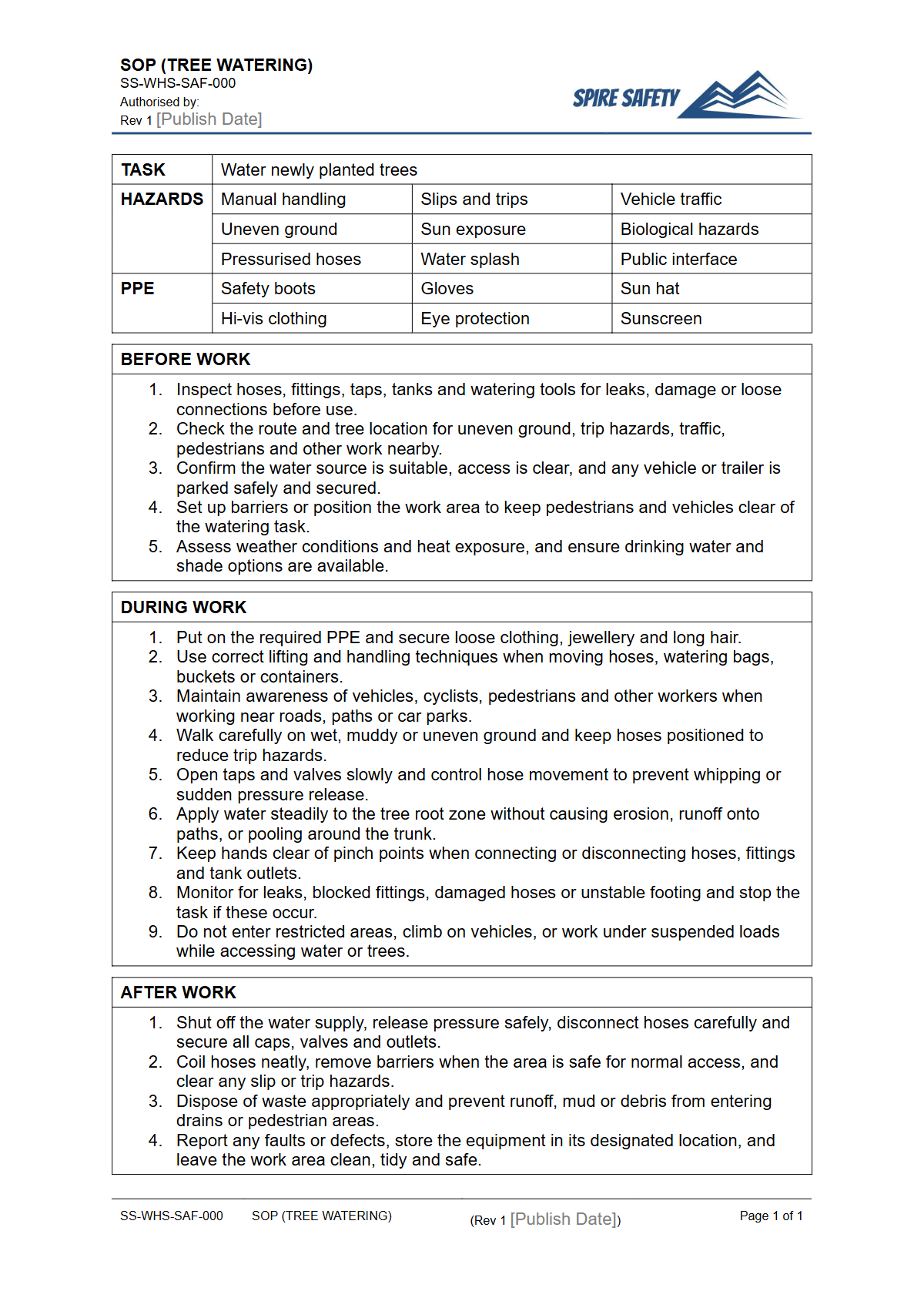
Our Free Safe Operating Procedure (Tree Watering) Template provides a structured framework for businesses to document the safe steps for watering trees and shrubs in commercial, horticultural, or public settings. Tree watering, while seemingly simple, involves several key hazards that must be managed to ensure worker safety.
These include manual handling risks from lifting heavy watering cans or dragging hoses, slip and trip hazards from wet surfaces and equipment, and potential interaction with vehicles or pedestrians in shared spaces.
This SOP template guides you in identifying these risks and establishing clear, step-by-step controls. By formalising the process, you create a consistent and safe method of work that minimises the chance of sprains, strains, falls, and other common injuries.
Documenting your procedure also provides a valuable tool for worker training and induction, ensuring everyone understands their responsibilities. The principles here are similar to those in other outdoor maintenance tasks, such as those covered in our safe operating procedure for spreaders.
Video walkthrough
How to use the Free Safe Operating Procedure (Tree Watering) Template
This downloadable DOCX and PDF file is a starting point designed for easy adaptation. To use it effectively, you must review and modify the content to reflect the specific conditions of your workplace.
This includes detailing the exact type of equipment used, whether it's manual watering cans, reel-based hoses, or vehicle-mounted water tanks. You should also add site-specific details, such as procedures for working on slopes, near public pathways, or in areas with high vehicle traffic.
Conduct a risk assessment for the task at your location to identify all potential hazards. Use the findings to populate and refine the SOP, ensuring the controls listed are relevant and effective.
For example, if your team works with more complex landscaping equipment, you may need to detail those specific operational steps, similar to the level of detail found in our trencher SOP for specialised machinery. Involve the workers who perform the task in this customisation process to ensure the procedure is practical and addresses real-world challenges.
Please note: this document is a template and must be customised to your specific workplace. We recommend a thorough review to ensure it addresses all unique site hazards, equipment, and operational contexts before implementation.
When to use a Safe Operating Procedure
An SOP for tree watering should be developed and implemented before any worker undertakes the task. It is a critical document for new employee inductions and for training existing staff on the recognised safe method of work.
The procedure should be readily accessible to all relevant workers, either in a printed format on-site or digitally.
It also serves as a benchmark for supervision and performance monitoring. The SOP should be reviewed periodically (e.g., annually), whenever there is a change in equipment or work environment, or following any incident or near miss.
This continuous improvement cycle is a core component of effective WHS management systems, ensuring your safety documents remain current and effective.
Regular reviews, often verified through processes like WHS compliance auditing, confirm that the documented procedures are being followed correctly in practice and are successfully controlling the identified risks.
Who should use this template
This Safe Operating Procedure template is designed for a range of personnel and industries. WHS managers, safety officers, and business owners can use it to establish and formalise safety protocols.
Supervisors, team leaders, and operations managers in landscaping, horticulture, agriculture, and local government will find it invaluable for training their teams and ensuring consistent, safe work practices.
Workers who perform tree watering tasks are the end-users of the finalised procedure. Their involvement in its development and review is crucial for creating a practical and effective document.
Developing clear procedures for seasonal or agricultural activities helps streamline training, and this document can be adapted alongside others like our free Planter SOP template. If you require assistance in adapting this template or developing more complex procedures, engaging with specialist WHS consulting services can provide expert guidance.
Explore our complete free WHS resources library for more templates, checklists, and guides to support your organisation's health and safety framework.
Common mistakes
Common mistakes to avoid
- Using the template without customising it for site-specific hazards and equipment.
- Failing to adequately train workers on the finalised procedure before they start the task.
- Not involving the workers who perform the task in the development and review process.
- Forgetting to include controls for environmental factors like sun exposure, heat stress, or uneven terrain.
Legal references
Legal considerations
The following legal requirements may be relevant to this type of work.
- Work Health and Safety Act (Harmonised) — Provides the primary duties for protecting workers and other people from work health and safety risks.
- Work Health and Safety Regulations (Harmonised) — Sets out requirements supporting the management of workplace hazards and risks.
The following codes may be relevant to this type of work.
- Managing WHS Risks Code of Practice — Provides practical guidance on identifying hazards, assessing risks and applying effective controls.
- Work Health and Safety Consultation, Cooperation and Coordination Code of Practice — Provides practical guidance on consulting workers and coordinating with other duty holders.
- Managing the Work Environment and Facilities Code of Practice — Provides practical guidance on safe work environments, workplace facilities and related controls.
Did you know
Water Weight
A standard 20-litre water container weighs approximately 20 kilograms. This is above the recommended lifting weight for many individuals, highlighting the importance of using trolleys, hoses, or other mechanical aids.
Dehydration Risk
Even on cool or overcast days, the physical exertion involved in grounds maintenance can lead to significant fluid loss. Dehydration impairs concentration and physical coordination, increasing the risk of accidents and injuries.
FAQ
Frequently asked questions
01What hazards should a tree watering SOP cover?
02How often should a Safe Operating Procedure be reviewed?
03Is a Safe Operating Procedure a legal requirement in Australia?
04Can this template be used for large-scale irrigation systems?
Share this resource
Free Safe Operating Procedure (Tree Watering) Template
Browse Categories
How To Use It
- 1Download and open in Word or PDF.
- 2Replace the placeholders with your business details.
- 3Get it reviewed by a WHS specialist before rollout.
Need it customised?
Our WHS consultants can adapt this template to your site, run a gap analysis, or audit what you already have in place.
Book a Free Consultation WHS consulting servicesor call 1300 156 382
Related templates
- Free Safe Operating Procedure (Tree Winch) Template
- Free Safe Operating Procedure (Trellis Installation) Template
- Free Safe Operating Procedure (Trellis Maintenance) Template
- Free Safe Operating Procedure (Trestle Platform) Template
- Free Safe Operating Procedure (Trommel Screen) Template
- Free Safe Operating Procedure (Truck Queue Control) Template