
Free Safe Operating Procedure (Tree Root Zone Mulching) Template
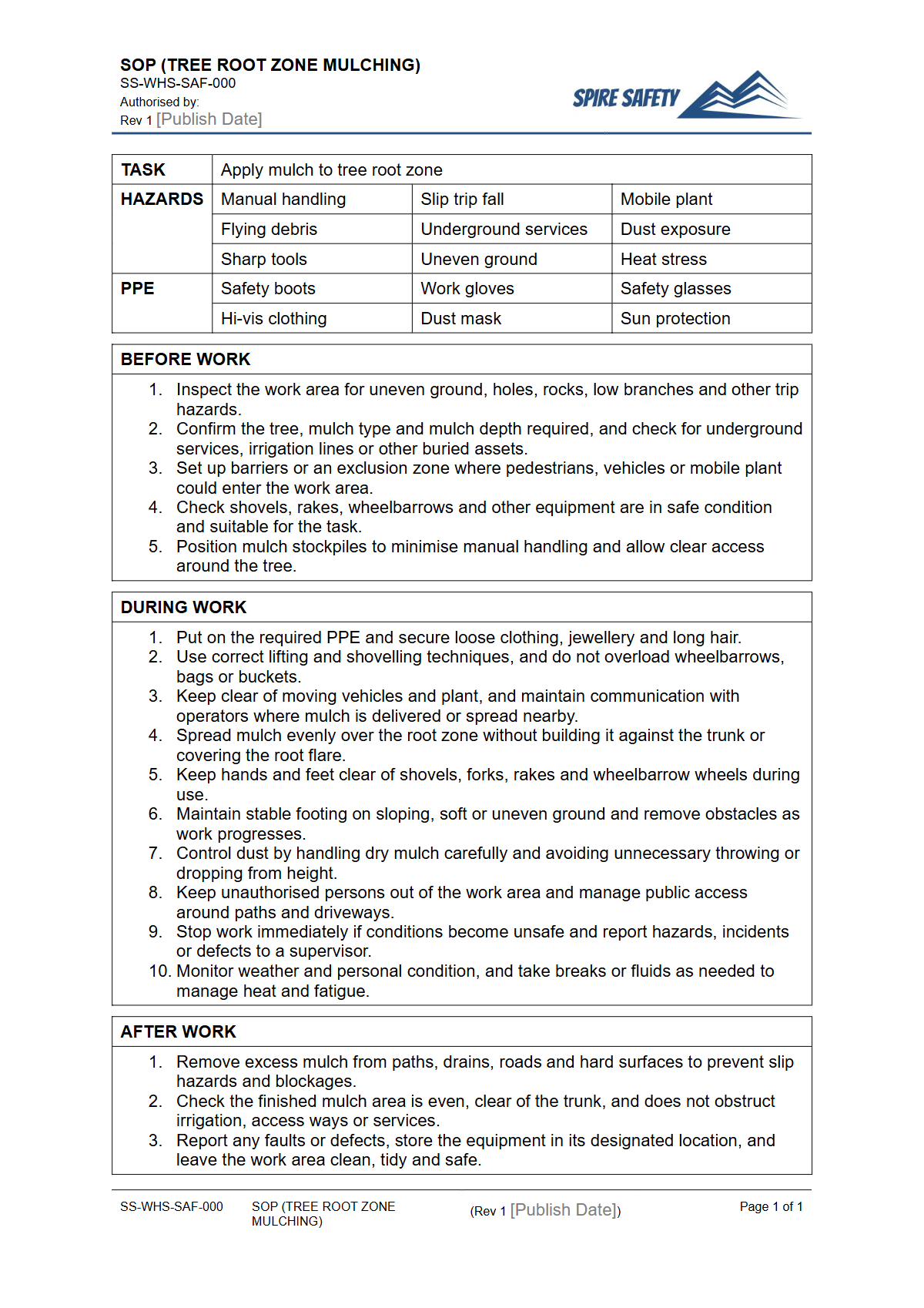
Download our free Safe Operating Procedure for tree root zone mulching to formalise safety steps for this common landscaping task.
Free Safe Operating Procedure (Tree Root Zone Mulching) Template
DOCX • 126 KB + PDF
Updated Oct 2026
No signup required
Purpose of the Free Safe Operating Procedure (Tree Root Zone Mulching) Template
Establishing a clear process for routine tasks is fundamental to workplace safety. This Free Safe Operating Procedure (Tree Root Zone Mulching) Template provides a structured framework for businesses in landscaping, arboriculture, and grounds maintenance to document the required safety measures for applying mulch.
Mulching, while seemingly simple, involves hazards such as manual handling injuries, slips and trips, exposure to organic dusts and pathogens, and risks associated with using machinery like chippers or loaders. Using a formal SOP helps to standardise the task, identify and control these risks, and provide a consistent basis for worker training and supervision.
A well-defined SOP is a critical operational document that demonstrates a commitment to safety. It serves as a practical tool for hazard identification and risk assessment, ensuring control measures are implemented and understood by all personnel involved.
Integrating task-specific procedures like this one is a core function of building robust and effective WHS management systems, helping your organisation meet its duty of care obligations under Australian WHS legislation.
Video walkthrough
How to use the Free Safe Operating Procedure (Tree Root Zone Mulching) Template
This document is designed as a starting point, providing a professional format and common control measures aligned with Australian WHS principles. To make it effective for your specific operations, you must conduct a site-specific risk assessment and tailor the content accordingly.
The procedure should detail the exact types of mulch, equipment, and environmental conditions relevant to your workplace.
Follow these steps to implement the SOP:
- Download: Choose either the DOCX for easy editing or the PDF for straightforward printing.
- Consult: Involve your workers, supervisors, and any health and safety representatives in the review process. Their hands-on experience is invaluable for identifying practical risks and effective controls.
- Customise: Modify the template to include your company branding, specific machinery models, required personal protective equipment (PPE), and emergency procedures.
- Train: Use the finalised SOP as a training document for all workers who perform or supervise the task. Ensure they understand every step and have an opportunity to ask questions.
- Implement & Monitor: Put the procedure into practice and have supervisors monitor its use to ensure it is being followed correctly.
- Review: Schedule regular reviews of the SOP, especially after any incident, near miss, or when new equipment or materials are introduced.
Important: This is a template and is not a complete work document. You must consult with your team and customise this SOP to reflect the specific equipment, materials, and hazards present in your workplace.
We can provide specialised WHS consulting if you require assistance with this process.
When to use it
This Safe Operating Procedure should be used whenever workers are tasked with applying mulch around the root zones of trees and plants. This applies to a wide range of commercial and civic operations, including public park maintenance by local councils, commercial landscaping projects, large-scale horticultural operations, and residential garden care services.
It is relevant for both manual application methods using wheelbarrows and shovels, and for mechanical application using equipment like mulch blowers or spreaders.
The SOP should be readily accessible at the worksite and referenced during pre-start meetings or toolbox talks before mulching activities begin. For tasks that involve creating trenches for garden beds or irrigation, a specific trencher safe operating procedure should also be consulted.
For larger jobs that involve machinery, our free Spreader SOP provides guidance for associated equipment.
Who should use it
This SOP is intended for several key roles within an organisation to ensure safety is managed from planning to execution:
- Workers and Operators: The primary users are the individuals performing the mulching task. The SOP provides them with clear, step-by-step instructions to complete the job safely.
- Supervisors and Team Leaders: Managers use the SOP to induct and train new employees, supervise work, and ensure safety standards are maintained. It also provides a benchmark for performance monitoring and post-incident investigations.
- WHS Managers and Advisors: Safety personnel use the SOP as part of the overall risk management framework. They assist in its development, review its effectiveness, and integrate it into safety audits and system-wide documentation.
By formalising procedures for common tasks like mulching, businesses can ensure a consistent approach to safety across all teams. For related horticultural activities, our dedicated Planter SOP can help document safe planting processes. To discover more templates to support your operations, you can explore our extensive library of free WHS resources.
Common mistakes
Common mistakes to avoid
- Applying mulch too deep (over 10cm) or piling it against the tree trunk, which can suffocate roots and cause rot.
- Failing to wear appropriate PPE, such as gloves, safety glasses, and a P2 respirator to protect against dust and microbes.
- Not checking for underground services like irrigation lines or cables before any minor digging or ground levelling.
- Using sour or un-composted mulch, which can be toxic to young plants and strip nitrogen from the soil.
Legal references
Legal considerations
The following legal requirements may be relevant to this type of work.
- Work Health and Safety Act (Harmonised) — Provides the primary duties for protecting workers and other people from work health and safety risks.
- Work Health and Safety Regulations (Harmonised) — Sets out requirements supporting the management of workplace hazards and risks.
The following codes may be relevant to this type of work.
- Managing WHS Risks Code of Practice — Provides practical guidance on identifying hazards, assessing risks and applying effective controls.
- Work Health and Safety Consultation, Cooperation and Coordination Code of Practice — Provides practical guidance on consulting workers and coordinating with other duty holders.
- Managing the Work Environment and Facilities Code of Practice — Provides practical guidance on safe work environments, workplace facilities and related controls.
Did you know
The 'Mulch Volcano' Problem
Piling mulch directly against a tree's trunk, known as a 'mulch volcano', can trap moisture, promote disease and pest infestation, and encourage the tree to grow roots into the mulch instead of the soil, ultimately harming its health and stability.
Mulch and Soil Temperature
A layer of organic mulch can keep the soil underneath it up to 10°C cooler in summer and warmer in winter. This temperature regulation helps protect tree roots from extreme weather stress.
FAQ
Frequently asked questions
01What are the main hazards involved in tree root zone mulching?
02How often should an SOP for mulching be reviewed?
03Is this SOP template suitable for both manual and mechanical mulching?
04Who is responsible for ensuring the SOP is followed?
Share this resource
Free Safe Operating Procedure (Tree Root Zone Mulching) Template
Browse Categories
How To Use It
- 1Download and open in Word or PDF.
- 2Replace the placeholders with your business details.
- 3Get it reviewed by a WHS specialist before rollout.
Need it customised?
Our WHS consultants can adapt this template to your site, run a gap analysis, or audit what you already have in place.
Book a Free Consultation WHS consulting servicesor call 1300 156 382
Related templates
- Free Safe Operating Procedure (Tree Stake Installation) Template
- Free Safe Operating Procedure (Tree Watering Bag) Template
- Free Safe Operating Procedure (Tree Watering) Template
- Free Safe Operating Procedure (Tree Winch) Template
- Free Safe Operating Procedure (Trellis Installation) Template
- Free Safe Operating Procedure (Trellis Maintenance) Template