
Free Safe Operating Procedure (Tree Rigging) Template
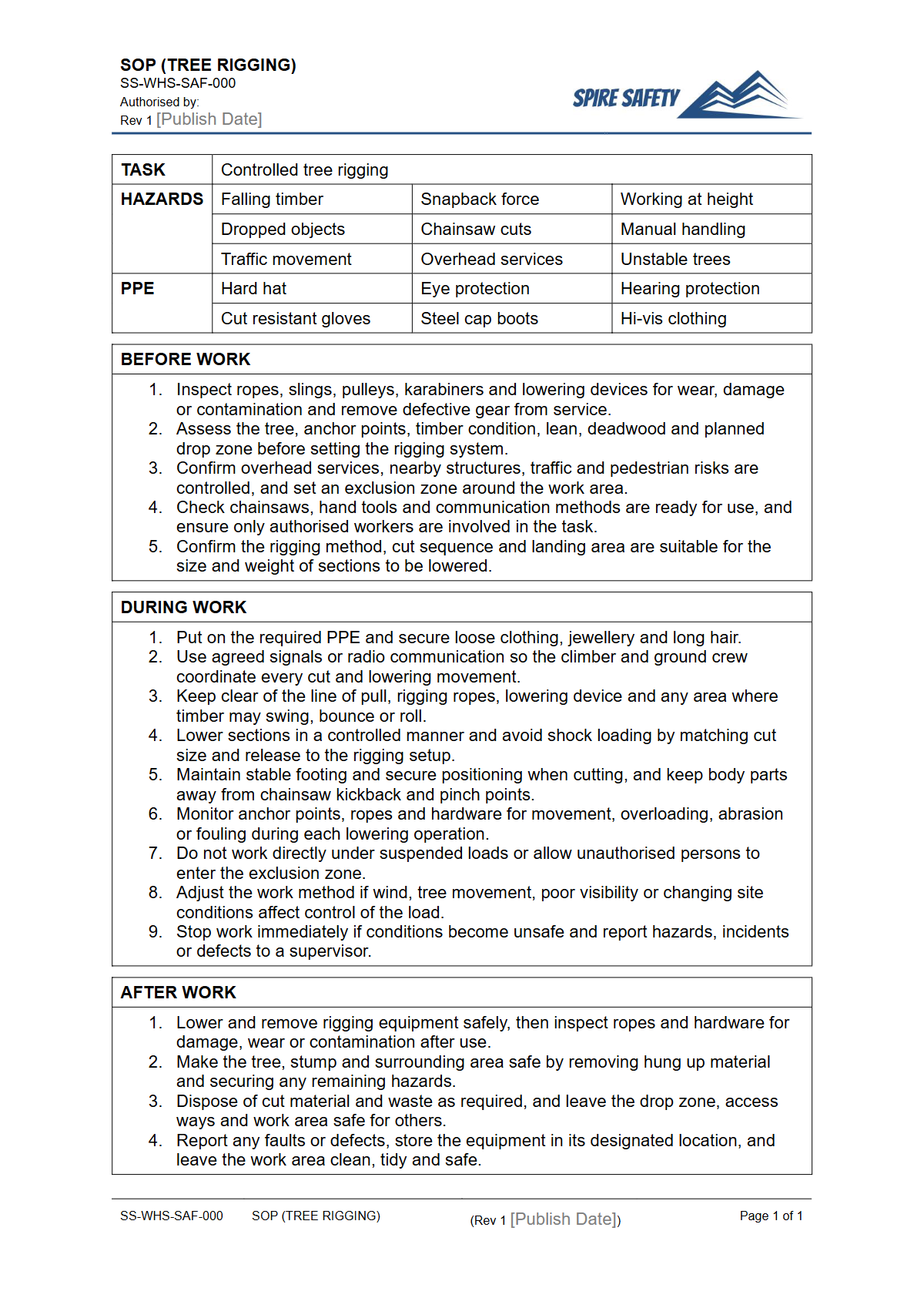
Formalise your high-risk tree work processes with our free Safe Operating Procedure for tree rigging. This user-friendly template helps you define key steps.
Free Safe Operating Procedure (Tree Rigging) Template
DOCX • 126 KB + PDF
Updated Oct 2026
No signup required
Purpose of the Free Safe Operating Procedure (Tree Rigging) Template
Tree rigging is a high-risk activity that involves complex forces and potentially hazardous falling objects. This free Safe Operating Procedure (Tree Rigging) Template provides a structured framework for documenting the required steps to perform these tasks safely.
A well-developed SOP is a critical tool for managing risk, standardising work methods, and ensuring every member of your team understands their role and the safety controls in place. By formalising your process, you create a consistent benchmark for operations, training, and incident investigation.
Using a detailed SOP helps your organisation meet its primary duty of care under Australian WHS laws by systematically identifying hazards and implementing effective control measures. This document serves as a practical guide for workers on the ground, outlining everything from pre-start checks to the specific sequence of actions required to safely dismantle and lower sections of a tree.
It forms a key part of your overall safety management documentation.
Video walkthrough
How to use the Free Safe Operating Procedure (Tree Rigging) Template
This Safe Operating Procedure for tree rigging is available for immediate download in both DOCX and PDF formats. The DOCX file is fully editable, allowing you to adapt the content to the specific context of your workplace.
While this template is aligned with Australian WHS principles and industry best practices, it must be customised to be effective and relevant.
Important: This document is a template, not a finished product. We have provided a comprehensive framework, but you must customise it to reflect the specific equipment (e.g., rope types, friction devices, rigging plates), personnel competencies, site conditions, and tree species relevant to your organisation's operations. An effective SOP is a living document that integrates seamlessly into your broader WHS management systems.
To customise the template:
- Review each section and add, remove, or modify content to match your specific procedures.
- Incorporate details of your specific rigging equipment, including Safe Working Loads (SWL) and inspection criteria.
- Define clear roles and responsibilities for the climber, ground crew, and spotters.
- Reference any relevant internal documents, such as risk assessments or emergency plans.
- Consult with your workers during the customisation process to ensure the SOP is practical and reflects how the work is actually performed.
When to use a Tree Rigging SOP
A Safe Operating Procedure for tree rigging should be developed and used for any task involving the controlled lowering of limbs or sections of a tree trunk. This is particularly critical when working in confined spaces, over property, or where free-falling timber would pose an unacceptable risk.
It applies to sectional dismantling, speed lining, and any other arboricultural task that relies on ropes and specialised equipment to manage loads. Similar principles of managing heavy or awkward loads are also critical when using machinery, as detailed in our FREE Telehandler SOP Template.
Who Should Use This Safe Operating Procedure?
This SOP is intended for use by all personnel involved in tree rigging operations. This includes, but is not limited to, qualified arborists who perform the climbing and cutting, ground crew responsible for managing ropes and exclusion zones, and site supervisors overseeing the work.
It also serves as an essential resource for WHS managers and business owners (PCBUs) to ensure that systematic safety procedures are documented and implemented. The document can be a key piece of evidence reviewed during a formal WHS compliance auditing process to verify that procedures are in place for high-risk work.
Key Elements of a Tree Rigging SOP
A comprehensive tree rigging SOP should cover several critical areas to be effective. The template is structured to guide you through these components, ensuring a holistic approach to safety.
- Personal Protective Equipment (PPE): Specifies the mandatory PPE for all personnel, including head protection, eye protection, chainsaw-protective clothing, and appropriate footwear.
- Equipment and Pre-Start Checks: Lists all rigging equipment required and details the inspection process for ropes, harnesses, carabiners, pulleys, and friction devices to ensure they are fit for purpose. This section also covers checks for chainsaws and other tools, a topic also covered in resources like our FREE Circular Saw SOP Template.
- Step-by-Step Operating Procedure: This is the core of the SOP. It breaks down the entire rigging process into a logical sequence, from initial site assessment and drop zone setup to the final clean-up. It includes actions for cutting, communicating, and lowering sections.
- Emergency Procedures: Outlines the immediate actions to be taken in case of an incident, such as equipment failure, injury to personnel, or a hung-up limb. This should include emergency contact details and the location of first aid equipment.
Thorough documentation is a cornerstone of good safety practice. Maintaining and regularly reviewing your SOPs ensures they remain current and effective. You can find more templates and guides to support your safety framework in our free WHS resources library.
Common mistakes
Common mistakes to avoid
- Miscalculating or underestimating the weight of limbs and the resulting dynamic load forces.
- Using climbing ropes for rigging tasks, or using rigging ropes that are worn, damaged, or not rated for the load.
- Failing to establish and maintain a sufficiently large, clearly marked exclusion zone for ground personnel and the public.
- Inadequate or unclear communication between the climber and the ground crew, leading to premature or uncontrolled lowering.
Legal references
Legal considerations
The following legal requirements may be relevant to this type of work.
- Work Health and Safety Act (Harmonised) — Provides the primary duties for protecting workers and other people from work health and safety risks.
- Work Health and Safety Regulations (Harmonised) — Sets out requirements supporting the management of workplace hazards and risks.
The following codes may be relevant to this type of work.
- Managing WHS Risks Code of Practice — Provides practical guidance on identifying hazards, assessing risks and applying effective controls.
- Work Health and Safety Consultation, Cooperation and Coordination Code of Practice — Provides practical guidance on consulting workers and coordinating with other duty holders.
- Managing the Work Environment and Facilities Code of Practice — Provides practical guidance on safe work environments, workplace facilities and related controls.
Did you know
Dynamic Forces
The force exerted on an anchor point during rigging, known as dynamic loading, can be 2 to 10 times greater than the static weight of the piece of wood being lowered, depending on the distance it's allowed to fall before the rope engages.
Industry Standard
AS 4373-2007 Pruning of amenity trees is a key Australian Standard that provides technical guidance for arborists, including principles that underpin safe rigging and cutting practices.
FAQ
Frequently asked questions
01What is the difference between a SWMS and an SOP for tree rigging?
02Who is qualified to perform tree rigging in Australia?
03Does this tree rigging SOP template cover working at heights?
04How often should a Safe Operating Procedure for tree rigging be reviewed?
Share this resource
Free Safe Operating Procedure (Tree Rigging) Template
Browse Categories
How To Use It
- 1Download and open in Word or PDF.
- 2Replace the placeholders with your business details.
- 3Get it reviewed by a WHS specialist before rollout.
Need it customised?
Our WHS consultants can adapt this template to your site, run a gap analysis, or audit what you already have in place.
Book a Free Consultation WHS consulting servicesor call 1300 156 382
Related templates
- Free Safe Operating Procedure (Tree Root Zone Mulching) Template
- Free Safe Operating Procedure (Tree Stake Installation) Template
- Free Safe Operating Procedure (Tree Watering Bag) Template
- Free Safe Operating Procedure (Tree Watering) Template
- Free Safe Operating Procedure (Tree Winch) Template
- Free Safe Operating Procedure (Trellis Installation) Template