
Free Safe Operating Procedure (Tree Mulching) Template
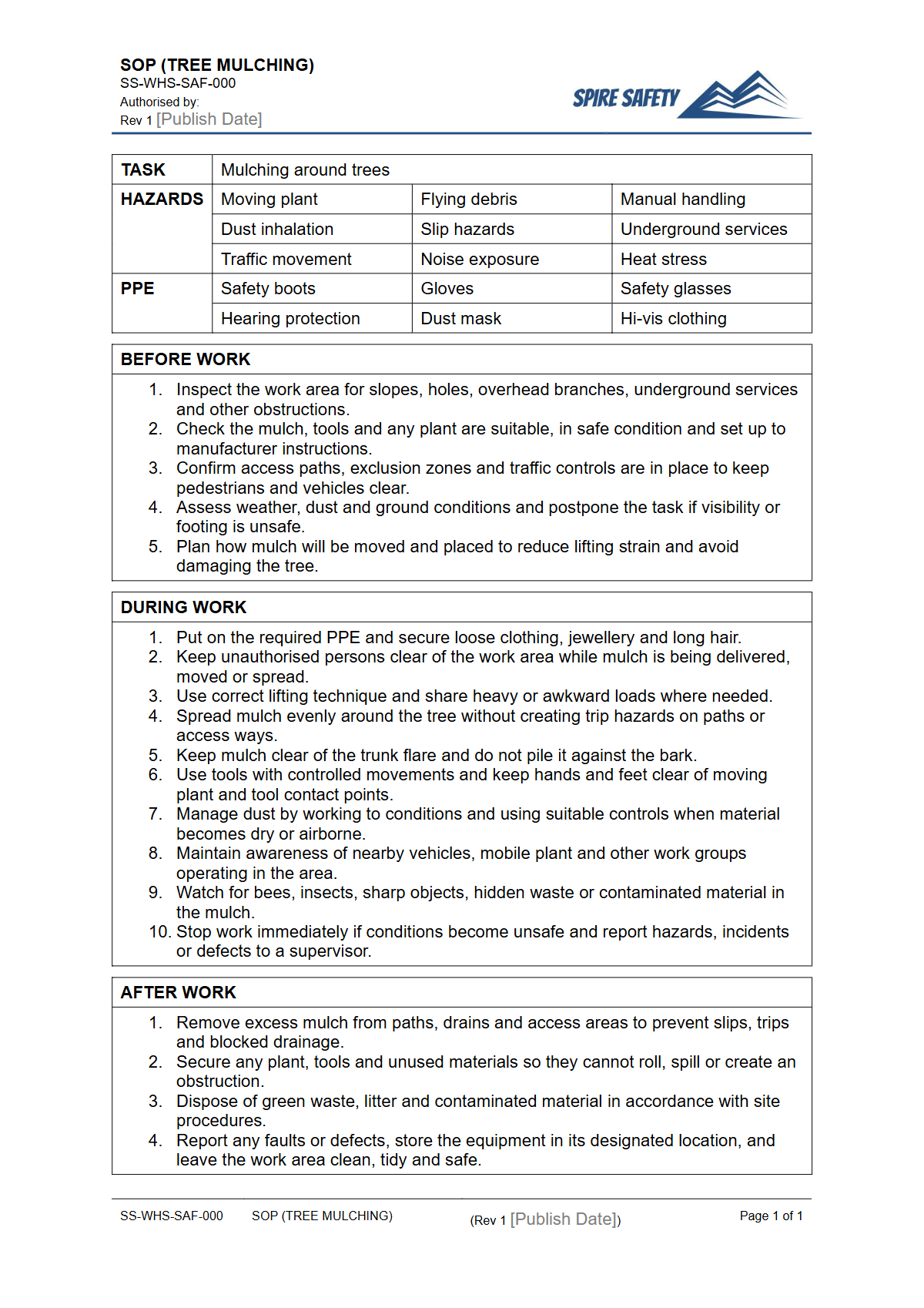
Download our free Safe Operating Procedure (Tree Mulching) Template to formalise safety protocols for wood chipper and mulcher use on your worksite.
Free Safe Operating Procedure (Tree Mulching) Template
DOCX • 126 KB + PDF
Updated Oct 2026
No signup required
Purpose of the Free Safe Operating Procedure (Tree Mulching) Template
Operating a tree mulcher or wood chipper presents significant workplace health and safety risks. This free Safe Operating Procedure (Tree Mulching) Template provides a structured framework for documenting the required steps to perform the task safely.
Its purpose is to minimise risks such as entanglement in feed rollers, being struck by ejected material, noise-induced hearing loss, and ergonomic injuries from manual handling. An SOP serves as a vital administrative control, forming a key part of your safety management system by providing clear, step-by-step instructions for workers to follow.
Video walkthrough
How to use the Free Safe Operating Procedure (Tree Mulching) Template
This document is a customisable template designed to be adapted to your specific workplace. Download the DOCX file and edit it to reflect the make and model of your mulching equipment, your site-specific hazards, and your organisation's established safety protocols.
You must consult the manufacturer’s operating manual and incorporate its specific instructions. This SOP should be integrated into your broader comprehensive WHS management systems, ensuring it aligns with your overall approach to risk management and worker training.
Important: This is a template only. We are not responsible for its customisation or implementation.
You must adapt this document to your specific equipment, processes, and the unique conditions of your workplace to ensure it is effective.
When to use a Safe Operating Procedure
A Safe Operating Procedure for tree mulching should be a primary reference document used in several key situations. It is essential during the induction and training of new operators to ensure they understand the correct and safe method of operation from the beginning.
It should also be readily available at the worksite as a quick reference guide before and during operation. The SOP is a critical tool for conducting refresher training and for post-incident investigations to identify any deviations from established safe work practices.
Who should use it
This SOP should be used by all personnel involved with tree mulching operations. This includes the equipment operators, who must follow the procedure for every task, and their direct supervisors, who are responsible for ensuring compliance and providing adequate training.
WHS managers and officers will use this document to develop training programs, conduct risk assessments, and verify competency. It ensures a consistent and safe approach is communicated and understood by everyone on the team, regardless of their experience level. Similar procedural discipline is required for other heavy equipment, as outlined in our Telehandler SOP template.
Key Elements of a Tree Mulching SOP
A robust SOP for tree mulching covers the entire work cycle, from initial setup to shutdown and maintenance. Documenting these phases ensures no steps are missed, reducing the likelihood of incidents.
Pre-Operational Checks
Before starting the engine, operators must conduct a thorough inspection. This includes checking fluid levels, inspecting blades for sharpness and damage, and verifying that all safety guards, shields, and emergency stops are in place and functional.
Any defects or missing components must be reported and rectified before the machine is used. This process is similar to pre-start checks on other cutting equipment, such as those detailed in our free Circular Saw SOP.
Safe Operating Sequence
The procedure must detail the correct sequence for starting, operating, and stopping the mulcher. This section should specify requirements for establishing an exclusion zone, correct techniques for feeding branches into the hopper (e.g., feeding butt-end first), and the use of push paddles.
It must explicitly forbid unsafe actions like using feet to push material or wearing loose-fitting clothing. Adherence to these steps is often verified through regular WHS compliance auditing.
Jamming and Shutdown Procedures
The SOP must provide clear, unambiguous instructions for dealing with jams or blockages. This process always begins with shutting down the machine completely and waiting for all moving parts to come to a complete stop before any attempt is made to clear the obstruction.
It should also detail the correct shutdown, cleaning, and storage procedures at the end of a shift. Following a consistent shutdown protocol is vital for all site machinery, including equipment detailed in our trencher use SOP.
By thoroughly documenting these steps, your organisation can significantly improve the safety and consistency of tree mulching tasks. For more templates and safety guides, explore our complete free WHS resources library.
Common mistakes
Common mistakes to avoid
- Feeding material with feet or hands instead of using a push paddle or longer branches.
- Bypassing or disabling safety features like the feed roller stop bar.
- Failing to establish and maintain a clear exclusion zone around the machine during operation.
- Attempting to clear jams or perform maintenance while the machine is running.
Legal references
Legal considerations
The following legal requirements may be relevant to this type of work.
- Work Health and Safety Act (Harmonised) — Provides the primary duties for protecting workers and other people from work health and safety risks.
- Work Health and Safety Regulations (Harmonised) — Sets out requirements supporting the management of workplace hazards and risks.
The following codes may be relevant to this type of work.
- Managing WHS Risks Code of Practice — Provides practical guidance on identifying hazards, assessing risks and applying effective controls.
- Work Health and Safety Consultation, Cooperation and Coordination Code of Practice — Provides practical guidance on consulting workers and coordinating with other duty holders.
- Managing the Work Environment and Facilities Code of Practice — Provides practical guidance on safe work environments, workplace facilities and related controls.
Did you know
Infeed Roller Speed
The infeed rollers on many commercial wood chippers can pull in material at speeds of 30 metres per minute or more. This speed gives an operator less than one second to react if a hand or limb gets caught.
FAQ
Frequently asked questions
01What Personal Protective Equipment (PPE) is mandatory for operating a tree mulcher?
02How does an SOP for tree mulching differ from a SWMS?
03What is the most critical safety feature on a modern wood chipper?
04Can I use this Safe Operating Procedure template for any brand of tree mulcher?
Share this resource
Free Safe Operating Procedure (Tree Mulching) Template
Browse Categories
How To Use It
- 1Download and open in Word or PDF.
- 2Replace the placeholders with your business details.
- 3Get it reviewed by a WHS specialist before rollout.
Need it customised?
Our WHS consultants can adapt this template to your site, run a gap analysis, or audit what you already have in place.
Book a Free Consultation WHS consulting servicesor call 1300 156 382
Related templates
- Free Safe Operating Procedure (Tree Pit Cleaning) Template
- Free Safe Operating Procedure (Tree Planting) Template
- Free Safe Operating Procedure (Tree Rigging) Template
- Free Safe Operating Procedure (Tree Root Zone Mulching) Template
- Free Safe Operating Procedure (Tree Stake Installation) Template
- Free Safe Operating Procedure (Tree Watering Bag) Template