
Free Safe Operating Procedure (Tree Planting) Template
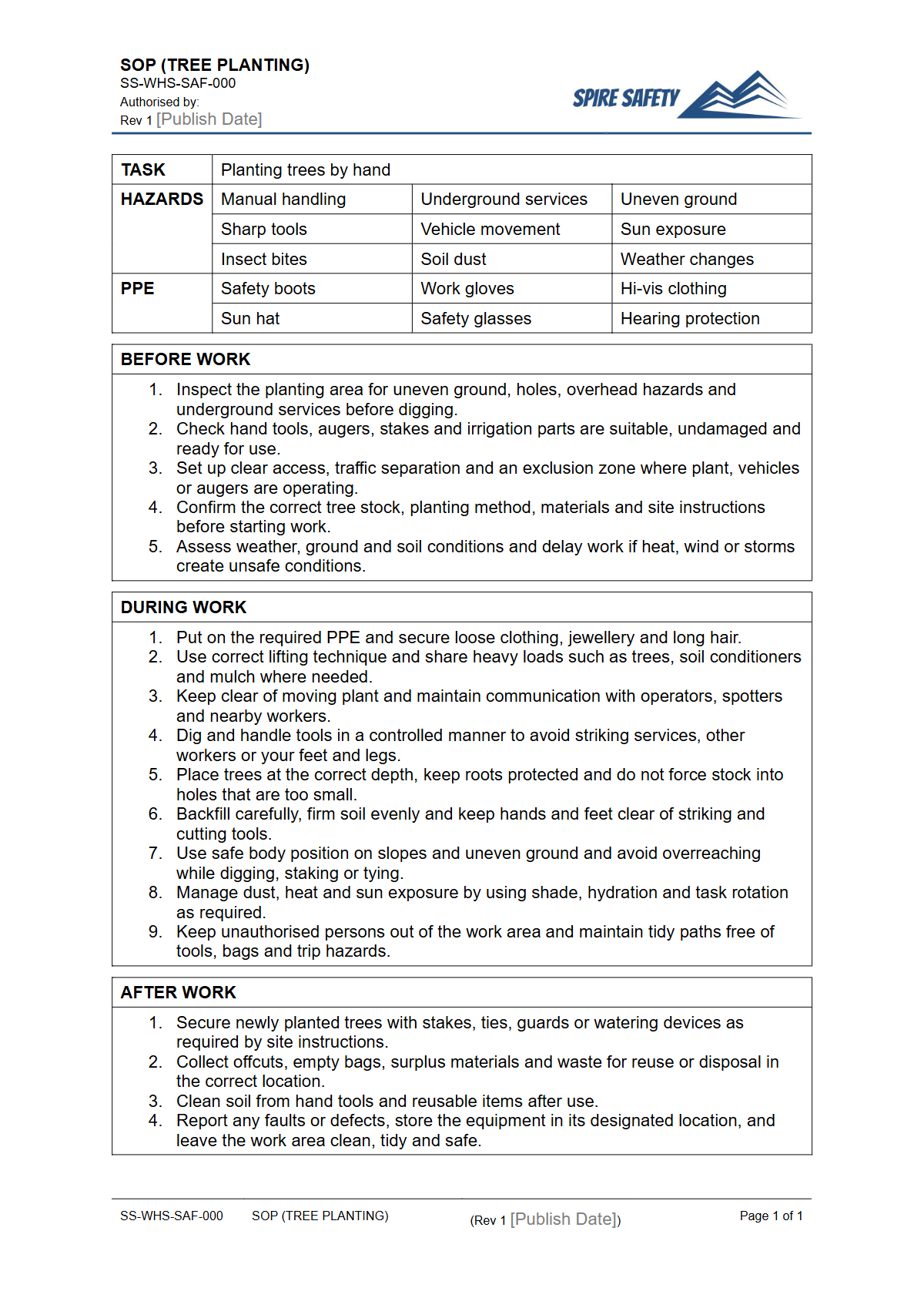
Our free Safe Operating Procedure for tree planting helps you document risks and controls for planting tasks. Download your customisable DOCX and PDF template.
Free Safe Operating Procedure (Tree Planting) Template
DOCX • 126 KB + PDF
Updated Oct 2026
No signup required
Purpose of the Free Safe Operating Procedure (Tree Planting) Template
This Free Safe Operating Procedure (Tree Planting) Template provides a structured framework for outlining the safest way to perform tree planting activities in your workplace. Documenting a clear process helps manage WHS risks by providing workers with clear, step-by-step instructions.
Effective SOPs are a fundamental component of a safe system of work, ensuring that all personnel, regardless of experience, follow a consistent and safe method for the task.
The template prompts you to identify potential hazards and establish robust control measures. Common risks in tree planting include manual handling injuries from lifting heavy root balls, sprains and strains from digging, striking underground services, and exposure to environmental elements like sun and heat.
For mechanised digging tasks, our free Trencher SOP template provides more specific guidance on associated equipment risks.
Key Hazards Covered
- Manual handling (lifting, carrying, digging)
- Use of hand and power tools (shovels, augers)
- Slips, trips, and falls on uneven or wet ground
- Underground and overhead services (e.g., pipes, cables)
- Vehicle and mobile plant interaction
- Environmental exposure (sun, heat, insects)
Video walkthrough
How to use the Free Safe Operating Procedure (Tree Planting) Template
This Safe Operating Procedure is provided as a starting point in both DOCX and PDF formats. Your organisation must adapt it to the specific context of your worksite.
Consult with your workers to identify the unique equipment, environmental conditions, and materials used in your operations. Effective procedures are not generic; they reflect the reality of the work being done on the ground.
Note: We have provided this template to help you create your own site-specific Safe Operating Procedure. You must review, edit, and customise this document to suit the specific hazards and control measures relevant to your workplace, equipment, and personnel. Integrating customised SOPs is a key activity in maintaining effective WHS management systems.
When customising, consider all associated tasks, such as site preparation, soil conditioning, and the application of fertilisers or mulch. If your work involves mechanical application of such materials, you may also benefit from our free Spreader SOP. Once finalised, the SOP should be used as a primary training document for all workers involved in tree planting.
When to use it
A Safe Operating Procedure for tree planting should be used consistently as part of your daily operations. It is essential for inducting and training new workers, providing refresher training for existing staff, and conducting pre-start meetings to discuss the day's tasks and associated hazards.
The SOP should be readily available at the worksite for easy reference. It is also a critical document to review during incident investigations or when a process or piece of equipment changes. This process is similar for other agricultural activities, such as those covered in our free Planter SOP.
Who should use it
This SOP is intended for use by all individuals involved in tree planting activities. This includes:
- Workers: To understand and follow the safe steps required to perform their job.
- Supervisors and Team Leaders: To oversee work, enforce safe practices, and deliver toolbox talks.
- WHS Managers and Advisors: To develop, implement, and review safety documentation as part of the overall safety management system.
By involving all levels of your organisation, you foster a positive safety culture where everyone takes responsibility for their own safety and the safety of others. For businesses needing expert assistance to develop and implement robust safety procedures, Spire Safety offers professional WHS consulting services.
You can also browse our complete free WHS resources library for more templates and guides.
Common mistakes
Common mistakes to avoid
- Failing to identify and locate all underground services before digging commences.
- Using incorrect manual handling techniques when lifting heavy trees or bags of soil.
- Inadequate site assessment for hazards like overhead powerlines, unstable ground, or vehicle traffic.
- Neglecting worker hydration and sun protection measures in outdoor environments.
Legal references
Legal considerations
The following legal requirements may be relevant to this type of work.
- Work Health and Safety Act (Harmonised) — Provides the primary duties for protecting workers and other people from work health and safety risks.
- Work Health and Safety Regulations (Harmonised) — Sets out requirements supporting the management of workplace hazards and risks.
The following codes may be relevant to this type of work.
- Managing WHS Risks Code of Practice — Provides practical guidance on identifying hazards, assessing risks and applying effective controls.
- Work Health and Safety Consultation, Cooperation and Coordination Code of Practice — Provides practical guidance on consulting workers and coordinating with other duty holders.
- Managing the Work Environment and Facilities Code of Practice — Provides practical guidance on safe work environments, workplace facilities and related controls.
Did you know
Dial Before You Dig
Striking an underground electrical cable or gas pipe can have catastrophic consequences. The Before You Dig Australia (BYDA) service is a free national referral service that provides essential information on the location of underground infrastructure.
Manual Task Risks
According to Safe Work Australia, manual handling is a leading cause of workplace injuries. A single tree sapling with its root ball can weigh over 20kg, posing a significant risk if not handled with correct technique.
FAQ
Frequently asked questions
01What should be included in a tree planting SOP?
02Is a Safe Work Method Statement (SWMS) required for tree planting?
03How do you handle underground services when planting trees?
04What Personal Protective Equipment (PPE) is needed for tree planting?
Share this resource
Free Safe Operating Procedure (Tree Planting) Template
Browse Categories
How To Use It
- 1Download and open in Word or PDF.
- 2Replace the placeholders with your business details.
- 3Get it reviewed by a WHS specialist before rollout.
Need it customised?
Our WHS consultants can adapt this template to your site, run a gap analysis, or audit what you already have in place.
Book a Free Consultation WHS consulting servicesor call 1300 156 382
Related templates
- Free Safe Operating Procedure (Tree Rigging) Template
- Free Safe Operating Procedure (Tree Root Zone Mulching) Template
- Free Safe Operating Procedure (Tree Stake Installation) Template
- Free Safe Operating Procedure (Tree Watering Bag) Template
- Free Safe Operating Procedure (Tree Watering) Template
- Free Safe Operating Procedure (Tree Winch) Template