
Free Safe Operating Procedure (Tree Pit Cleaning) Template
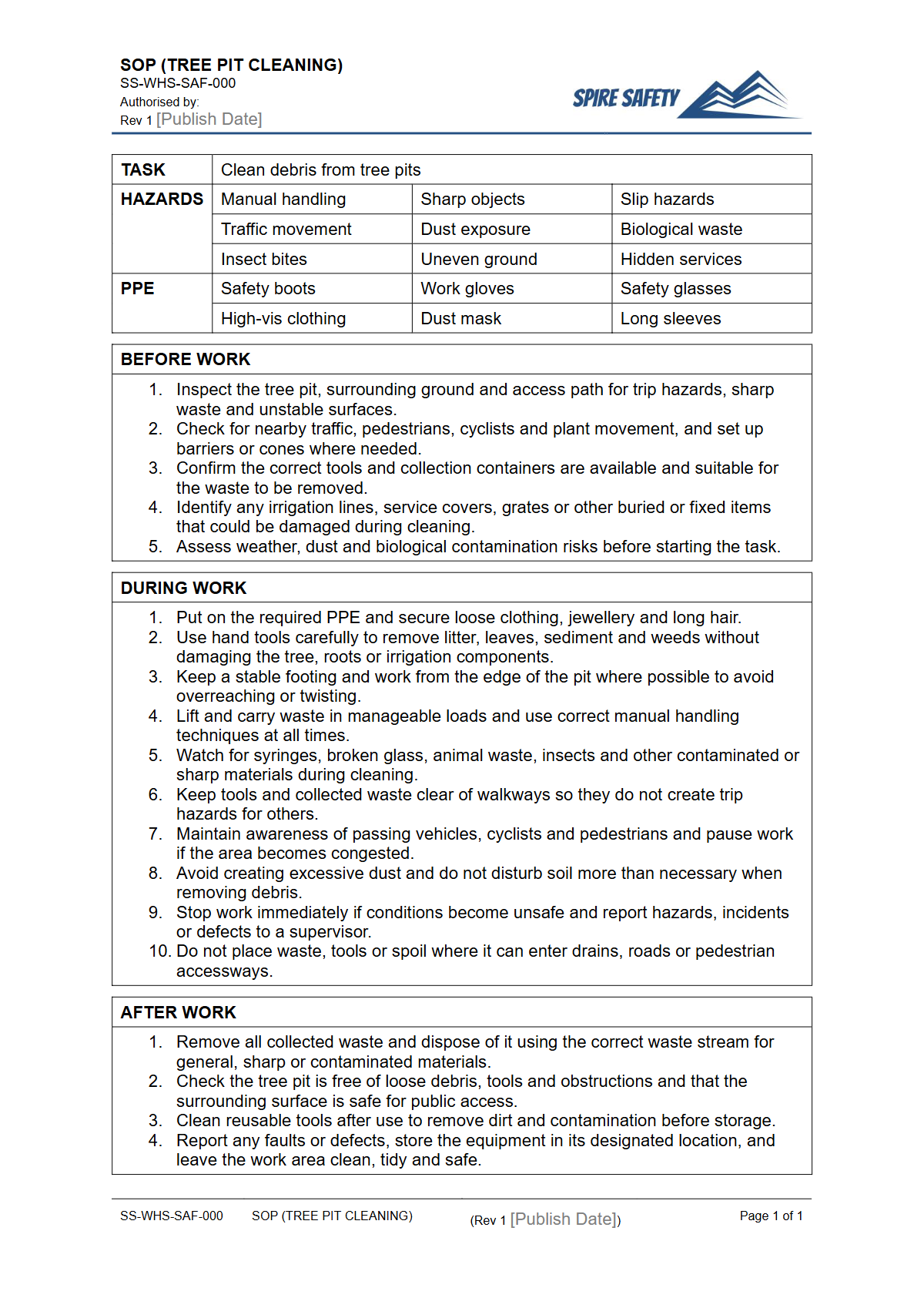
Download our free Safe Operating Procedure for tree pit cleaning. This customisable template helps you document step-by-step instructions for safe work.
Free Safe Operating Procedure (Tree Pit Cleaning) Template
DOCX • 126 KB + PDF
Updated Oct 2026
No signup required
Purpose of the Free Safe Operating Procedure (Tree Pit Cleaning) Template
This free Safe Operating Procedure (Tree Pit Cleaning) Template provides a structured starting point for documenting the process of cleaning and maintaining tree pits in public and commercial spaces. Cleaning these areas is more complex than it appears, involving potential exposure to various hazards including sharp objects, biological waste, hazardous substances, ergonomic strains, and interaction with pedestrians or traffic.
Using a formal SOP helps your organisation manage these risks by providing clear, step-by-step instructions for workers to follow.
Implementing a robust SOP for this task is a practical way to meet your duties under WHS legislation to provide and maintain a safe system of work. It forms an essential component of your overall safety framework, ensuring consistency in how tasks are performed safely.
Documenting your procedures is a cornerstone of effective WHS management systems and demonstrates a commitment to worker safety.
Video walkthrough
How to use the Free Safe Operating Procedure (Tree Pit Cleaning) Template
Our Safe Operating Procedure (Tree Pit Cleaning) Template is provided in an editable DOCX format so you can adapt it to your specific operational needs. To use it effectively, you must conduct a site-specific risk assessment and consult with your workers—the people who will be performing the task.
This ensures the final SOP is practical, relevant, and accounts for the unique conditions of your workplace.
Note: This document is a template and is not a substitute for legal advice or a comprehensive risk assessment. We strongly recommend that you customise this SOP by incorporating details about the specific tools (e.g., shovels, brooms, vacuum excavators), site conditions, local council regulations, and emergency procedures relevant to your business. If high-pressure water or air is used, consider referencing procedures like those in our Free Air Compressor SOP Template.
When to use this Safe Operating Procedure
A Safe Operating Procedure for tree pit cleaning should be used before commencing any work. It is an essential tool for worker inductions, pre-start meetings, and refresher training.
This SOP is applicable for a range of scenarios, including routine maintenance by council and landscaping crews, seasonal clean-ups, and post-storm debris removal. It ensures every worker understands the approved method for completing the job safely, every time.
For larger projects involving soil replacement or rejuvenation around trees, more extensive ground-disturbing equipment may be necessary. In these cases, you may need to develop additional procedures for specific machinery, drawing on resources like our FREE Trencher SOP Template to manage associated risks.
Who should use this Safe Operating Procedure
This SOP is designed for any Person Conducting a Business or Undertaking (PCBU) whose workers perform tree pit cleaning. This includes landscaping companies, local government authorities, grounds maintenance contractors, and facilities management services.
Supervisors and managers can use the SOP to train team members, supervise work, and verify that safety protocols are being followed. Workers should use it as a practical guide to understand the required steps, identify hazards, and use the correct controls.
Regularly reviewing and updating your SOPs is crucial for maintaining a safe workplace. An external review can often identify gaps or areas for improvement in your safety documentation.
Engaging specialists for WHS compliance auditing can provide valuable assurance that your systems are robust and effective.
If heavy equipment is used to clear debris from surrounding paved areas before manual cleaning begins, ensure operators are trained and competent. You may need to supplement your procedures with equipment-specific guides, such as a FREE Scraper SOP Template.
Developing comprehensive and site-specific WHS documentation can be a complex task. For organisations that need tailored support in creating or refining their safety systems, engaging professional WHS consulting services can provide the necessary expertise and guidance to ensure your procedures are practical and aligned with Australian WHS standards.
Common mistakes
Common mistakes to avoid
- Using a generic SOP without customising it for specific site hazards and equipment.
- Failing to consult Dial Before You Dig (DBYD) before any ground disturbance.
- Neglecting worker consultation, resulting in impractical or ignored procedures.
- Inadequate provision, training, and enforcement of Personal Protective Equipment (PPE) use.
Legal references
Legal considerations
The following legal requirements may be relevant to this type of work.
- Work Health and Safety Act (Harmonised) — Provides the primary duties for protecting workers and other people from work health and safety risks.
- Work Health and Safety Regulations (Harmonised) — Sets out requirements supporting the management of workplace hazards and risks.
The following codes may be relevant to this type of work.
- Managing WHS Risks Code of Practice — Provides practical guidance on identifying hazards, assessing risks and applying effective controls.
- Work Health and Safety Consultation, Cooperation and Coordination Code of Practice — Provides practical guidance on consulting workers and coordinating with other duty holders.
- Managing the Work Environment and Facilities Code of Practice — Provides practical guidance on safe work environments, workplace facilities and related controls.
Did you know
Urban Tree Health
Clean tree pits are vital for urban tree health. Removing compacted soil, rubbish, and weeds allows for better water penetration and oxygen exchange to the root system, helping trees thrive in harsh city environments.
Underground Services
A significant, often overlooked, hazard is the presence of underground utilities like electrical cables, gas lines, or communication conduits. Always consult Dial Before You Dig (DBYD) plans before breaking ground, even for shallow work.
FAQ
Frequently asked questions
01What are the main hazards of cleaning tree pits?
02Is a Safe Work Method Statement (SWMS) required for tree pit cleaning?
03How often should a Safe Operating Procedure for tree pit cleaning be reviewed?
04What Personal Protective Equipment (PPE) is needed for cleaning tree pits?
Share this resource
Free Safe Operating Procedure (Tree Pit Cleaning) Template
Browse Categories
How To Use It
- 1Download and open in Word or PDF.
- 2Replace the placeholders with your business details.
- 3Get it reviewed by a WHS specialist before rollout.
Need it customised?
Our WHS consultants can adapt this template to your site, run a gap analysis, or audit what you already have in place.
Book a Free Consultation WHS consulting servicesor call 1300 156 382
Related templates
- Free Safe Operating Procedure (Tree Planting) Template
- Free Safe Operating Procedure (Tree Rigging) Template
- Free Safe Operating Procedure (Tree Root Zone Mulching) Template
- Free Safe Operating Procedure (Tree Stake Installation) Template
- Free Safe Operating Procedure (Tree Watering Bag) Template
- Free Safe Operating Procedure (Tree Watering) Template