
Free Safe Operating Procedure (Tree Guard Installation) Template
Download our free Safe Operating Procedure (Tree Guard Installation) template to outline safe work methods.
Free Safe Operating Procedure (Tree Guard Installation) Template
DOCX • 126 KB + PDF
Updated Oct 2026
No signup required
Purpose of the Free Safe Operating Procedure (Tree Guard Installation) Template
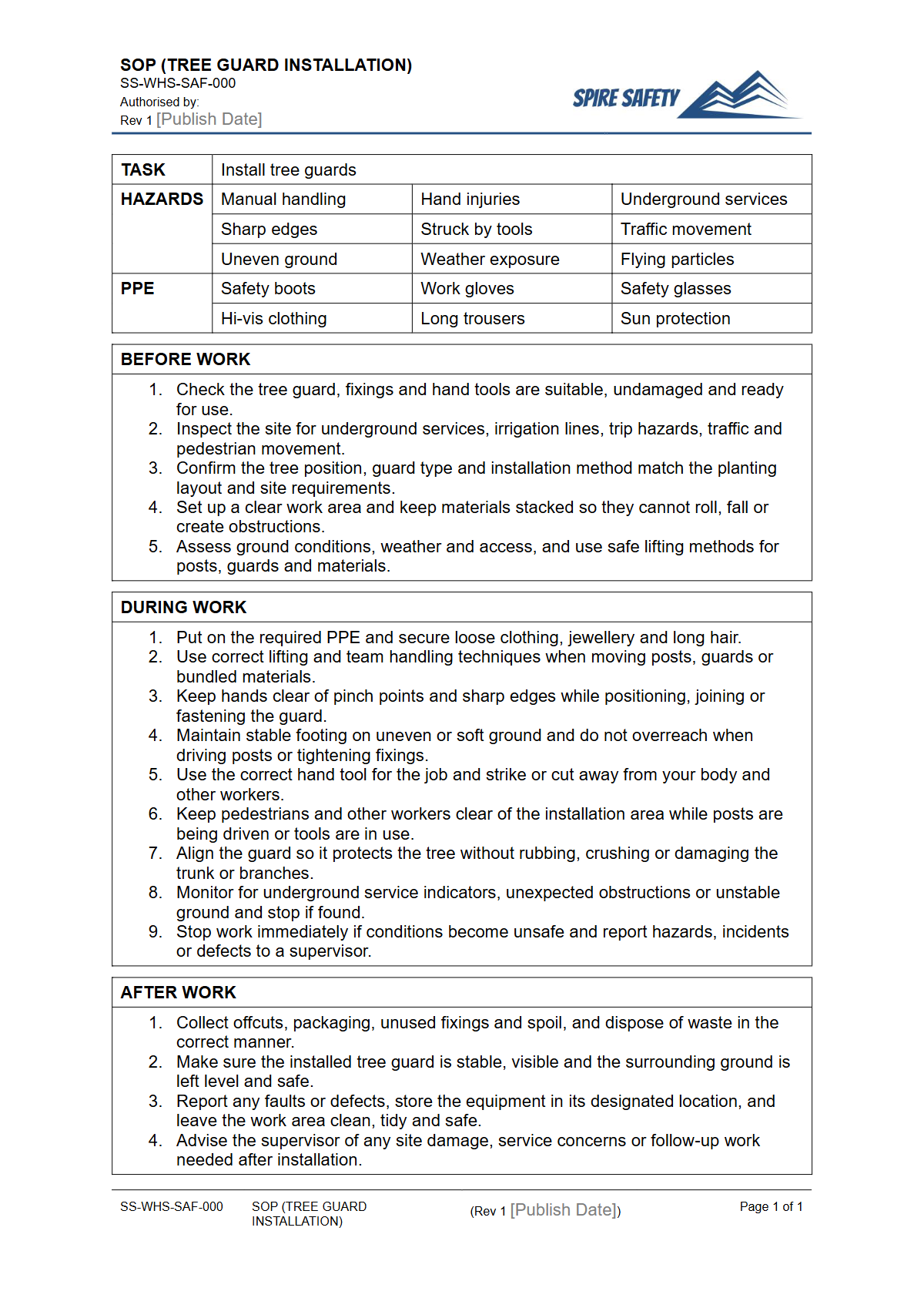
This Safe Operating Procedure (SOP) template provides a structured framework for documenting the safe and correct method for installing tree guards. Properly installed guards protect young trees from pests, weather, and accidental damage, but the installation process itself carries risks.
Our free Safe Operating Procedure (Tree Guard Installation) template helps you systematically address these hazards, such as manual handling injuries from lifting materials, cuts from sharp guard edges or tools, and ergonomic strains from repetitive bending and kneeling. By formalising your process, you create a vital tool for training, risk management, and demonstrating due diligence. Documenting procedures like this is a fundamental part of building and maintaining effective WHS management systems.
Video walkthrough
How to use the Free Safe Operating Procedure (Tree Guard Installation) Template
This template is available as an easy-to-use DOCX file for customisation, as well as a print-ready PDF. To use it effectively, a competent person must review and adapt the content to your specific operational context.
This includes detailing the exact type of tree guards used, the specific tools required (e.g., mallets, stake drivers, wire cutters), the site conditions, and the required Personal Protective Equipment (PPE). For guidance on adapting technical documents to your workplace, you can seek expert WHS consulting to ensure your final document is robust.
Important Customisation Notice
This is a template only. Before implementation, it must be thoroughly customised by a competent person to align with your specific workplace environment, equipment, materials, and worker capabilities.
Generic procedures are insufficient for managing risk. We are not liable for any incidents that may arise from the use of this document in its un-customised form.
When to use it
A Safe Operating Procedure for tree guard installation should be developed and approved before any work commences. It serves as a primary reference document for multiple WHS activities.
Use it to train new employees and contractors, ensuring they understand the approved method and its associated risks from day one. It is also an excellent tool for pre-start toolbox talks, allowing teams to review the safe work steps immediately before starting the task.
The SOP should be readily accessible on-site for workers to consult whenever they are unsure of a step, and it should be reviewed periodically or after any incident or change in process.
Who should use it
This SOP is intended for use by Persons Conducting a Business or Undertaking (PCBUs) whose workers perform landscaping, horticultural, grounds maintenance, or revegetation tasks. This includes workers at local councils, land care groups, and commercial landscaping companies.
Supervisors and managers should use the finalised document to train their teams and monitor work practices for compliance. All workers assigned to the task of installing tree guards must be trained on the contents of the site-specific SOP and demonstrate their understanding before beginning work.
If the site preparation involves mechanical digging, a separate SOP for operating a trencher may also be required.
The SOP ensures every team member, regardless of experience level, has a clear, consistent, and safe guide to follow. For related tasks such as applying mulch or soil conditioners in bulk around the newly guarded trees, a dedicated safe operating procedure for spreader use would be a valuable addition to your safety documentation.
Having distinct SOPs for each high-risk task creates a comprehensive safety framework for the entire project.
Integrating this SOP into your safety system helps standardise performance and minimise deviations from safe practice. The documented procedure also provides a clear benchmark against which work practices can be assessed during inspections or WHS compliance audits. It helps demonstrate that the organisation has a formal system for instructing workers on how to perform tasks safely, which is a key requirement under Australian WHS law.
By implementing task-specific SOPs, you build a safer, more organised, and more professional operation. Explore our complete free WHS resources library for more templates to support your safety management system and help you control risks across your worksite.
Common mistakes
Common mistakes to avoid
- Using a generic template without customising it for the specific site, guard type, and tools.
- Failing to identify and control all hazards, particularly sharp edges on mesh guards or unstable ground.
- Not providing adequate PPE, such as cut-resistant gloves and UV-rated safety glasses.
- Neglecting to train workers on the finalised, site-specific SOP before they commence work.
Legal references
Legal considerations
The following legal requirements may be relevant to this type of work.
- Work Health and Safety Act (Harmonised) — Provides the primary duties for protecting workers and other people from work health and safety risks.
- Work Health and Safety Regulations (Harmonised) — Sets out requirements supporting the management of workplace hazards and risks.
The following codes may be relevant to this type of work.
- Managing WHS Risks Code of Practice — Provides practical guidance on identifying hazards, assessing risks and applying effective controls.
- Work Health and Safety Consultation, Cooperation and Coordination Code of Practice — Provides practical guidance on consulting workers and coordinating with other duty holders.
- Managing the Work Environment and Facilities Code of Practice — Provides practical guidance on safe work environments, workplace facilities and related controls.
Did you know
Manual Task Risk
Hazardous manual tasks are a leading cause of workplace injuries in Australia. Documented procedures for physically demanding jobs like installing tree guards are a crucial control measure for preventing musculoskeletal disorders.
FAQ
Frequently asked questions
01What are the main hazards involved in tree guard installation?
02Is a Safe Operating Procedure a legal requirement in Australia?
03How often should an SOP for tree guard installation be reviewed?
04Can I use this SOP template for different types of tree guards?
Share this resource
Free Safe Operating Procedure (Tree Guard Installation) Template
Browse Categories
How To Use It
- 1Download and open in Word or PDF.
- 2Replace the placeholders with your business details.
- 3Get it reviewed by a WHS specialist before rollout.
Need it customised?
Our WHS consultants can adapt this template to your site, run a gap analysis, or audit what you already have in place.
Book a Free Consultation WHS consulting servicesor call 1300 156 382
Related templates
- Free Safe Operating Procedure (Tree Hand Pruning) Template
- Free Safe Operating Procedure (Tree Mulching) Template
- Free Safe Operating Procedure (Tree Pit Cleaning) Template
- Free Safe Operating Procedure (Tree Planting) Template
- Free Safe Operating Procedure (Tree Rigging) Template
- Free Safe Operating Procedure (Tree Root Zone Mulching) Template