
Free Safe Operating Procedure (Tree Climbing) Template
Download our free Safe Operating Procedure (Tree Climbing) template, a structured starting point for arborists and tree workers in Australia. Get your DOCX now.
Free Safe Operating Procedure (Tree Climbing) Template
DOCX • 126 KB + PDF
Updated Oct 2026
No signup required
Purpose of the Free Safe Operating Procedure (Tree Climbing) Template
Working as an arborist or tree worker involves significant risks, particularly when climbing. This is why having a documented system of work is critical.
Our Free Safe Operating Procedure (Tree Climbing) Template provides a structured starting point for organisations to formalise their safety protocols for this high-risk task. It is designed to be adapted to your specific operational needs, helping you manage hazards and ensure worker safety.
The primary purpose of this Safe Operating Procedure (Tree Climbing) Template is to provide clear, step-by-step instructions for performing climbing tasks safely and consistently. A well-developed SOP helps to minimise risks associated with working at heights, using specialised equipment, and navigating unpredictable natural environments.
It serves as a vital training tool for new and existing workers, establishes a benchmark for expected performance, and forms a key part of your overall WHS management systems. Implementing a robust SOP demonstrates a commitment to meeting WHS obligations and protecting your team from harm.
Video walkthrough
How to use the Free Safe Operating Procedure (Tree Climbing) Template
This template is a comprehensive foundation, not a finished document. To make it effective, you must adapt it to the unique context of your business and worksites.
Review each section and add, remove, or modify content to align with your specific equipment, team competency, and the types of trees and environments you work in. You must consult with your workers during this customisation process.
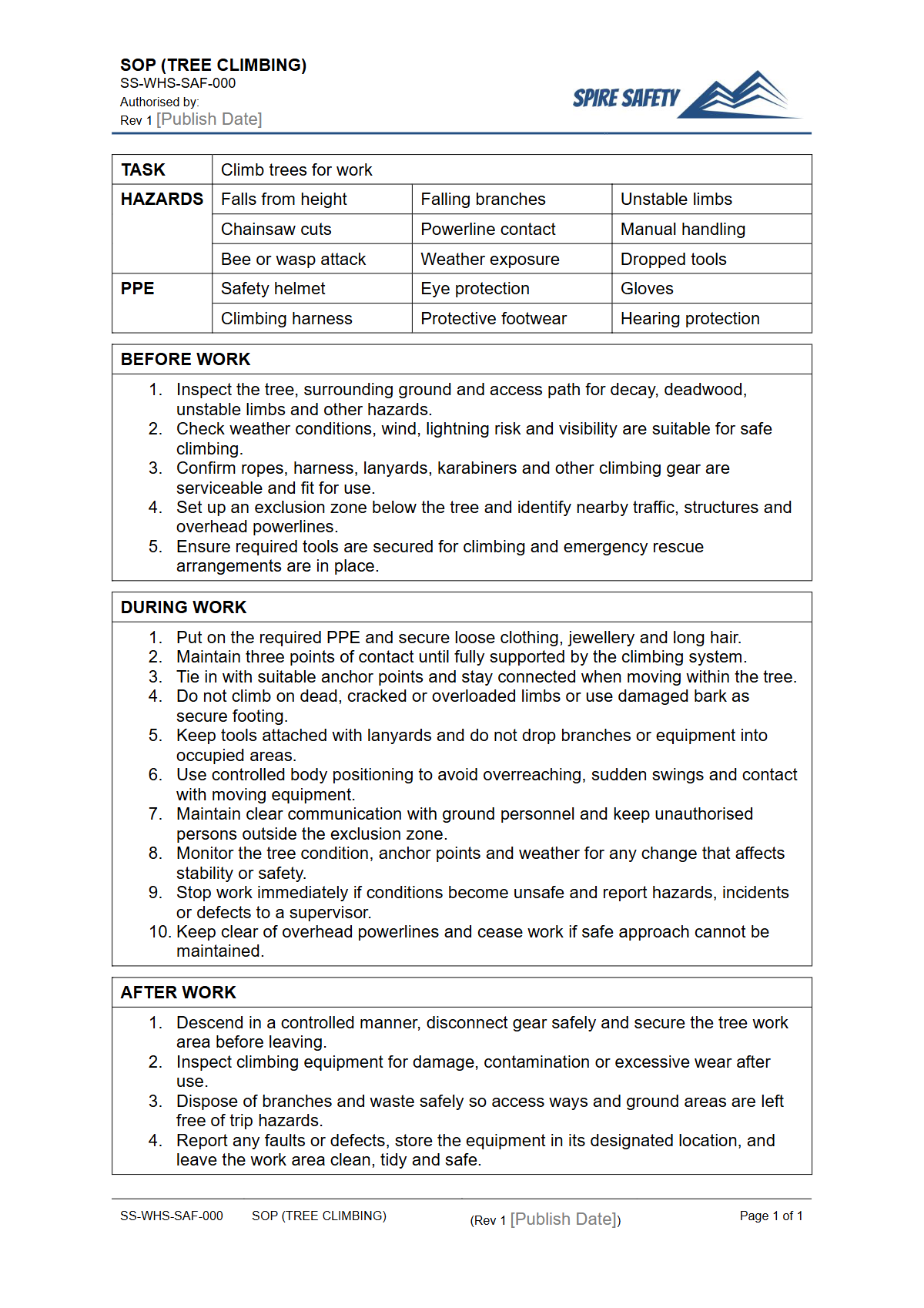
The template includes sections for pre-operational checks, hazard identification, step-by-step climbing procedures, post-task clean-up, and emergency protocols.
Please note: We have designed this document as a template. You must customise it to reflect the specific hazards, equipment, environment, and control measures relevant to your workplace.
When to use a Safe Operating Procedure
A Tree Climbing SOP should be an active document, used consistently across your operations. It must be consulted before commencing any climbing task, especially those that are non-routine or involve complex variables.
It is an essential resource during worker induction and training sessions to ensure all team members understand the required safety standards from day one. Furthermore, the SOP should be reviewed and updated regularly, particularly after an incident or near miss, when new equipment is introduced, or when industry best practices evolve. A regular review schedule can be verified through a formal WHS compliance audit.
Who should use this Safe Operating Procedure
This procedure is intended for all personnel involved in arboricultural climbing operations. This includes qualified arborists, tree climbers, ground crew, apprentices, and trainees.
Supervisors and managers must use the SOP to oversee work, supports your compliance efforts, and conduct safety briefings, also known as toolbox talks. A Person Conducting a Business or Undertaking (PCBU) has the primary duty of care and is responsible for ensuring such safe systems of work are developed, implemented, and maintained in consultation with their workers. You can find more templates and guides in our free WHS resources library.
Key Elements of a Tree Climbing SOP
A comprehensive SOP for tree climbing should address several critical areas to be effective. The following sections outline the core components you should focus on when customising your document.
PPE and Equipment
Detail the mandatory Personal Protective Equipment (PPE) such as a helmet (compliant with AS/NZS 1801), eye protection, and appropriate footwear. It must also list all climbing and rigging equipment, including harnesses, ropes, lanyards, carabiners, and friction devices, referencing relevant Australian Standards.
The procedure should include steps for pre-use inspection and criteria for retiring damaged equipment from service.
Pre-Climb Inspection
This section outlines the process for assessing the tree for structural integrity, weaknesses, decay, and environmental hazards like powerlines or animal nests. It should also include a check of weather conditions and a site assessment to manage public access and ground-level risks. For large-scale tree removal operations, site management may also involve heavy machinery for moving logs or debris, requiring its own set of instructions, similar to our FREE Telehandler SOP Template.
Safe Climbing and Rigging Techniques
Provide step-by-step instructions for common climbing systems (e.g., Moving Rope System, Stationary Rope System). This includes selecting suitable anchor points, installing ropes, proper ascent and descent techniques, and safe work positioning.
It should also cover basic rigging principles for lowering branches. Procedures may also cover the use of equipment on the ground, and for tasks like cutting firewood or processing limbs, a specific procedure like our free circular saw SOP can be adapted for related ground tools.
Emergency Procedures
This is arguably the most critical component. The SOP must detail the on-site emergency plan, including communication methods (whistles, radios), first aid provisions, and a documented aerial rescue plan.
All climbers and ground crew must be trained and competent in these procedures. For complex sites or high-risk tasks, seeking external expertise through WHS consulting can help validate your emergency plans and rescue strategies.
Common mistakes
Common mistakes to avoid
- Using a generic template without site-specific customisation.
- Failing to conduct and document a thorough pre-climb tree and site assessment.
- Neglecting to inspect climbing equipment before each use.
- Not having a documented and regularly practiced aerial rescue plan.
Legal references
Legal considerations
The following legal requirements may be relevant to this type of work.
- Work Health and Safety Act (Harmonised) — Provides the primary duties for protecting workers and other people from work health and safety risks.
- Work Health and Safety Regulations (Harmonised) — Sets out requirements supporting the management of workplace hazards and risks.
The following codes may be relevant to this type of work.
- Managing WHS Risks Code of Practice — Provides practical guidance on identifying hazards, assessing risks and applying effective controls.
- Work Health and Safety Consultation, Cooperation and Coordination Code of Practice — Provides practical guidance on consulting workers and coordinating with other duty holders.
- Managing the Work Environment and Facilities Code of Practice — Provides practical guidance on safe work environments, workplace facilities and related controls.
Did you know
Working at Heights
Falls from height remain a leading cause of serious injury and fatalities in the arboriculture industry. A well-implemented SOP is a key control measure to manage this critical risk.
Competency is Key
Australian standards require tree climbers to be assessed as competent for the specific tasks they perform, including complex rigging and aerial rescue. This goes beyond just holding a qualification.
FAQ
Frequently asked questions
01Is a Safe Operating Procedure the same as a Safe Work Method Statement (SWMS)?
02How often should our Tree Climbing SOP be reviewed?
03What qualifications are needed for tree climbing in Australia?
04Does this template cover aerial rescue procedures?
Share this resource
Free Safe Operating Procedure (Tree Climbing) Template
Browse Categories
How To Use It
- 1Download and open in Word or PDF.
- 2Replace the placeholders with your business details.
- 3Get it reviewed by a WHS specialist before rollout.
Need it customised?
Our WHS consultants can adapt this template to your site, run a gap analysis, or audit what you already have in place.
Book a Free Consultation WHS consulting servicesor call 1300 156 382
Related templates
- Free Safe Operating Procedure (Tree Guard Installation) Template
- Free Safe Operating Procedure (Tree Hand Pruning) Template
- Free Safe Operating Procedure (Tree Mulching) Template
- Free Safe Operating Procedure (Tree Pit Cleaning) Template
- Free Safe Operating Procedure (Tree Planting) Template
- Free Safe Operating Procedure (Tree Rigging) Template