
Free Safe Operating Procedure (Tree Basin Weeding) Template
Formalise your safety process for groundskeeping and landscaping with our Safe Operating Procedure for tree basin weeding. Download the free template now.
Free Safe Operating Procedure (Tree Basin Weeding) Template
DOCX • 126 KB + PDF
Updated Oct 2026
No signup required
Purpose of the Free Safe Operating Procedure (Tree Basin Weeding) Template
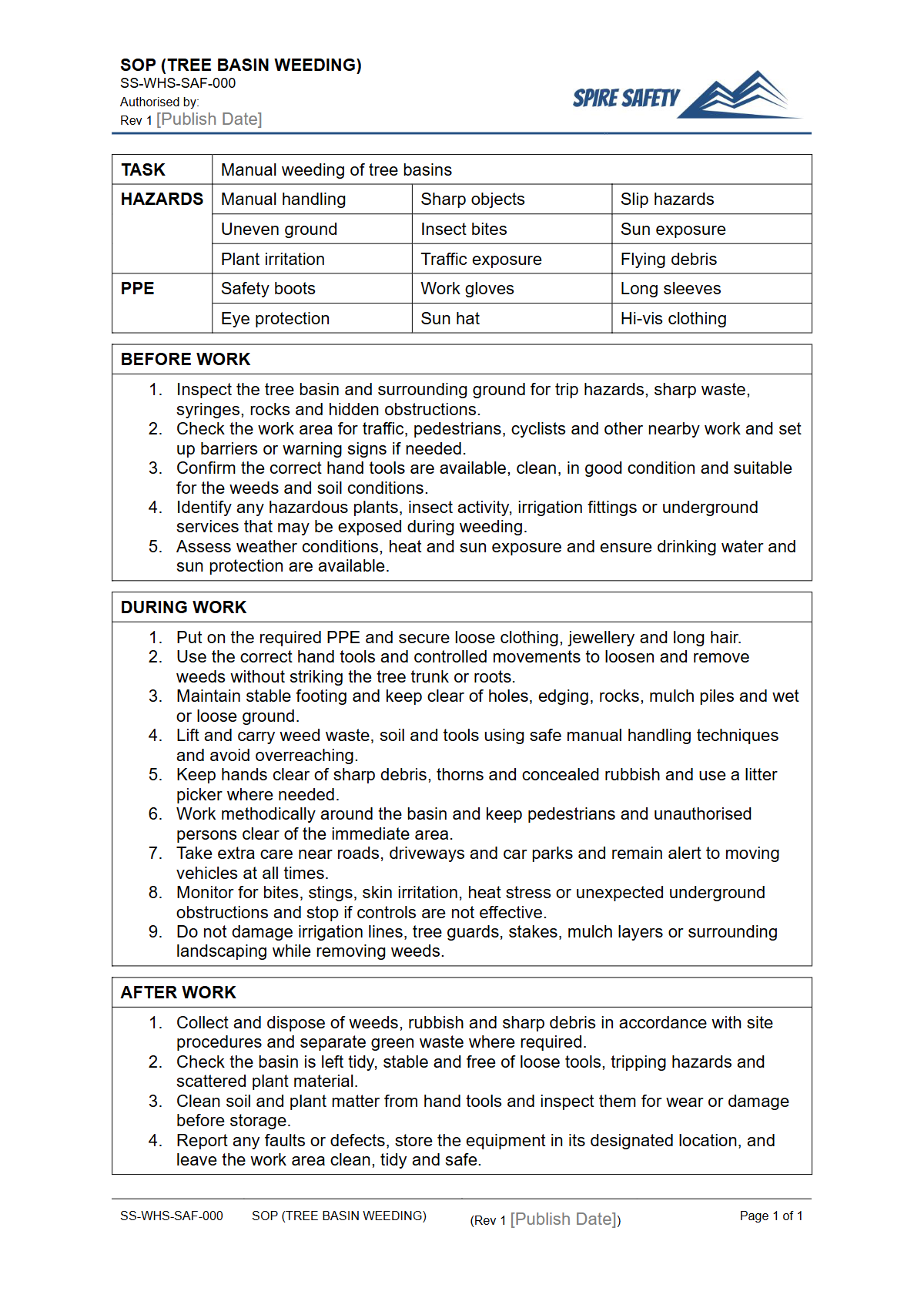
This free Safe Operating Procedure (Tree Basin Weeding) template provides a comprehensive framework for outlining the safety requirements for manual weeding of tree basins in landscaping, horticultural, and groundskeeping settings. The document is designed to help persons conducting a business or undertaking (PCBUs) manage risks and demonstrate a commitment to workplace health and safety.
It provides a structured format to detail the step-by-step process, identify potential hazards, and implement effective control measures.
Using this SOP helps standardise the task, ensuring all workers follow the same safe method. Hazards addressed include ergonomic risks from prolonged bending and kneeling, manual handling injuries from lifting bags of mulch or soil, and environmental hazards such as sun exposure, heat stress, and bites or stings from insects and other fauna. Documenting these procedures is a fundamental part of developing robust and effective WHS management systems.
What is covered in the template?
The template provides sections to detail required PPE, pre-operational checks of tools and the work area, a logical sequence for performing the task safely, and post-task cleanup and checks. It is formatted for easy adaptation, allowing you to incorporate site-specific rules, emergency procedures, and consultation records. While this SOP covers manual weeding, tasks involving significant earthmoving may require procedures for specific machinery, similar to our free Trencher SOP template.
Video walkthrough
How to use the Free Safe Operating Procedure (Tree Basin Weeding) Template
This template is available as both a DOCX file for easy editing in Microsoft Word and a PDF for straightforward printing and distribution. To get the most out of this resource, you should download the DOCX version and meticulously add details specific to your operational context.
This includes listing the exact hand tools used (e.g., specific models of hoes, cultivators, trowels), identifying unique hazards of your sites (e.g., local pest species, ground instability), and defining your organisation's emergency contacts.
Important: This document is a template, not a finished product. It is crucial to customise this SOP for the specific equipment, site conditions, and personnel at your workplace.
We have provided a solid foundation, but you must adapt it to reflect your unique operational risks and control measures. Regular review and updates are essential, and a formal WHS compliance audit can help verify the effectiveness of your implemented procedures.
When to use a Safe Operating Procedure for Tree Basin Weeding
An SOP for tree basin weeding should be used as a primary training and operational document for any worker required to perform this task. It is particularly important for inducting new employees or contractors to ensure they understand the recognised safe method of work from day one.
It also serves as an excellent tool for pre-start meetings or toolbox talks, allowing supervisors to quickly refresh workers on key hazards and controls before work commences.
This procedure should be readily accessible in the work area for reference. It becomes a critical document during incident investigations, helping to determine if established procedures were followed.
For businesses managing large grounds or multiple sites, having standardised SOPs for common tasks like weeding and fertilising ensures consistent safety standards are applied everywhere. For related horticultural tasks, you might also find a free Spreader SOP template useful for documenting safe fertiliser or seed application.
Who should use this SOP Template
This Safe Operating Procedure is intended for a range of personnel within an organisation to ensure a vertical integration of safety practices. Key users include:
- Workers and Groundskeepers: The primary audience. The SOP guides them on how to perform their tasks safely, minimising their risk of injury.
- Supervisors and Team Leaders: Use the SOP to train their teams, monitor work, and enforce safety standards on site. They are responsible for ensuring the procedure is understood and followed.
- WHS Managers and Advisors: Responsible for developing, implementing, and reviewing safety documentation as part of the overall safety management system. They will adapt this template to align it with organisational policies and legislative requirements. For complex safety challenges, organisations often benefit from expert WHS consulting to ensure best practice.
- Business Owners and Directors (PCBUs): Ultimately responsible for providing a safe workplace. This SOP serves as evidence of a system for managing risks associated with common operational tasks.
By ensuring everyone from the on-the-ground operator to senior management understands and utilises the SOP, a business can foster a stronger safety culture. You can find more templates like this one in our extensive library of free WHS resources to build out your safety document framework.
Common mistakes
Common mistakes to avoid
- Failing to properly inspect hand tools for damage (e.g., splintered handles, loose heads) before starting work.
- Adopting poor posture, such as bending from the waist for extended periods instead of kneeling or squatting.
- Neglecting to check the work area for hazards like spiders, snakes, sharp objects, or uneven ground before commencing.
- Not taking regular breaks to stretch and rehydrate, especially when working in hot or humid conditions.
Legal references
Legal considerations
The following legal requirements may be relevant to this type of work.
- Work Health and Safety Act (Harmonised) — Provides the primary duties for protecting workers and other people from work health and safety risks.
- Work Health and Safety Regulations (Harmonised) — Sets out requirements supporting the management of workplace hazards and risks.
The following codes may be relevant to this type of work.
- Managing WHS Risks Code of Practice — Provides practical guidance on identifying hazards, assessing risks and applying effective controls.
- Work Health and Safety Consultation, Cooperation and Coordination Code of Practice — Provides practical guidance on consulting workers and coordinating with other duty holders.
- Managing the Work Environment and Facilities Code of Practice — Provides practical guidance on safe work environments, workplace facilities and related controls.
Did you know
Ergonomic Risk
Sprains and strains are the most common type of workplace injury in Australia, with lifting, pushing, pulling, or bending being primary causes. Proper technique during manual tasks like weeding is crucial.
UV Exposure
Australia has one of the highest rates of skin cancer in the world. Outdoor workers like landscapers and groundskeepers are at a significantly higher risk, making sun-safe PPE and work practices non-negotiable.
FAQ
Frequently asked questions
01What are the main hazards involved in tree basin weeding?
02What Personal Protective Equipment (PPE) is essential for this task?
03How often should a Safe Operating Procedure for weeding be reviewed?
04Does this SOP cover the use of herbicides for weeding?
Share this resource
Free Safe Operating Procedure (Tree Basin Weeding) Template
Browse Categories
How To Use It
- 1Download and open in Word or PDF.
- 2Replace the placeholders with your business details.
- 3Get it reviewed by a WHS specialist before rollout.
Need it customised?
Our WHS consultants can adapt this template to your site, run a gap analysis, or audit what you already have in place.
Book a Free Consultation WHS consulting servicesor call 1300 156 382
Related templates
- Free Safe Operating Procedure (Tree Climbing) Template
- Free Safe Operating Procedure (Tree Guard Installation) Template
- Free Safe Operating Procedure (Tree Hand Pruning) Template
- Free Safe Operating Procedure (Tree Mulching) Template
- Free Safe Operating Procedure (Tree Pit Cleaning) Template
- Free Safe Operating Procedure (Tree Planting) Template