
Free Safe Operating Procedure (Tray Washing) Template
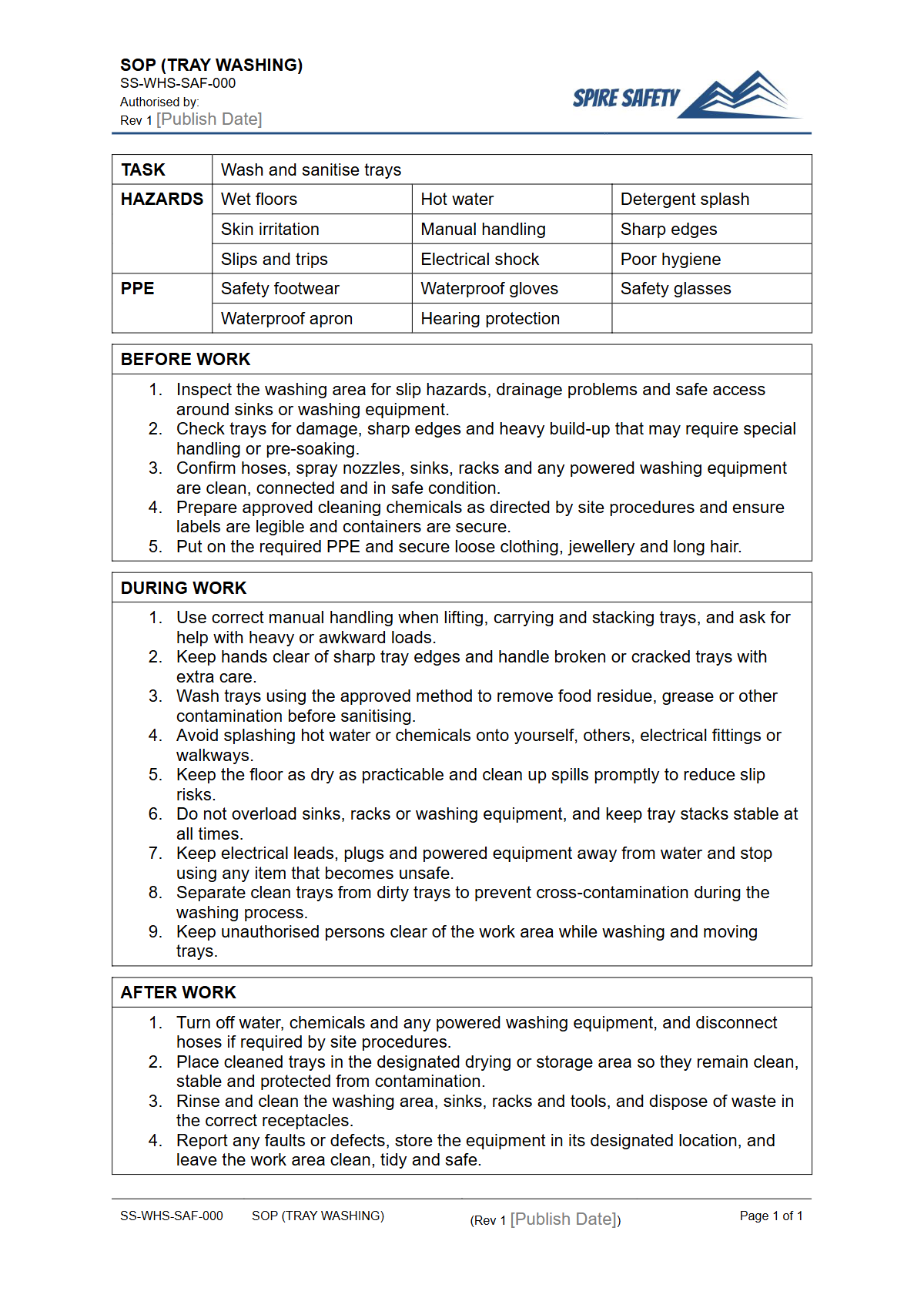
Formalise your kitchen and food service safety protocols with our free tray washing SOP. Download this customisable template to get started today.
Free Safe Operating Procedure (Tray Washing) Template
DOCX • 126 KB + PDF
Updated Oct 2026
No signup required
Purpose of the Free Safe Operating Procedure (Tray Washing) Template
Operating commercial tray washing equipment involves specific risks, including exposure to hot water and steam, hazardous chemicals, electrical hazards, and manual handling injuries. This Free Safe Operating Procedure (Tray Washing) Template provides a structured starting point for documenting the safe use of this equipment in your workplace.
By formalising your process, you can standardise operations, minimise the risk of injury, ensure consistent hygiene outcomes, and provide a clear, reliable tool for staff training and competency assessments.
A well-defined SOP is a fundamental component of a proactive safety culture. It demonstrates a commitment to worker safety and forms a critical part of your broader WHS management systems. Using this template helps ensure all workers, from new hires to experienced staff, follow the same approved steps every time, reducing variability and the potential for incidents.
Video walkthrough
How to use the Free Safe Operating Procedure (Tray Washing) Template
This document is a template and must be customised to reflect the specific equipment, chemicals, and processes used in your workplace. Download the DOCX file and adapt it to your unique operational environment.
Follow these steps for effective implementation:
- Consult with your team: Involve the workers who operate the tray washing equipment. Their firsthand experience is invaluable for identifying practical steps and unaddressed hazards.
- Conduct a risk assessment: Evaluate your specific tray washer model, the surrounding environment, and the cleaning agents used. Identify all potential hazards and establish effective control measures.
- Fill in the details: Populate the template with your site-specific information. This includes the make and model of the equipment, required Personal Protective Equipment (PPE) such as heat-resistant gloves and eye protection, pre-operational checks, step-by-step operating instructions, and post-operational cleaning and shutdown procedures.
- Review and approve: Have a competent person, such as a manager or WHS representative, review and approve the finalised SOP before it is put into use.
- Train all relevant staff: Use the completed SOP as a central document for training and inducting all operators. Ensure everyone understands the procedures and has demonstrated their ability to follow them safely. For an example of another kitchen-based procedure, you can reference our deep fryer SOP.
When to use it
A Safe Operating Procedure for tray washing is not a document to be filed away and forgotten. It should be a living document integrated into your daily operations.
It is essential for initial training when a new employee starts, for conducting refresher training to prevent complacency, and as a go-to reference for daily tasks. The SOP also serves as a critical piece of evidence during safety inspections or a WHS compliance auditing process, demonstrating that you have established safe systems of work.
Furthermore, it should be reviewed and updated whenever there is a change in equipment, chemicals, or processes, or following any incident or near miss. For facilities with large-scale automated washers, the principles in our conveyor system SOP may also provide valuable insights into managing associated risks like nip points and entanglement.
Who should use it
This SOP template is designed for use by Persons Conducting a Business or Undertaking (PCBUs), managers, supervisors, and WHS personnel across various industries where commercial tray washing is performed. This includes hospitality venues like hotels and restaurants, catering companies, food processing facilities, and healthcare settings such as hospitals and aged care homes.
It empowers supervisors to enforce safe work practices and provides operators with clear, unambiguous instructions to follow.
Implementing robust SOPs is a key responsibility for any organisation looking to meet its duty of care under Australian WHS legislation. For businesses that require more specialised guidance in developing their safety documentation, engaging external WHS consulting services can provide tailored support.
You can also explore our complete free WHS resources library for more templates and guides.
Common mistakes
Common mistakes to avoid
- Using a generic procedure without customising it for the specific machine and chemicals on site.
- Failing to adequately train all workers on the finalised SOP and confirm their understanding.
- Neglecting to specify the exact type of Personal Protective Equipment (PPE) required, such as thermal gloves or chemical-resistant goggles.
- Forgetting to include procedures for emergency shutdowns, clearing blockages, and first aid response to chemical or heat exposure.
Legal references
Legal considerations
The following legal requirements may be relevant to this type of work.
- Work Health and Safety Act (Harmonised) — Provides the primary duties for protecting workers and other people from work health and safety risks.
- Work Health and Safety Regulations (Harmonised) — Sets out requirements supporting the management of workplace hazards and risks.
The following codes may be relevant to this type of work.
- Managing WHS Risks Code of Practice — Provides practical guidance on identifying hazards, assessing risks and applying effective controls.
- Work Health and Safety Consultation, Cooperation and Coordination Code of Practice — Provides practical guidance on consulting workers and coordinating with other duty holders.
- Managing the Work Environment and Facilities Code of Practice — Provides practical guidance on safe work environments, workplace facilities and related controls.
Did you know
Slips, Trips, and Falls
Slips, trips, and falls are a leading cause of serious injury in the hospitality industry, often resulting from wet or greasy floors in kitchen environments.
Chemical Contact
Prolonged or repeated contact with commercial-grade detergents and sanitisers can cause occupational contact dermatitis, a painful skin condition that can prevent workers from performing their duties.
FAQ
Frequently asked questions
01What are the main hazards associated with commercial tray washing?
02Is a Safe Operating Procedure legally required for a tray washer in Australia?
03How often should our tray washing SOP be reviewed?
04Can this SOP template be used for a domestic dishwasher in a commercial setting?
Share this resource
Free Safe Operating Procedure (Tray Washing) Template
Browse Categories
How To Use It
- 1Download and open in Word or PDF.
- 2Replace the placeholders with your business details.
- 3Get it reviewed by a WHS specialist before rollout.
Need it customised?
Our WHS consultants can adapt this template to your site, run a gap analysis, or audit what you already have in place.
Book a Free Consultation WHS consulting servicesor call 1300 156 382
Related templates
- Free Safe Operating Procedure (Tree Basin Weeding) Template
- Free Safe Operating Procedure (Tree Climbing) Template
- Free Safe Operating Procedure (Tree Guard Installation) Template
- Free Safe Operating Procedure (Tree Hand Pruning) Template
- Free Safe Operating Procedure (Tree Mulching) Template
- Free Safe Operating Procedure (Tree Pit Cleaning) Template