
Free Safe Operating Procedure (Tray Clearing) Template
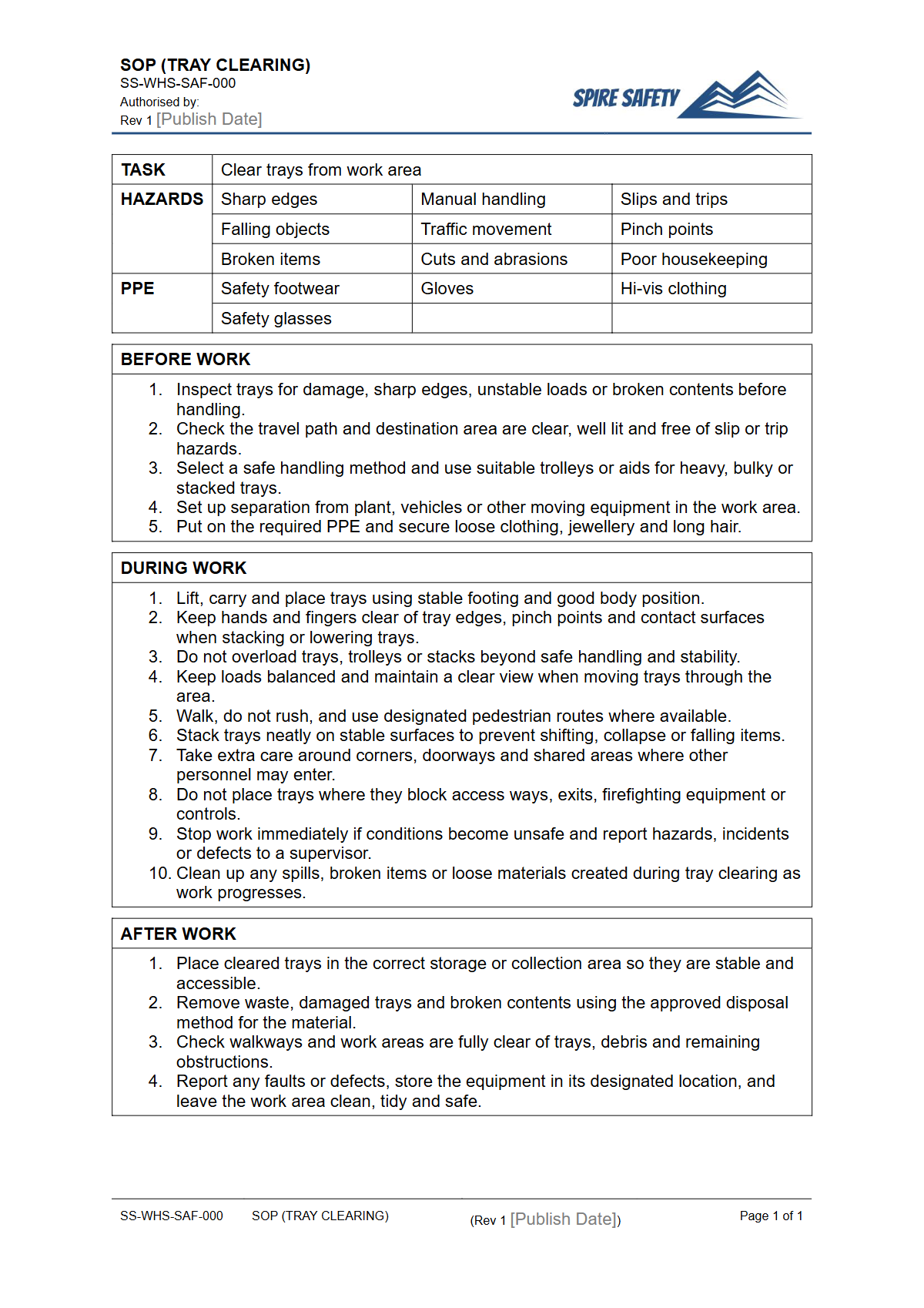
Download our free Safe Operating Procedure for tray clearing to help formalise your safety processes.
Free Safe Operating Procedure (Tray Clearing) Template
DOCX • 126 KB + PDF
Updated Oct 2026
No signup required
Purpose of the Free Safe Operating Procedure (Tray Clearing) Template
This Free Safe Operating Procedure (Tray Clearing) Template provides a structured framework for safely performing tray clearing tasks in hospitality, healthcare, and food service environments. The primary goal of an SOP is to minimise the risk of injury by outlining a consistent, safe method for a specific task.
Tray clearing, while seemingly simple, presents numerous hazards, including ergonomic strains from lifting and carrying, slips and falls from spills, cuts from broken glassware, and exposure to cleaning chemicals. By formalising the procedure, you establish clear expectations for safe work behaviour and provide a vital training tool for workers.
Implementing a documented SOP helps your organisation meet its duties under WHS legislation by systematically managing identified risks. It serves as evidence of a commitment to worker safety and forms a critical component of your overall safety management system.
In a busy kitchen or dining environment, having clear procedures for all tasks is essential, just as it is for operating equipment. For instance, a clear process for tray clearing is as important as having a specific Safe Operating Procedure for deep fryer use to prevent burns and fires.
Video walkthrough
How to use the Free Safe Operating Procedure (Tray Clearing) Template
Our template is designed for ease of use and customisation. Available as a DOCX file, it allows you to edit the content to reflect the specific circumstances of your workplace.
To use it effectively, download the document and conduct a thorough risk assessment of your tray clearing process. Identify the specific types of trays used, the layout of the dining and cleaning areas, the cleaning chemicals involved, and the waste disposal methods.
You must adapt this template to suit your unique operational needs. We've provided a comprehensive starting point, but it is not a finished document.
Add site-specific details, such as emergency contact numbers, diagrams of the workflow, and the exact names of cleaning products. Involve workers who perform the task in the customisation process to ensure the procedure is practical and reflects how the work is actually done.
This collaborative approach improves the quality of the SOP and increases worker buy-in.
Developing individual SOPs is a key activity within broader WHS management systems, ensuring that each part of your operation has clearly defined safety protocols.
When to use this Safe Operating Procedure
This SOP should be implemented in any environment where staff are required to clear trays from tables, service areas, or patient rooms. This includes restaurants, cafes, pubs, hotels, hospitals, aged care facilities, and large-scale cafeterias.
It is particularly important in high-volume settings where the repetitive nature of the task increases the risk of ergonomic injury and the likelihood of spills.
Use the finalised SOP as a primary document for inducting new employees and for refresher training for existing staff. It should be readily accessible to all relevant workers, either as a printed copy in the work area or digitally.
In large-scale operations that use automated dishwashing lines, you may also need to consult our Conveyer System SOP template to manage associated hazards.
Who should use this Safe Operating Procedure
This document is intended for several key roles within an organisation. WHS managers, venue managers, and supervisors should use it to establish, implement, and monitor safe work practices.
They are responsible for ensuring the SOP is customised correctly, that workers are trained in its contents, and that the prescribed controls are in place and effective.
Front-line workers, such as waitstaff, kitchen hands, and cleaning personnel, are the end-users of the SOP. They must understand and follow the procedure to protect themselves and others from harm.
For organisations seeking to verify that procedures are being followed correctly, engaging an external provider for WHS compliance auditing can provide valuable, independent insight.
Ultimately, this SOP is a tool for everyone in the workplace to contribute to a safer environment. If you require assistance in developing or implementing procedures like this one, our team of experts provides specialised WHS consulting to guide you through the process.
You can also explore hundreds of other documents in our free WHS resources library to support your safety objectives.
Common mistakes
Common mistakes to avoid
- Failing to customise the template for specific site conditions and hazards.
- Using incorrect manual handling techniques when lifting heavy or awkward trays.
- Not providing or using the specified Personal Protective Equipment (PPE), such as gloves or non-slip footwear.
- Forgetting to clean up spills immediately, creating a serious slip hazard for others.
Legal references
Legal considerations
The following legal requirements may be relevant to this type of work.
- Work Health and Safety Act (Harmonised) — Provides the primary duties for protecting workers and other people from work health and safety risks.
- Work Health and Safety Regulations (Harmonised) — Sets out requirements supporting the management of workplace hazards and risks.
The following codes may be relevant to this type of work.
- Managing WHS Risks Code of Practice — Provides practical guidance on identifying hazards, assessing risks and applying effective controls.
- Work Health and Safety Consultation, Cooperation and Coordination Code of Practice — Provides practical guidance on consulting workers and coordinating with other duty holders.
- Managing the Work Environment and Facilities Code of Practice — Provides practical guidance on safe work environments, workplace facilities and related controls.
Did you know
Ergonomic Risk
Musculoskeletal disorders from repetitive tasks like lifting and carrying trays are one of Australia's most common and costly types of work-related injuries, particularly in the hospitality sector.
Slips and Trips
According to Safe Work Australia, slips, trips, and falls are a leading cause of serious injury claims in the accommodation and food services industry, often due to wet or contaminated floors.
FAQ
Frequently asked questions
01What are the main hazards involved in tray clearing?
02Is this Safe Operating Procedure template ready to use immediately?
03Who is responsible for training workers on the tray clearing SOP?
04How often should an SOP for tray clearing be reviewed?
Share this resource
Free Safe Operating Procedure (Tray Clearing) Template
Browse Categories
How To Use It
- 1Download and open in Word or PDF.
- 2Replace the placeholders with your business details.
- 3Get it reviewed by a WHS specialist before rollout.
Need it customised?
Our WHS consultants can adapt this template to your site, run a gap analysis, or audit what you already have in place.
Book a Free Consultation WHS consulting servicesor call 1300 156 382
Related templates
- Free Safe Operating Procedure (Tray Return Handling) Template
- Free Safe Operating Procedure (Tray Sealer) Template
- Free Safe Operating Procedure (Tray Washing) Template
- Free Safe Operating Procedure (Tree Basin Weeding) Template
- Free Safe Operating Procedure (Tree Climbing) Template
- Free Safe Operating Procedure (Tree Guard Installation) Template