
Free Safe Operating Procedure (Tray Return Handling) Template
Formalise your processes for handling tray return systems with our structured Safe Operating Procedure. Download your free, customisable template today.
Free Safe Operating Procedure (Tray Return Handling) Template
DOCX • 126 KB + PDF
Updated Oct 2026
No signup required
Purpose of the Free Safe Operating Procedure (Tray Return Handling) Template
Tray return systems are common in food courts, large canteens, and hospitality venues. While they improve efficiency, they also introduce specific workplace hazards, including musculoskeletal injuries from awkward postures, entanglement in moving parts, and slips from spills.
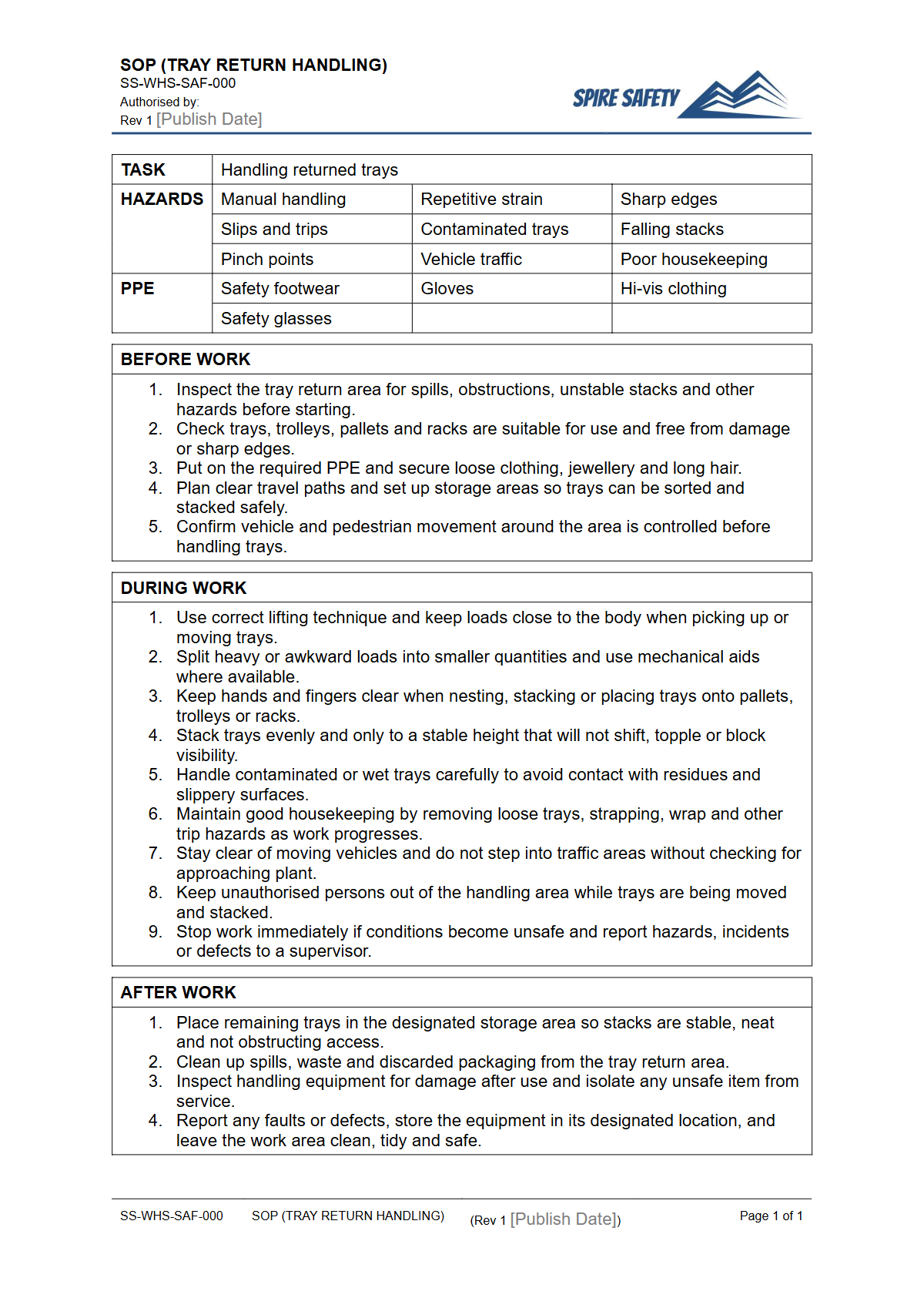
This Free Safe Operating Procedure (Tray Return Handling) Template provides a structured framework for documenting the safest way to operate, clean, and maintain this equipment.
The primary purpose of this Safe Operating Procedure is to help your organisation establish and standardise safe work practices, thereby minimising the risk of injury to workers. A well-developed SOP is a critical tool for demonstrating compliance with WHS duties and forms an essential part of your broader WHS management systems. It clearly outlines operator responsibilities, required personal protective equipment (PPE), and step-by-step instructions for all phases of use.
Video walkthrough
How to use the Free Safe Operating Procedure (Tray Return Handling) Template
This template is provided in both DOCX and PDF formats for your convenience. The DOCX file is fully editable, allowing you to tailor the content to the specific model of tray return system and the unique environment of your workplace.
It includes sections for site details, hazard identification, risk controls, operational steps, cleaning procedures, and emergency protocols.
To use the template effectively, you must conduct a site-specific risk assessment for your tray return equipment. Identify all potential hazards and document the control measures your organisation has implemented.
This information should then be used to populate the relevant sections of the SOP. In a food service environment, you may also manage other equipment risks, making documents like our Free Safe Operating Procedure for deep fryer operation a useful reference for maintaining consistency in your documentation.
Important: Customisation is Required
This document is a template only. It is not a complete Safe Operating Procedure.
You must customise this document to reflect the specific equipment, processes, and risks present in your workplace. We are not responsible for the outcomes if you fail to adapt this template to your own operational context.
Generic procedures are not sufficient to ensure safety or compliance.
When to use this Safe Operating Procedure
An SOP for tray return handling should be used as the primary reference document for all interactions with the equipment. It serves as a vital training tool during the induction of new staff and for refresher training for existing employees.
Workers should refer to it before operating the system, especially when performing non-routine tasks like clearing a jam or conducting deep cleaning.
Supervisors should use the SOP as a benchmark for observing work practices and ensuring procedures are being followed correctly. Many tray return units are a form of conveyor, so familiarising your team with our FREE Conveyer System SOP Template can provide broader context on the principles of safely working with automated transport systems.
It should also be reviewed and updated following any incident, near-miss, or when changes are made to the equipment or work environment.
Who should use it
This Safe Operating Procedure is intended for all personnel who interact with, work near, or supervise the use of tray return systems. This includes:
- Food Service Staff and Kitchen Hands: For guidance on daily operation, loading, and routine cleaning.
- Cleaning and Sanitation Crews: For instructions on safe deep cleaning, chemical handling, and lock-out tag-out (LOTO) procedures if applicable.
- Maintenance Personnel: As a reference for safe access, isolation, and testing procedures before and after maintenance work.
- Supervisors and Managers: To facilitate training, conduct competency assessments, and perform workplace inspections. Regular reviews of SOP adherence are a key part of any WHS compliance auditing program.
By ensuring all relevant workers are trained on and have access to the SOP, a Person Conducting a Business or Undertaking (PCBU) can better manage risks and promote a consistent safety culture. If you need other templates to build out your safety systems, our free WHS resources library has a wide range of documents available for download.
Common mistakes
Common mistakes to avoid
- Failing to customise the template with site-specific hazards and controls.
- Neglecting to train all relevant staff on the final procedure.
- Not including procedures for non-routine tasks like clearing jams or maintenance.
- Forgetting to schedule and document regular reviews of the SOP's effectiveness.
Legal references
Legal considerations
The following legal requirements may be relevant to this type of work.
- Work Health and Safety Act (Harmonised) — Provides the primary duties for protecting workers and other people from work health and safety risks.
- Work Health and Safety Regulations (Harmonised) — Sets out requirements supporting the management of workplace hazards and risks.
The following codes may be relevant to this type of work.
- Managing WHS Risks Code of Practice — Provides practical guidance on identifying hazards, assessing risks and applying effective controls.
- Work Health and Safety Consultation, Cooperation and Coordination Code of Practice — Provides practical guidance on consulting workers and coordinating with other duty holders.
- Managing the Work Environment and Facilities Code of Practice — Provides practical guidance on safe work environments, workplace facilities and related controls.
Did you know
Ergonomic Risk
Work-related musculoskeletal disorders are a leading cause of serious workers' compensation claims in Australia. Tasks involving repetitive or forceful movements, like those in hospitality, account for a significant portion of these injuries.
FAQ
Frequently asked questions
01What are the main hazards associated with tray return systems?
02How often should a Safe Operating Procedure for tray return handling be reviewed?
03Is training required after implementing an SOP for tray return handling?
04What should be included in an SOP for a tray return system?
Share this resource
Free Safe Operating Procedure (Tray Return Handling) Template
Browse Categories
How To Use It
- 1Download and open in Word or PDF.
- 2Replace the placeholders with your business details.
- 3Get it reviewed by a WHS specialist before rollout.
Need it customised?
Our WHS consultants can adapt this template to your site, run a gap analysis, or audit what you already have in place.
Book a Free Consultation WHS consulting servicesor call 1300 156 382
Related templates
- Free Safe Operating Procedure (Tray Sealer) Template
- Free Safe Operating Procedure (Tray Washing) Template
- Free Safe Operating Procedure (Tree Basin Weeding) Template
- Free Safe Operating Procedure (Tree Climbing) Template
- Free Safe Operating Procedure (Tree Guard Installation) Template
- Free Safe Operating Procedure (Tree Hand Pruning) Template