
Free Safe Operating Procedure (Transfer Belt Cleaning) Template
Get our free Safe Operating Procedure (Transfer Belt Cleaning) template. This document helps create clear instructions for cleaning transfer belts safely.
Free Safe Operating Procedure (Transfer Belt Cleaning) Template
DOCX • 126 KB + PDF
Updated Oct 2026
No signup required
Purpose of the Free Safe Operating Procedure (Transfer Belt Cleaning) Template
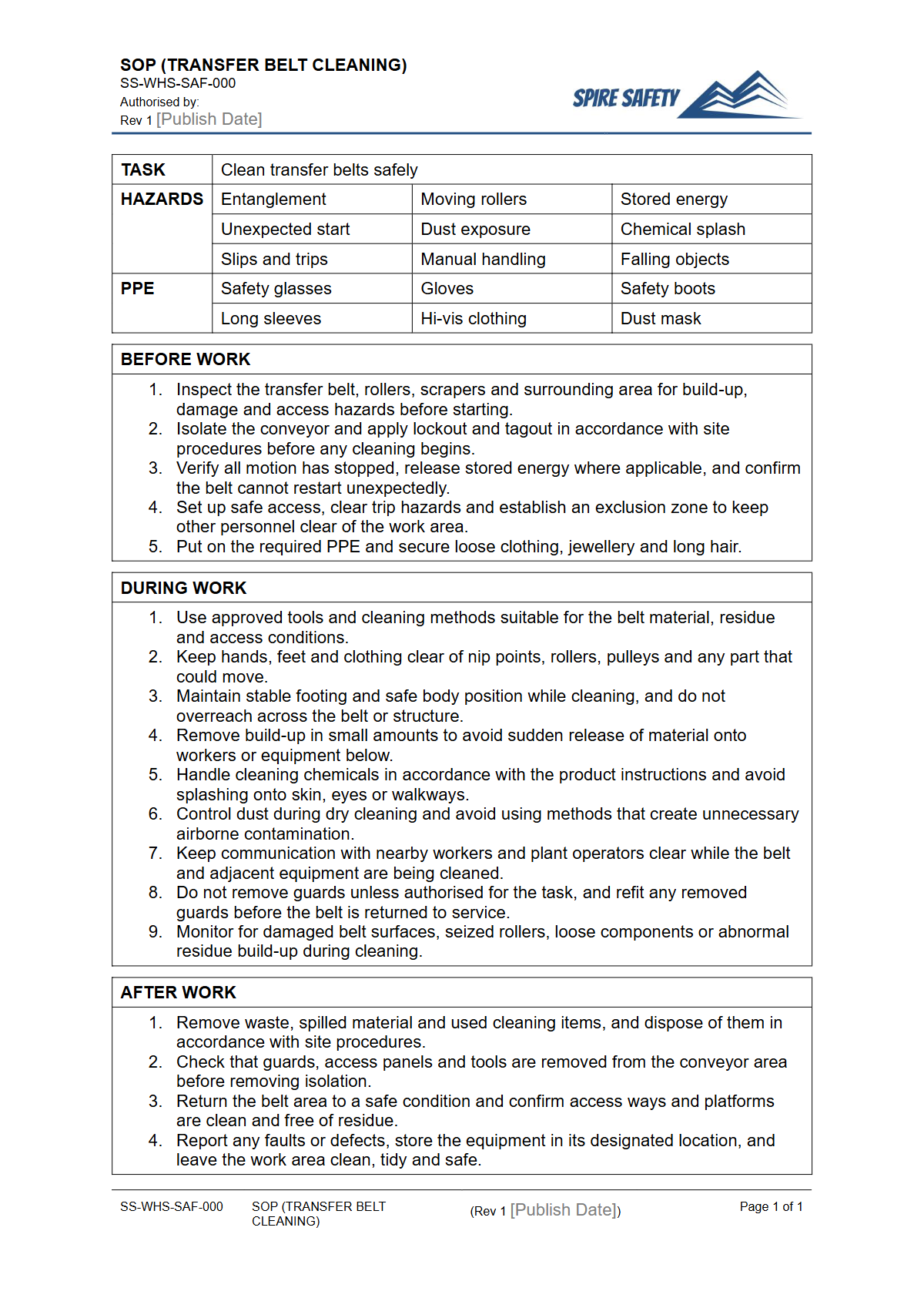
This Free Safe Operating Procedure (Transfer Belt Cleaning) Template provides a structured starting point for documenting the safety steps required to clean transfer belts. Transfer belts, a common component in larger material handling systems, pose significant risks if not managed correctly.
Cleaning tasks can expose workers to hazards like entanglement in moving parts, chemical burns from cleaning agents, electrical shocks, and slips, trips, and falls. The primary purpose of this SOP is to help your organisation establish and communicate a clear, step-by-step process that minimises these risks.
It guides you in outlining pre-operational checks, the specific cleaning sequence, and post-cleaning procedures to ensure the task is completed safely and efficiently every time.
By implementing a formalised procedure, you create a consistent standard for all workers to follow. This is a fundamental aspect of managing workplace safety, particularly for high-risk maintenance tasks.
While this template covers general transfer belt cleaning, it serves as a valuable document within a broader safety framework for machinery operation. For a comprehensive look at the overall system, you may also find our FREE Conveyer System SOP Template useful.
Video walkthrough
How to use the Free Safe Operating Procedure (Transfer Belt Cleaning) Template
This document is provided in DOCX format for easy customisation. It is not a complete, out-of-the-box solution but a framework designed to be adapted to your specific operational context.
To use it effectively, you must identify the specific model of transfer belt, the types of materials it conveys, the approved cleaning chemicals, and the energy isolation (Lockout-Tagout) points unique to your equipment. A competent person with thorough knowledge of the machinery and relevant WHS principles should lead this customisation process.
Once adapted, the SOP becomes a critical control measure within your overall safety program.
Important: This is a template and must be customised to your specific workplace. We are not WHS consultants and cannot guarantee that this document will be suitable for your site-specific risks.
It is your responsibility to ensure the final document is accurate, comprehensive, and reflects the actual hazards and control measures in your work environment. Developing robust procedures is a key part of building effective WHS management systems that protect your workers and ensure operational resilience.
Key Customisation Steps:
- Plant & Equipment Details: List the exact make, model, and identification number of the transfer belt system.
- Hazard Identification: Conduct a risk assessment for the cleaning task in your environment. Identify all potential hazards, including mechanical (entanglement, crushing), electrical, chemical, and ergonomic risks.
- Personal Protective Equipment (PPE): Specify the mandatory PPE required for the task, such as chemical-resistant gloves, safety glasses or goggles, protective clothing, and non-slip footwear.
- Energy Isolation: Detail the precise Lockout-Tagout (LOTO) procedure, including the location of all isolation points for electrical, hydraulic, pneumatic, and gravitational energy sources.
- Step-by-Step Procedure: Write clear, simple, and sequential instructions for the entire cleaning process, from preparation to completion and handover. Include steps for using specific tools safely, such as high-pressure hoses or air wands. For guidance on related equipment, our Free Air Compressor SOP Template may be helpful.
- Emergency Procedures: Outline the response required in case of an emergency, such as chemical spills, injury, or equipment malfunction.
When to use it
A Safe Operating Procedure for transfer belt cleaning should be used consistently before and during every cleaning task. It is not a document to be filed away; it is an active tool for ensuring safety.
It should be a core part of worker training, ensuring everyone understands the approved method for performing the job. The SOP should also be readily available at the work location for easy reference.
Furthermore, it should be a key document reviewed during safety meetings, incident investigations, and periodic safety audits. Regular reviews as part of your WHS compliance auditing schedule ensure the procedure remains current and effective.
Who should use it
This SOP is intended for several groups within an organisation. Primarily, workers and maintenance personnel tasked with cleaning transfer belts must use it to guide their work.
Supervisors and managers are responsible for ensuring the procedure is followed correctly, that workers are adequately trained, and that all required resources (like PPE and LOTO equipment) are available. WHS officers and committees can use the SOP as a benchmark for risk assessments, training development, and workplace inspections.
If the cleaning process involves manual scraping of stubborn residue, you may also need procedures for specific tools; our FREE Scraper SOP Template can provide a useful starting point for that task. For organisations needing expert assistance in developing and implementing such procedures, engaging professional WHS consulting services can provide tailored support.
Common mistakes
Common mistakes to avoid
- Failing to perform a full Lockout-Tagout (LOTO) procedure to isolate all energy sources.
- Attempting to clean the belt while it is still moving, even at a very slow speed.
- Using incorrect or incompatible cleaning chemicals that can damage the belt or create hazardous fumes.
- Not wearing the correct, task-specific Personal Protective Equipment (PPE), especially chemical-resistant gloves and eye protection.
Legal references
Legal considerations
The following legal requirements may be relevant to this type of work.
- Work Health and Safety Act (Harmonised) — Provides the primary duties for protecting workers and other people from work health and safety risks.
- Work Health and Safety Regulations (Harmonised) — Sets out requirements supporting the management of workplace hazards and risks.
The following codes may be relevant to this type of work.
- Managing WHS Risks Code of Practice — Provides practical guidance on identifying hazards, assessing risks and applying effective controls.
- Work Health and Safety Consultation, Cooperation and Coordination Code of Practice — Provides practical guidance on consulting workers and coordinating with other duty holders.
- Managing the Work Environment and Facilities Code of Practice — Provides practical guidance on safe work environments, workplace facilities and related controls.
Did you know
Stored Energy Risks
Even after a conveyor is switched off, it can retain stored energy—mechanical, electrical, or hydraulic—that can cause unexpected movement. A robust Lockout-Tagout procedure is critical to control these unseen hazards.
Conveyor Speeds
Some industrial conveyor belts can move faster than 10 metres per second. At these speeds, entanglement can cause a severe or fatal injury almost instantaneously if a worker makes contact while the belt is in motion.
FAQ
Frequently asked questions
01What are the main hazards when cleaning a transfer belt?
02Is a Safe Operating Procedure a legal requirement for transfer belt cleaning in Australia?
03How often should a transfer belt cleaning SOP be reviewed?
04Can I use this template for any type of conveyor system?
Share this resource
Free Safe Operating Procedure (Transfer Belt Cleaning) Template
Browse Categories
How To Use It
- 1Download and open in Word or PDF.
- 2Replace the placeholders with your business details.
- 3Get it reviewed by a WHS specialist before rollout.
Need it customised?
Our WHS consultants can adapt this template to your site, run a gap analysis, or audit what you already have in place.
Book a Free Consultation WHS consulting servicesor call 1300 156 382
Related templates
- Free Safe Operating Procedure (Transfer Board Cleaning) Template
- Free Safe Operating Procedure (Transfer Sling Storage) Template
- Free Safe Operating Procedure (Transfer Station Clean) Template
- Free Safe Operating Procedure (Transformer Oil Sample) Template
- Free Safe Operating Procedure (Transmission Jack) Template
- Free Safe Operating Procedure (Transmission Oil Change) Template