
Free Safe Operating Procedure (Transfer Board Cleaning) Template
Establish a clear and safe process for cleaning transfer boards in healthcare or aged care settings. Download our free, customisable template today.
Free Safe Operating Procedure (Transfer Board Cleaning) Template
DOCX • 126 KB + PDF
Updated Oct 2026
No signup required
Purpose of the Free Safe Operating Procedure (Transfer Board Cleaning) Template
Transfer boards, also known as slide boards, are essential patient handling aids in healthcare, aged care, and disability support settings. However, if not cleaned correctly, they can become a source of cross-contamination and pose a risk to both patients and staff.
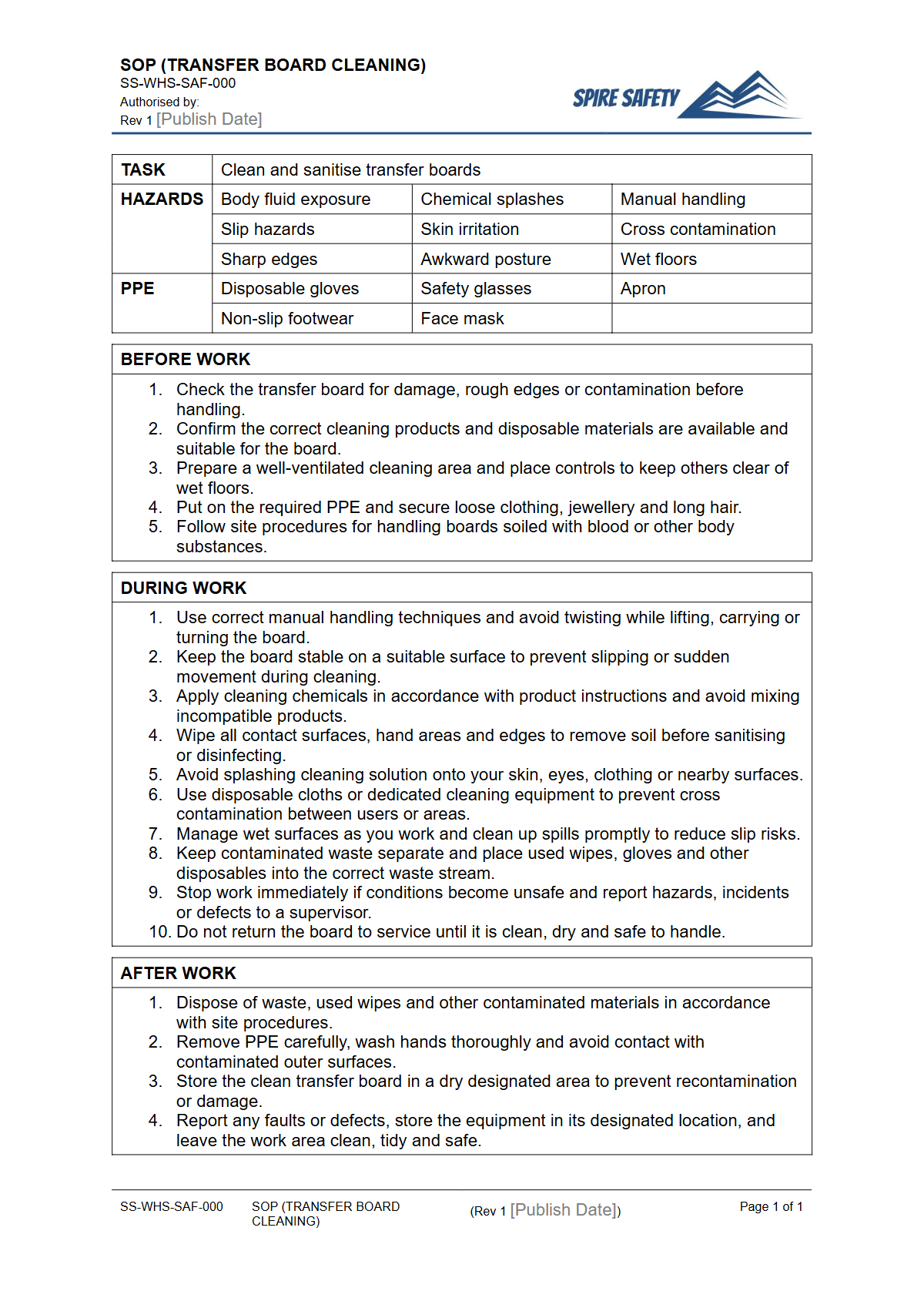
This Free Safe Operating Procedure (Transfer Board Cleaning) Template provides a structured framework for documenting a safe, consistent, and effective cleaning process.
A documented SOP ensures that every worker follows the same steps, using the correct cleaning agents and personal protective equipment (PPE). It serves as a vital training tool for new employees and a reference for existing staff, minimising the risk of healthcare-associated infections (HAIs) and chemical handling injuries.
Formalising this procedure helps your organisation meet its primary duty of care under Australian WHS laws by managing risks associated with hygiene and hazardous chemicals.
Key Elements in this Safe Operating Procedure
This template guides you to document the critical components of a safe work process, including:
- Required PPE (e.g., gloves, eye protection).
- Approved cleaning and disinfectant chemicals.
- A clear, sequential step-by-step cleaning and drying process.
- Pre- and post-cleaning inspection criteria to check for damage.
- Safe disposal of used materials like wipes and cloths.
- Emergency procedures for chemical spills or exposure.
Video walkthrough
How to use the Free Safe Operating Procedure (Transfer Board Cleaning) Template
This SOP template is available as a DOCX file for easy editing and a PDF for straightforward printing and distribution. To use it effectively, download the DOCX version and thoroughly adapt it to your specific operational context.
This involves identifying the particular transfer boards, cleaning agents, and PPE used at your facility.
Important: It's crucial that you customise this template. We provide a structured starting point aligned with Australian WHS principles, but you must adapt it to reflect the specific chemicals, equipment, and procedures used in your workplace.
An SOP is only effective when it is a true reflection of your work practices. This document should form one part of your broader WHS management systems, which integrate all your safety policies and procedures.
When to use this Safe Operating Procedure
The procedure outlined in your customised SOP should be followed diligently to maintain hygiene standards and equipment integrity. The primary trigger for cleaning is after every single patient use to prevent cross-contamination. Beyond this, the SOP should be referenced:
- As part of a scheduled cleaning routine for equipment that is used infrequently.
- Before the transfer board is returned to storage.
- During the induction and training of new staff members responsible for patient handling or cleaning.
- As a refresher training tool for all relevant personnel.
Documenting routine cleaning tasks is a fundamental safety practice applicable across all industries, not just healthcare. For instance, similar principles apply when creating an SOP for deep fryer cleaning in a commercial kitchen to prevent fire and hygiene risks.
Who should use this Safe Operating Procedure
This SOP is intended for all personnel who may be required to clean, handle, or inspect transfer boards. This typically includes a range of roles within a healthcare or support environment:
- Nurses and nursing assistants.
- Patient care assistants (PCAs).
- Aged care workers.
- Disability support workers.
- Therapists (e.g., physiotherapists, occupational therapists).
- Dedicated cleaning and sterilisation staff.
Furthermore, WHS managers, team leaders, and supervisors should use this document to enforce standards, conduct training, and verify competency. The effectiveness of your SOPs can be a key point of focus during internal or external safety reviews, such as WHS compliance auditing, to ensure documented procedures are being followed correctly.
Developing SOPs for every hazardous task or piece of powered equipment is a cornerstone of a safe workplace. While this document focuses on a manual cleaning task, the same structured approach is necessary for mechanical equipment, as shown in our Air Compressor SOP, which details risks like high-pressure air and noise.
If you require assistance in developing a suite of SOPs tailored to your unique operational risks, our WHS consulting services can provide expert guidance.
Common mistakes
Common mistakes to avoid
- Using abrasive cloths or harsh chemicals (e.g., bleach) that damage the board's low-friction surface.
- Failing to allow the board to air dry completely before storage, which can promote microbial growth.
- Neglecting to inspect the board for cracks, chips, or deep scratches during the cleaning process.
- Storing clean boards in a way that allows them to become re-contaminated before their next use.
Legal references
Legal considerations
The following legal requirements may be relevant to this type of work.
- Work Health and Safety Act (Harmonised) — Provides the primary duties for protecting workers and other people from work health and safety risks.
- Work Health and Safety Regulations (Harmonised) — Sets out requirements supporting the management of workplace hazards and risks.
The following codes may be relevant to this type of work.
- Managing WHS Risks Code of Practice — Provides practical guidance on identifying hazards, assessing risks and applying effective controls.
- Work Health and Safety Consultation, Cooperation and Coordination Code of Practice — Provides practical guidance on consulting workers and coordinating with other duty holders.
- Managing the Work Environment and Facilities Code of Practice — Provides practical guidance on safe work environments, workplace facilities and related controls.
Did you know
Cross-Contamination Hotspot
Patient transfer equipment is a recognised high-touch surface in healthcare settings. Studies have shown that items like transfer boards can easily become contaminated with multi-drug resistant organisms (MDROs) if cleaning protocols are inconsistent or incorrect.
FAQ
Frequently asked questions
01What kind of cleaning agents are suitable for transfer boards?
02How often should a transfer board be inspected for damage?
03Is a Safe Operating Procedure legally required for cleaning tasks?
04Can this transfer board cleaning template be adapted for other equipment?
Share this resource
Free Safe Operating Procedure (Transfer Board Cleaning) Template
Browse Categories
How To Use It
- 1Download and open in Word or PDF.
- 2Replace the placeholders with your business details.
- 3Get it reviewed by a WHS specialist before rollout.
Need it customised?
Our WHS consultants can adapt this template to your site, run a gap analysis, or audit what you already have in place.
Book a Free Consultation WHS consulting servicesor call 1300 156 382
Related templates
- Free Safe Operating Procedure (Transfer Sling Storage) Template
- Free Safe Operating Procedure (Transfer Station Clean) Template
- Free Safe Operating Procedure (Transformer Oil Sample) Template
- Free Safe Operating Procedure (Transmission Jack) Template
- Free Safe Operating Procedure (Transmission Oil Change) Template
- Free Safe Operating Procedure (Transport Yard Cleanup) Template