
Free Safe Operating Procedure (Train Seat Cleaning) Template
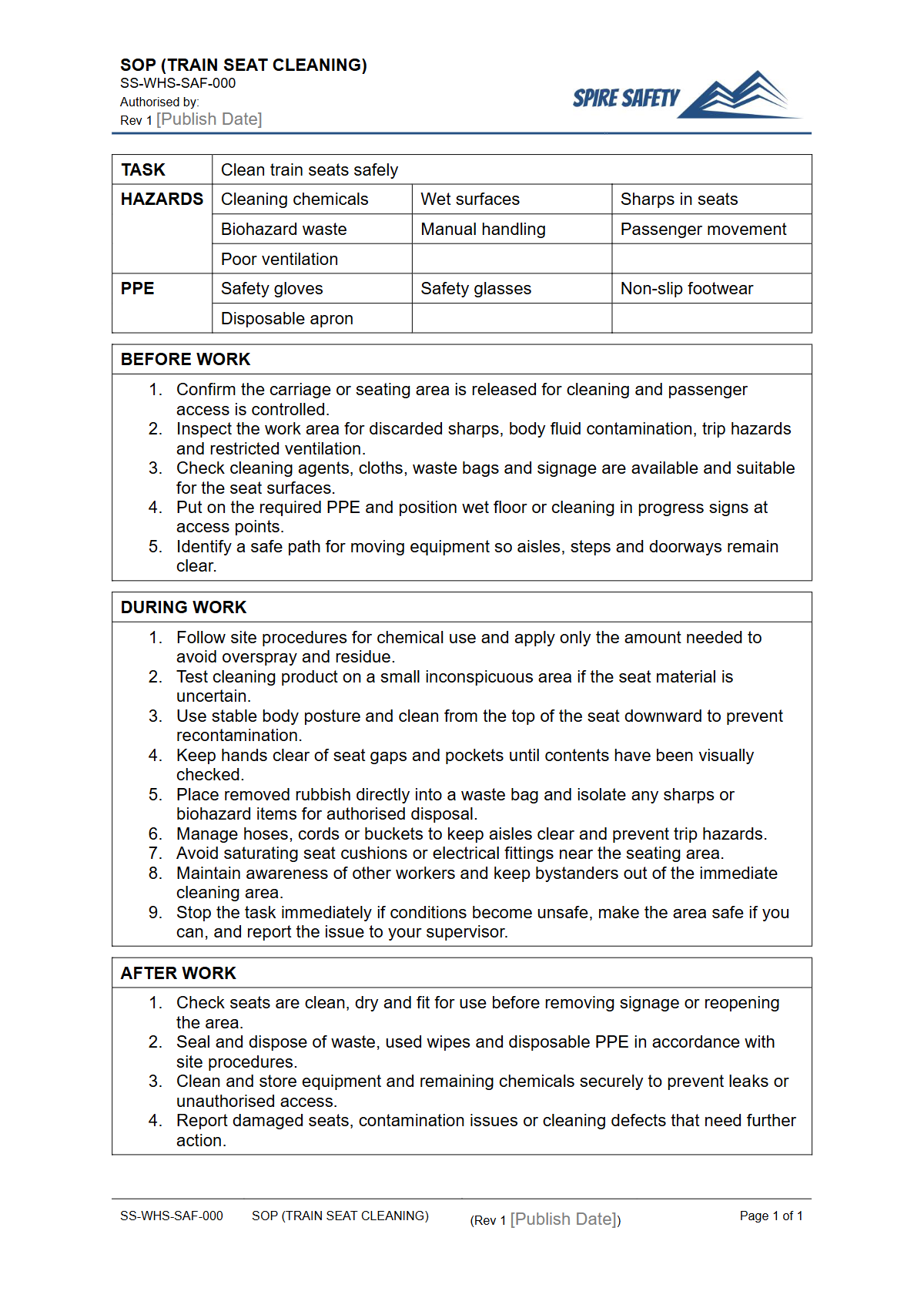
Formalise your train seat cleaning process with our structured Safe Operating Procedure. Download this free, customisable template to get started today.
Free Safe Operating Procedure (Train Seat Cleaning) Template
DOCX • 126 KB + PDF
Updated Oct 2026
No signup required
Purpose of the Free Safe Operating Procedure (Train Seat Cleaning) Template
Cleaning train seats involves specific risks, including exposure to hazardous chemicals, biological contaminants, and musculoskeletal strain from manual tasks. A formalised process is essential for protecting your workers and ensuring consistent hygiene standards.
This Free Safe Operating Procedure (Train Seat Cleaning) Template provides a structured starting point for documenting a safe system of work. It helps your organisation meet its duty of care by outlining step-by-step instructions for pre-operational checks, task execution, and post-cleaning procedures.
Using a clear SOP reduces the likelihood of incidents, promotes a positive safety culture, and provides a valuable tool for staff training and competency assessment.
The document is designed to guide supervisors and workers through the process safely, covering critical aspects like Personal Protective Equipment (PPE) selection, handling cleaning agents, waste disposal, and emergency responses. It acts as a key component within your broader WHS management systems, integrating operational tasks with overarching safety policies.
Video walkthrough
How to use the Free Safe Operating Procedure (Train Seat Cleaning) Template
This resource is available as a DOCX file, which is fully editable in Microsoft Word or other compatible software, and a PDF for easy viewing and printing. To get the most value, you should download the DOCX version and adapt it to the specific context of your workplace.
Important: We have provided a comprehensive framework, but you must customise this template to reflect your unique equipment, cleaning chemicals, work environment, and internal policies. A generic document is not sufficient.
Conduct a site-specific risk assessment to identify all relevant hazards and incorporate your specific control measures into the SOP. Involve your cleaning staff in the customisation process to ensure the procedure is practical and reflects how the work is actually done.
Once tailored, the SOP should be formally approved by management, communicated to all relevant personnel, and made easily accessible in the work area. Regular reviews and updates are crucial to keep it relevant, especially if new equipment, chemicals, or procedures are introduced. The effectiveness of your documented procedures can be verified through routine WHS compliance auditing.
When to use it
A Safe Operating Procedure for train seat cleaning should be a central part of your daily operations. It should be used as:
- A training tool: For inducting new cleaning staff and for periodic refresher training to ensure competency.
- A pre-start checklist: For workers to consult before beginning a cleaning shift to ensure they have the correct PPE and equipment.
- An on-the-job reference: A guide for workers to follow during the task, reinforcing the correct and safe sequence of actions.
- An incident investigation resource: To help determine if procedural deviations contributed to a near miss or injury.
- A standard for supervisors: To assist managers in monitoring work practices and conducting safety observations.
Integrating this SOP into your daily workflow helps standardise safety behaviour and reinforces that health and safety are integral to operational efficiency.
Who should use it
This SOP is intended for several key roles within a rail or public transport organisation:
- Cleaning Operatives and Transit Workers: The primary users who will follow the step-by-step instructions to perform their tasks safely.
- Work Health and Safety (WHS) Managers: Professionals who are responsible for developing, implementing, and reviewing safety documentation as part of the overall safety management system.
- Supervisors and Team Leaders: Individuals who oversee cleaning crews and are responsible for ensuring procedures are followed, providing training, and monitoring compliance.
- Maintenance Staff: Workers in maintenance depots may use a variety of equipment for cleaning and repairs. If their duties involve using specific machinery, you might also need our Free Air Compressor SOP to supplement your documentation.
A well-drafted SOP ensures everyone, from frontline staff to management, has a clear and consistent understanding of how to manage the risks associated with the task. For advice on integrating SOPs across your entire organisation, consider engaging expert WHS consulting services.
Documenting procedures is vital across all areas of a transport hub, not just cleaning. For example, staff working near baggage handling areas would benefit from our FREE Conveyer System SOP. You can find many more specific templates in our complete free WHS resources library to build a comprehensive safety documentation portfolio.
Common mistakes
Common mistakes to avoid
- Using a generic template without customising it for the specific cleaning agents and equipment in use.
- Failing to make Safety Data Sheets (SDS) for all chemicals readily available to workers.
- Neglecting to provide practical training on the SOP, including proper PPE use and emergency procedures.
- Not involving the cleaning crew in the development or review of the procedure, leading to impractical steps.
Legal references
Legal considerations
The following legal requirements may be relevant to this type of work.
- Work Health and Safety Act (Harmonised) — Provides the primary duties for protecting workers and other people from work health and safety risks.
- Work Health and Safety Regulations (Harmonised) — Sets out requirements supporting the management of workplace hazards and risks.
The following codes may be relevant to this type of work.
- Managing WHS Risks Code of Practice — Provides practical guidance on identifying hazards, assessing risks and applying effective controls.
- Work Health and Safety Consultation, Cooperation and Coordination Code of Practice — Provides practical guidance on consulting workers and coordinating with other duty holders.
- Managing the Work Environment and Facilities Code of Practice — Provides practical guidance on safe work environments, workplace facilities and related controls.
Did you know
A Key WHS Statistic
According to Safe Work Australia, injuries resulting from manual handling are one of the most common causes of workers' compensation claims, making ergonomic considerations in cleaning tasks critically important.
The Importance of Customisation
Using a generic safety document without tailoring it to your specific site, chemicals, and equipment can create a false sense of security and may not be considered a valid safe system of work.
FAQ
Frequently asked questions
01What key hazards should be covered in a train seat cleaning SOP?
02Is a Safe Operating Procedure legally required for cleaning tasks in Australia?
03How often should an SOP for train seat cleaning be reviewed?
04What training is necessary for workers cleaning train seats?
Share this resource
Free Safe Operating Procedure (Train Seat Cleaning) Template
Browse Categories
How To Use It
- 1Download and open in Word or PDF.
- 2Replace the placeholders with your business details.
- 3Get it reviewed by a WHS specialist before rollout.
Need it customised?
Our WHS consultants can adapt this template to your site, run a gap analysis, or audit what you already have in place.
Book a Free Consultation WHS consulting servicesor call 1300 156 382
Related templates
- Free Safe Operating Procedure (Train Toilet Cleaning) Template
- Free Safe Operating Procedure (Transfer Belt Cleaning) Template
- Free Safe Operating Procedure (Transfer Board Cleaning) Template
- Free Safe Operating Procedure (Transfer Sling Storage) Template
- Free Safe Operating Procedure (Transfer Station Clean) Template
- Free Safe Operating Procedure (Transformer Oil Sample) Template