
Free Safe Operating Procedure (Trailer Seal Check) Template
Formalise your logistics safety with our free Safe Operating Procedure for trailer seal checks. Download the customisable DOCX and PDF template today.
Free Safe Operating Procedure (Trailer Seal Check) Template
DOCX • 126 KB + PDF
Updated Oct 2026
No signup required
Purpose of the Free Safe Operating Procedure (Trailer Seal Check) Template
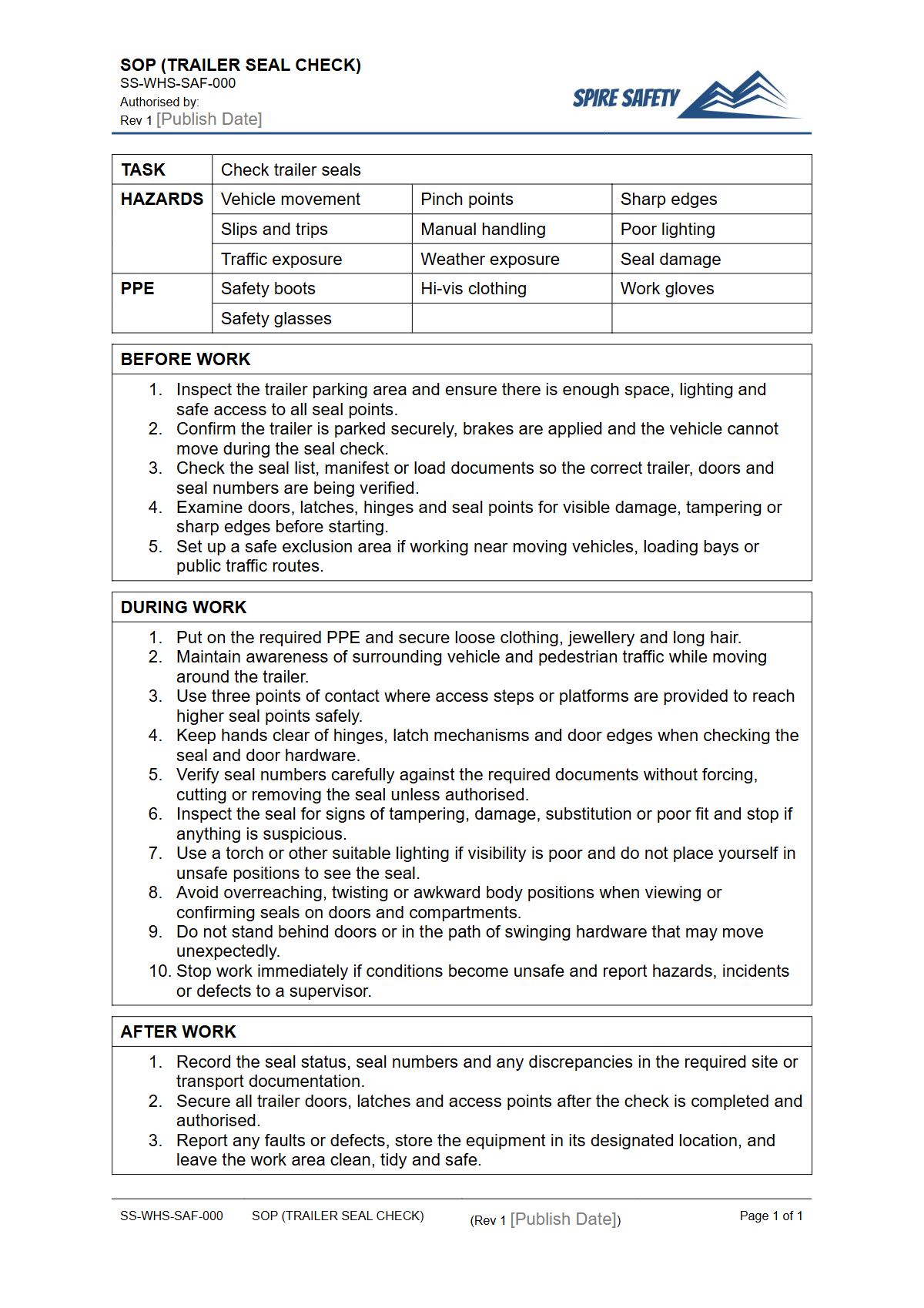
Ensuring the security and integrity of cargo is a critical task in any transport or logistics operation. Our Free Safe Operating Procedure (Trailer Seal Check) Template provides a structured framework for formalising the process of inspecting and verifying trailer seals.
This Safe Operating Procedure helps your organisation establish a consistent, safe, and verifiable method for checking that cargo has not been tampered with during transit. Implementing a clear SOP for this task is vital not only for security but also for meeting Chain of Responsibility (CoR) obligations under the Heavy Vehicle National Law (HVNL).
It demonstrates that proactive steps are being taken to maintain load integrity, prevent unauthorised access, and ensure the safety of goods from dispatch to delivery.
This procedure is a key component of a broader safety framework, often documented within comprehensive WHS management systems to ensure consistency and compliance across all operations.
Video walkthrough
How to use the Free Safe Operating Procedure (Trailer Seal Check) Template
This downloadable template is provided in both DOCX and PDF formats for your convenience. It is designed as a foundational document that you can adapt to the specific context of your workplace.
To use it effectively, download the file and systematically work through each section, adding or removing details to align with your equipment, seal types (e.g., bolt, cable, plastic), and unique operational risks. Engage with your drivers, warehouse staff, and WHS representatives to ensure the final procedure is practical, easy to understand, and reflects the realities of the job.
Note: This document is a template and must be customised to suit the specific requirements of your workplace. We recommend consulting with operators and other relevant personnel during the customisation process to ensure the procedure is robust and effective.
What this Safe Operating Procedure covers:
- Required Personal Protective Equipment (PPE)
- A step-by-step guide for inspecting and documenting seal condition and number
- Pre-operational checks of the trailer and sealing mechanism
- Actions to take if a seal is found to be missing, damaged, or showing signs of tampering
- A section for sign-offs to confirm operator training and competency
Regular reviews of your safety procedures are crucial. A formal WHS compliance auditing process can help identify gaps and areas for improvement in your trailer seal check process.
When to Use This Safe Operating Procedure
A trailer seal check should be performed at several key points in the supply chain to maintain a secure chain of custody. This SOP should be implemented:
- Before Departure: The driver or dispatcher should verify the seal is correctly applied and its number matches the shipping documents before the vehicle leaves the point of origin.
- At Checkpoints or Handover: If the trailer is handed over to another driver or enters a secure depot, a seal check should be conducted to verify its integrity.
- Upon Arrival: Before the seal is broken at the final destination, the receiver must inspect it to confirm it is intact and the number matches the manifest. Any discrepancy must be addressed before unloading begins.
Who Should Use This Safe Operating Procedure
This SOP is intended for all personnel involved in the handling and transportation of sealed cargo. Specific roles that should be trained in and adhere to this procedure include:
- Truck Drivers: They are often the first and last line of defence, responsible for checks at the start and end of their journey.
- Warehouse and Dispatch Staff: Personnel who apply the seals and prepare the documentation must follow the procedure to ensure a secure start.
- Receiving Staff: Those who accept deliveries must be competent in verifying seal integrity before accepting the goods.
- Security Personnel: At facilities with dedicated security, guards may be responsible for performing or overseeing seal checks at gates.
While this SOP covers seal checks, other warehouse activities require their own specific procedures, such as our conveyer system SOP for managing risks associated with automated transport.
If you require expert assistance in adapting this template or developing other critical safety documents, our WHS consulting services can provide tailored support for your business.
By standardising your trailer seal check process, you not only enhance security but also strengthen your overall WHS culture. Explore our entire collection of templates and guides in our free WHS resources library to continue building a robust safety program.
Common mistakes
Common mistakes to avoid
- Failing to record the seal number correctly on all documentation.
- Only performing a visual check without physically testing the seal's integrity.
- Not having a clear escalation procedure for when a compromised seal is discovered.
- Using the SOP for training once but not for regular reinforcement or as a reference tool.
Legal references
Legal considerations
The following legal requirements may be relevant to this type of work.
- Work Health and Safety Act (Harmonised) — Provides the primary duties for protecting workers and other people from work health and safety risks.
- Work Health and Safety Regulations (Harmonised) — Sets out requirements supporting the management of workplace hazards and risks.
The following codes may be relevant to this type of work.
- Managing WHS Risks Code of Practice — Provides practical guidance on identifying hazards, assessing risks and applying effective controls.
- Work Health and Safety Consultation, Cooperation and Coordination Code of Practice — Provides practical guidance on consulting workers and coordinating with other duty holders.
- Managing the Work Environment and Facilities Code of Practice — Provides practical guidance on safe work environments, workplace facilities and related controls.
Did you know
Numbered Seals
High-security bolt seals often have unique serial numbers. Recording these numbers is a critical step in creating a verifiable audit trail for the cargo.
Colour Coding
Some logistics companies use colour-coded seals to quickly identify specific routes, cargo types, or destinations, adding another layer of visual verification to the process.
FAQ
Frequently asked questions
01What should be included in a trailer seal check SOP?
02Why is a trailer seal check important for Chain of Responsibility (CoR)?
03Can I use this template for shipping containers as well?
04How often should our trailer seal check SOP be reviewed?
Share this resource
Free Safe Operating Procedure (Trailer Seal Check) Template
Browse Categories
How To Use It
- 1Download and open in Word or PDF.
- 2Replace the placeholders with your business details.
- 3Get it reviewed by a WHS specialist before rollout.
Need it customised?
Our WHS consultants can adapt this template to your site, run a gap analysis, or audit what you already have in place.
Book a Free Consultation WHS consulting servicesor call 1300 156 382
Related templates
- Free Safe Operating Procedure (Train Interior Cleaning) Template
- Free Safe Operating Procedure (Train Seat Cleaning) Template
- Free Safe Operating Procedure (Train Toilet Cleaning) Template
- Free Safe Operating Procedure (Transfer Belt Cleaning) Template
- Free Safe Operating Procedure (Transfer Board Cleaning) Template
- Free Safe Operating Procedure (Transfer Sling Storage) Template