
Free Safe Operating Procedure (Train Interior Cleaning) Template
Download our free Safe Operating Procedure for train interior cleaning. This customisable template helps you document safe work methods and meet WHS duties.
Free Safe Operating Procedure (Train Interior Cleaning) Template
DOCX • 126 KB + PDF
Updated Oct 2026
No signup required
Purpose of the Free Safe Operating Procedure (Train Interior Cleaning) Template
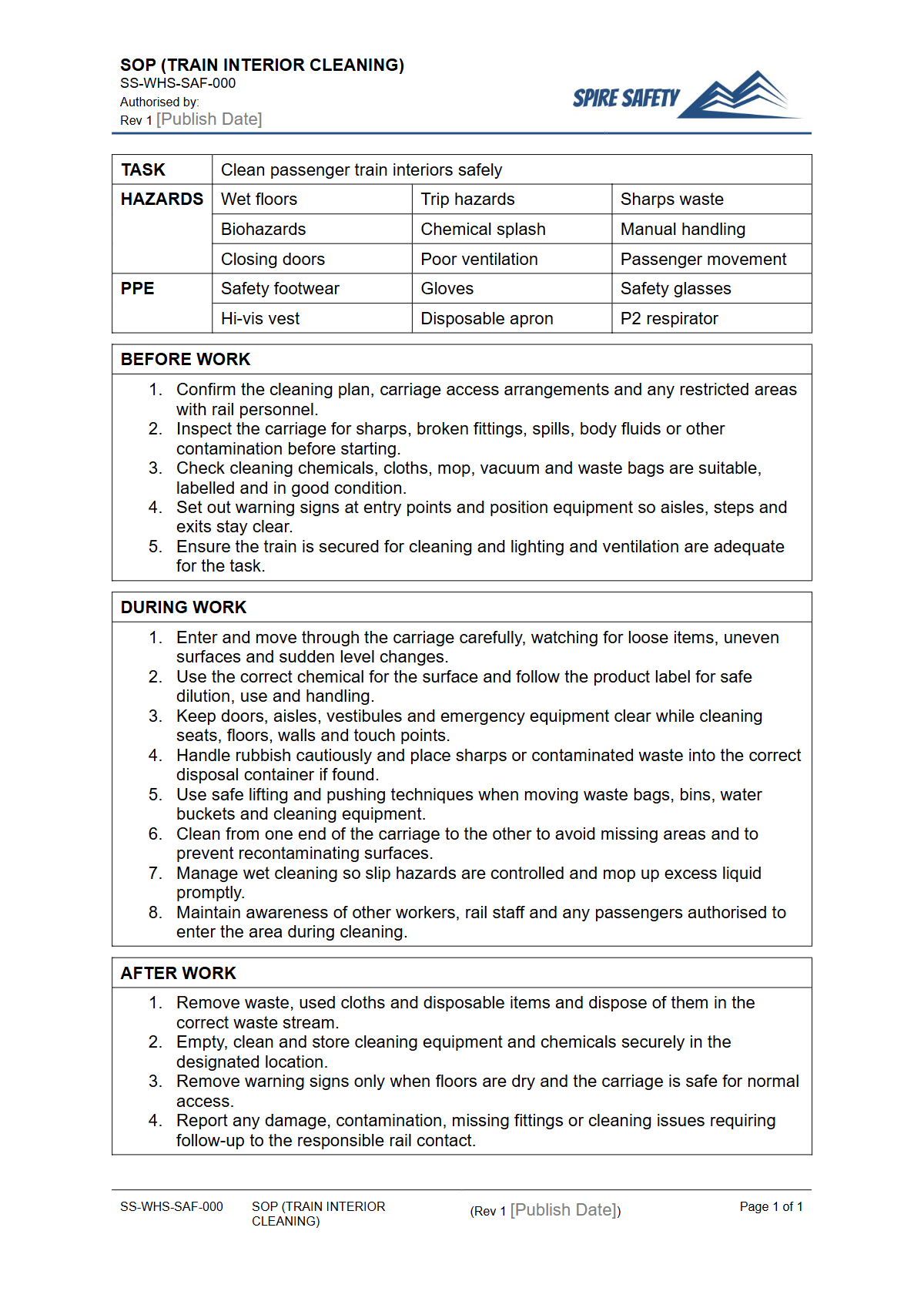
Establishing a clear, documented process for cleaning train interiors is fundamental to worker safety and operational consistency. This Free Safe Operating Procedure (Train Interior Cleaning) Template provides a structured framework for outlining the step-by-step tasks, identifying associated hazards, and implementing effective control measures.
Using this SOP helps persons conducting a business or undertaking (PCBUs) fulfil their primary duty of care by providing a safe system of work. It formalises procedures for tasks like waste removal, surface sanitation, vacuuming, and managing chemical use, reducing the risk of injuries and incidents.
Properly documented procedures are a cornerstone of effective WHS management systems, ensuring that all workers follow a consistent, safe, and efficient methodology.
Video walkthrough
How to use the Free Safe Operating Procedure (Train Interior Cleaning) Template
To effectively use the Free Safe Operating Procedure (Train Interior Cleaning) Template, begin by downloading the DOCX file and adapting it to the specific context of your rail operations. The document includes sections for detailing required PPE, pre-operational checks, step-by-step cleaning processes, and post-task clean-up.
It is crucial to conduct a site-specific risk assessment to identify all unique hazards present in your work environment, such as specific train carriage layouts, cleaning chemicals used, and equipment models.
Important: This is a template only. You must customise it to reflect your specific equipment, chemicals, work environment, and local procedures in consultation with your workers.
We make no guarantee that this document is suitable for your specific circumstances.
Once customised, the SOP should be used to train all relevant personnel. It should be readily accessible in the workplace for reference.
Regular reviews of the SOP's effectiveness are essential for maintaining safety standards; this can be integrated into your internal review schedule or supported by external WHS compliance auditing to verify its implementation and adequacy.
The Train Interior Cleaning SOP template covers:
- Required personal protective equipment (PPE)
- Hazard identification and risk controls
- Pre-operational checks
- A step-by-step procedure for safe operation
- Post-operational tasks and clean-up
- Emergency procedures
When to use it
A Safe Operating Procedure for train interior cleaning should be used as a primary reference document for multiple WHS activities. It is essential for inducting new employees and for providing refresher training to existing staff, ensuring everyone understands the standardised, safe way to perform their duties.
The SOP is also a critical tool during pre-start meetings to discuss the day's tasks and associated risks. In the unfortunate event of an incident or near-miss, the SOP serves as a benchmark for investigation, helping to identify any procedural gaps or non-conformance.
Furthermore, it should be reviewed and updated whenever a new cleaning chemical, piece of equipment, or work process is introduced. Some cleaning tasks might require specific machinery; for instance, if high-pressure air is used to dislodge debris, a separate Free Air Compressor SOP (Safe Operating Procedure) Template may also be required.
Who should use it
This template is designed for use by a range of personnel within an organisation responsible for rail maintenance and operations. WHS Managers and Advisors will use it as a foundational document to build and formalise the organisation's safety procedures. Supervisors and Team Leaders are responsible for implementing the SOP on the ground, using it for training, monitoring compliance, and ensuring their teams follow the prescribed safe work methods. Cleaning Operatives are the primary end-users, referring to the SOP to understand and correctly execute their tasks safely. For managers aiming to integrate such procedures into a certified framework, engaging with ISO 45001 consulting can help align your documentation with international best practice for occupational health and safety management. Finally, this document is a useful resource for anyone looking to browse our free WHS resources library for other relevant safety templates.
Common mistakes
Common mistakes to avoid
- Using a generic template without customising it for specific train models, cleaning agents, and equipment.
- Failing to consult with cleaning operatives, who have practical, hands-on knowledge of the tasks and risks.
- Not providing adequate training on the contents of the finalised SOP before implementation.
- Neglecting to schedule regular reviews, leading to the SOP becoming outdated and irrelevant.
Legal references
Legal considerations
The following legal requirements may be relevant to this type of work.
- Work Health and Safety Act (Harmonised) — Provides the primary duties for protecting workers and other people from work health and safety risks.
- Work Health and Safety Regulations (Harmonised) — Sets out requirements supporting the management of workplace hazards and risks.
The following codes may be relevant to this type of work.
- Managing WHS Risks Code of Practice — Provides practical guidance on identifying hazards, assessing risks and applying effective controls.
- Work Health and Safety Consultation, Cooperation and Coordination Code of Practice — Provides practical guidance on consulting workers and coordinating with other duty holders.
- Managing the Work Environment and Facilities Code of Practice — Provides practical guidance on safe work environments, workplace facilities and related controls.
Did you know
Slips, Trips, and Falls
Slips, trips, and falls are a leading cause of injury in the cleaning industry, accounting for a significant percentage of all serious workers' compensation claims in the sector.
Chemical Contact Time
For disinfectants to be effective, they must remain on a surface for a specific period known as 'dwell time' or 'contact time'. This is often overlooked but is critical for achieving proper sanitation.
FAQ
Frequently asked questions
01What hazards should be included in an SOP for train interior cleaning?
02How often should a train cleaning SOP be reviewed?
03Is a Safe Work Method Statement (SWMS) required for train cleaning?
04What PPE is typically required for train interior cleaning?
Share this resource
Free Safe Operating Procedure (Train Interior Cleaning) Template
Browse Categories
How To Use It
- 1Download and open in Word or PDF.
- 2Replace the placeholders with your business details.
- 3Get it reviewed by a WHS specialist before rollout.
Need it customised?
Our WHS consultants can adapt this template to your site, run a gap analysis, or audit what you already have in place.
Book a Free Consultation WHS consulting servicesor call 1300 156 382
Related templates
- Free Safe Operating Procedure (Train Seat Cleaning) Template
- Free Safe Operating Procedure (Train Toilet Cleaning) Template
- Free Safe Operating Procedure (Transfer Belt Cleaning) Template
- Free Safe Operating Procedure (Transfer Board Cleaning) Template
- Free Safe Operating Procedure (Transfer Sling Storage) Template
- Free Safe Operating Procedure (Transfer Station Clean) Template