
Free Safe Operating Procedure (Traffic Cone Setup) Template
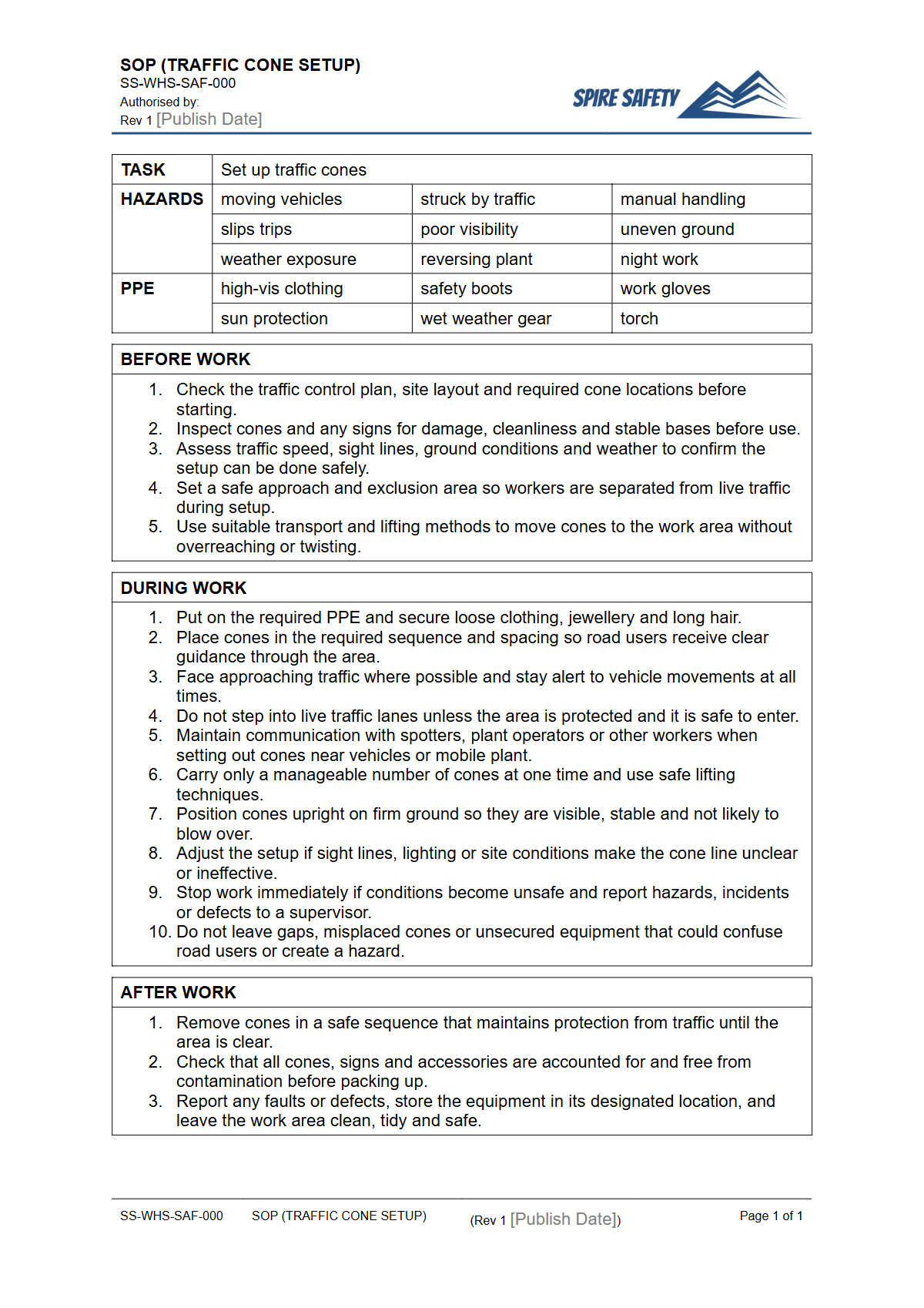
Our Safe Operating Procedure template for traffic cone setup helps formalise your safety processes. Download the free DOCX or PDF to get started today.
Free Safe Operating Procedure (Traffic Cone Setup) Template
DOCX • 126 KB + PDF
Updated Oct 2026
No signup required
Purpose of the Free Safe Operating Procedure (Traffic Cone Setup) Template
Establishing clear, safe, and repeatable processes is fundamental to workplace safety. This is especially true for tasks that seem simple but carry significant risk, like setting up traffic cones.
Our Free Safe Operating Procedure (Traffic Cone Setup) Template provides a structured starting point for organisations to document the required steps for safely deploying and retrieving traffic cones. The primary goal is to guide workers in managing risks associated with temporary traffic and pedestrian management, protecting both the work team and the public from potential harm.
Using a standardised SOP helps ensure every worker follows the same approved method, reducing the chance of error and creating a safer work environment. This document forms a critical component of your site safety documentation and demonstrates a proactive approach to risk management.
Video walkthrough
How to use the Free Safe Operating Procedure (Traffic Cone Setup) Template
This template is provided in both DOCX and PDF formats for your convenience. To get started, download the editable DOCX file and adapt it to your specific operational context.
It's crucial to conduct a site-specific risk assessment and incorporate your findings, including unique hazards and control measures, into the document. The final SOP should be a practical tool used for training and on-the-job reference.
This document is a template and is not a substitute for professional advice. We have provided this template as a starting point; you must customise it to reflect the specific hazards, risks, and control measures relevant to your workplace, equipment, and personnel.
Integrating this customised SOP into your overall WHS management systems ensures it is part of a holistic safety strategy, not just a standalone document.
When to use this Safe Operating Procedure
A Safe Operating Procedure for traffic cone setup is essential in any situation where you need to temporarily alter or guide the flow of vehicle or pedestrian traffic. Common scenarios include:
- Cordoning off a specific hazard, such as a pothole, a spill, or an open excavation.
- Creating temporary pedestrian walkways or exclusion zones around a work area.
- Guiding vehicles around a stationary work vehicle on a low-speed site.
- Delineating a safe work area for short-term maintenance or landscaping tasks.
- Directing traffic at site entry and exit points.
For complex work on or near public roads with live traffic, this SOP should be used in conjunction with a formal Traffic Management Plan (TMP) developed by a qualified person. This procedure is a valuable part of the toolkit for managing risks associated with equipment like that covered in our FREE Telehandler SOP Template.
Who should use it
This template is designed for use by a range of personnel within an organisation. Persons Conducting a Business or Undertaking (PCBUs) have a primary duty of care to ensure safe systems of work are in place.
WHS Managers and Safety Officers will find the template useful for developing and implementing formal procedures. Site Supervisors and Team Leaders are responsible for ensuring these procedures are followed on the ground.
Finally, the workers who physically perform the task are the ultimate end-users, and they should be involved in the customisation and review process to ensure the SOP is practical and effective. Effective procedures are also vital when managing the interface between pedestrians and mobile plant, such as equipment detailed in the FREE Trencher SOP Template.
Key Elements of a Traffic Cone SOP
A comprehensive SOP for traffic cone setup should detail every phase of the operation. Our template prompts you to consider:
- Pre-operational checks: Inspecting cones for cleanliness, damage, and retroreflectivity. Ensuring the correct number and type of cones are available for the task.
- Required PPE: Specifying high-visibility clothing meeting Australian Standards (AS/NZS 4602.1), along with other necessary gear like safety footwear and gloves.
- Safe setup sequence: Outlining the process for safely deploying cones, including correct taper lengths and spacing based on the speed environment. It should always be done facing oncoming traffic.
- Safe removal sequence: Detailing the procedure for retrieving cones in reverse order, which is a high-risk part of the job.
- Emergency procedures: What to do in case of an incident or near-miss.
Maintaining procedural consistency across all site activities is key, from traffic control to operating heavy machinery like that in our FREE Scraper SOP (Safe Operating Procedure) Template. Regular reviews and updates are crucial to keep your SOPs relevant. If you need assistance, our WHS consulting team can help you develop and implement robust safety systems. Performing periodic checks ensures these documented procedures are being followed correctly, a service provided through WHS compliance auditing.
This resource is just one of many we offer to help Australian businesses improve their safety practices. Explore our complete free WHS resources library for more templates, checklists, and guides.
Common mistakes
Common mistakes to avoid
- Placing cones too close together or too far apart for the road's speed limit.
- Using dirty, faded, or damaged cones that have poor visibility, especially at dawn or dusk.
- Failing to use retroreflective cones or supplementary lighting for night work or in low-light conditions.
- Setting up or removing cones while facing away from oncoming traffic, which significantly increases risk.
Legal references
Legal considerations
The following legal requirements may be relevant to this type of work.
- Work Health and Safety Act (Harmonised) — Provides the primary duties for protecting workers and other people from work health and safety risks.
- Work Health and Safety Regulations (Harmonised) — Sets out requirements supporting the management of workplace hazards and risks.
The following codes may be relevant to this type of work.
- Managing WHS Risks Code of Practice — Provides practical guidance on identifying hazards, assessing risks and applying effective controls.
- Work Health and Safety Consultation, Cooperation and Coordination Code of Practice — Provides practical guidance on consulting workers and coordinating with other duty holders.
- Managing the Work Environment and Facilities Code of Practice — Provides practical guidance on safe work environments, workplace facilities and related controls.
Did you know
Cone Colour Codes
While orange is the standard for road works in Australia, other colours can signify different things. For example, yellow cones often indicate no parking zones, while blue cones may be used to mark the location of overhead wires.
FAQ
Frequently asked questions
01What is a 'taper' in traffic cone setup?
02What PPE is required for setting up traffic cones?
03How far apart should traffic cones be spaced?
04Do I need a formal traffic management plan for simple cone setups?
Share this resource
Free Safe Operating Procedure (Traffic Cone Setup) Template
Browse Categories
How To Use It
- 1Download and open in Word or PDF.
- 2Replace the placeholders with your business details.
- 3Get it reviewed by a WHS specialist before rollout.
Need it customised?
Our WHS consultants can adapt this template to your site, run a gap analysis, or audit what you already have in place.
Book a Free Consultation WHS consulting servicesor call 1300 156 382
Related templates
- Free Safe Operating Procedure (Trailer Door Check) Template
- Free Safe Operating Procedure (Trailer Seal Check) Template
- Free Safe Operating Procedure (Train Interior Cleaning) Template
- Free Safe Operating Procedure (Train Seat Cleaning) Template
- Free Safe Operating Procedure (Train Toilet Cleaning) Template
- Free Safe Operating Procedure (Transfer Belt Cleaning) Template