
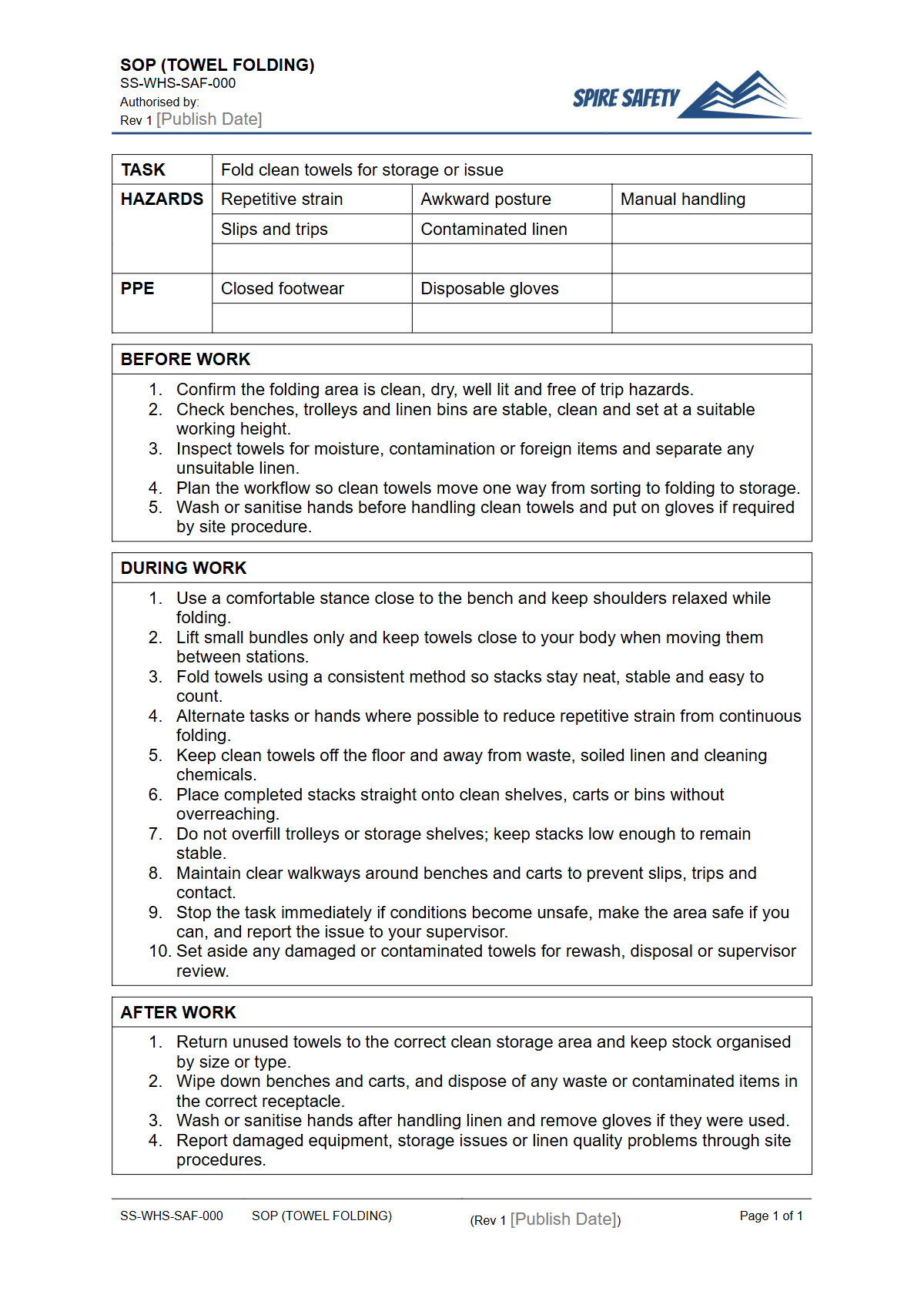
Free Safe Operating Procedure (Towel Folding) Template
Streamline your hotel, spa, or laundry's safety protocols with our free Safe Operating Procedure (Towel Folding) Template. Download your DOCX or PDF now.
Free Safe Operating Procedure (Towel Folding) Template
DOCX • 126 KB + PDF
Updated Oct 2026
No signup required
Purpose of the Free Safe Operating Procedure (Towel Folding) Template
While towel folding might seem like a simple task, performing it repetitively over a full shift can introduce significant ergonomic risks. This free Safe Operating Procedure (Towel Folding) Template provides a structured framework for documenting the safest, most efficient method for this common task.
Using an SOP helps standardise your process, reduce the risk of musculoskeletal injuries like repetitive strain injury (RSI), ensure consistent quality in presentation, and provide a clear, reliable tool for training new employees. It formalises a safe system of work, which is a key part of managing your WHS duties as an employer.
Documenting procedures for all tasks, from the complex to the seemingly simple, is a cornerstone of a robust safety framework. For instance, while folding towels in a hotel, staff may also interact with kitchen equipment, which requires its own documented procedures like those found in our deep fryer SOP. This comprehensive approach ensures safety is integrated into every aspect of your operation.
Video walkthrough
How to use the Free Safe Operating Procedure (Towel Folding) Template
This template is available for instant download in both DOCX and PDF formats. The DOCX file is fully editable, allowing you to tailor it to the unique requirements of your organisation. To use it effectively, you should:
- Identify the specific hazards associated with towel folding in your environment (e.g., poor workstation setup, awkward postures, highly repetitive motions).
- Consult with your workers who perform the task daily. Their feedback is invaluable for creating a practical and effective procedure.
- Document the step-by-step process, incorporating control measures to mitigate identified risks. This might include instructions on posture, workstation height, and taking micro-breaks.
- Add site-specific details, such as the location of laundry carts, storage shelves, and required personal protective equipment (PPE) if applicable.
- Use the finalised SOP as part of your induction and ongoing training programs.
Please note: This template provides a structured starting point. We have developed it to be aligned with Australian WHS best practices, but it is not a complete, out-of-the-box solution.
You MUST customise this Safe Operating Procedure to reflect the specific equipment, environment, and processes in your workplace. Integrating customised SOPs into your overall safety framework is a critical function of effective WHS management systems.
When to use a Towel Folding Safe Operating Procedure
A Safe Operating Procedure for towel folding should be used consistently as a key operational document. It is particularly important during:
- New Employee Induction: Ensure every new team member learns the correct, safe method from day one.
- Refresher Training: Periodically review the SOP with existing staff to prevent complacency and reinforce safe work habits.
- Process Changes: If you introduce a new type of towel, a folding machine, or change the workstation layout, the SOP must be reviewed and updated.
- After an Incident: If a strain or injury occurs, the SOP should be a key part of the incident investigation and subsequent review to prevent recurrence.
Many workplaces, such as hotels or industrial laundries, use machinery that also requires strict procedures. If your facility uses compressed air for cleaning or maintenance, having a corresponding Air Compressor SOP template is equally important for worker safety.
Who should use this Safe Operating Procedure
This SOP template is designed for a range of personnel within any organisation where towel folding is a regular task, such as hotels, commercial laundries, spas, gyms, and healthcare facilities. Key users include:
- WHS Managers and Safety Officers: To develop and implement consistent safety documentation.
- Supervisors and Department Heads: To train their teams and monitor compliance with safe work practices.
- Workers: As a clear guide to performing their tasks safely and efficiently.
- Business Owners: To meet their duty of care obligations under WHS legislation by providing clear instruction and managing risks.
For large-scale operations, especially industrial laundries that might use automated systems, documenting procedures for all equipment is vital. A Conveyer System SOP would be a critical document alongside manual task procedures.
Regularly reviewing these documents is a key activity that can be supported by professional WHS compliance auditing services to ensure your systems remain effective.
By implementing a clear, well-documented SOP for towel folding, you demonstrate a commitment to worker health and operational excellence. Explore our complete free WHS resources library for more templates to support your safety management system.
Common mistakes
Common mistakes to avoid
- Failing to identify and address ergonomic risks like twisting, reaching, and repetitive wrist movements.
- Not consulting with the workers who actually perform the task when developing the procedure.
- Using the template without customising it for the specific types of towels and folding techniques used.
- Treating the SOP as a 'set and forget' document instead of a live tool for training and improvement.
Legal references
Legal considerations
The following legal requirements may be relevant to this type of work.
- Work Health and Safety Act (Harmonised) — Provides the primary duties for protecting workers and other people from work health and safety risks.
- Work Health and Safety Regulations (Harmonised) — Sets out requirements supporting the management of workplace hazards and risks.
The following codes may be relevant to this type of work.
- Managing WHS Risks Code of Practice — Provides practical guidance on identifying hazards, assessing risks and applying effective controls.
- Work Health and Safety Consultation, Cooperation and Coordination Code of Practice — Provides practical guidance on consulting workers and coordinating with other duty holders.
- Managing the Work Environment and Facilities Code of Practice — Provides practical guidance on safe work environments, workplace facilities and related controls.
Did you know
Ergonomic Risks
Repetitive Strain Injury (RSI) is a common work-related injury in Australia, often caused by tasks involving repetitive movements. Documenting safe procedures is a key control measure.
Hospitality Safety
The accommodation and food services industry has one of the higher rates of serious workers' compensation claims for body stressing, highlighting the importance of managing manual task risks.
FAQ
Frequently asked questions
01Is an SOP really necessary for folding towels?
02What are the main hazards in towel folding?
03How often should we review this Towel Folding SOP?
04Can I just use this template as is without any changes?
Share this resource
Free Safe Operating Procedure (Towel Folding) Template
Browse Categories
How To Use It
- 1Download and open in Word or PDF.
- 2Replace the placeholders with your business details.
- 3Get it reviewed by a WHS specialist before rollout.
Need it customised?
Our WHS consultants can adapt this template to your site, run a gap analysis, or audit what you already have in place.
Book a Free Consultation WHS consulting servicesor call 1300 156 382
Related templates
- Free Safe Operating Procedure (Towel Laundry Handling) Template
- Free Safe Operating Procedure (Tower Crane Access) Template
- Free Safe Operating Procedure (Track Surface Cleaning) Template
- Free Safe Operating Procedure (Traffic Cone Setup) Template
- Free Safe Operating Procedure (Trailer Door Check) Template
- Free Safe Operating Procedure (Trailer Seal Check) Template