
Free Safe Operating Procedure (Tilt Meter) Template
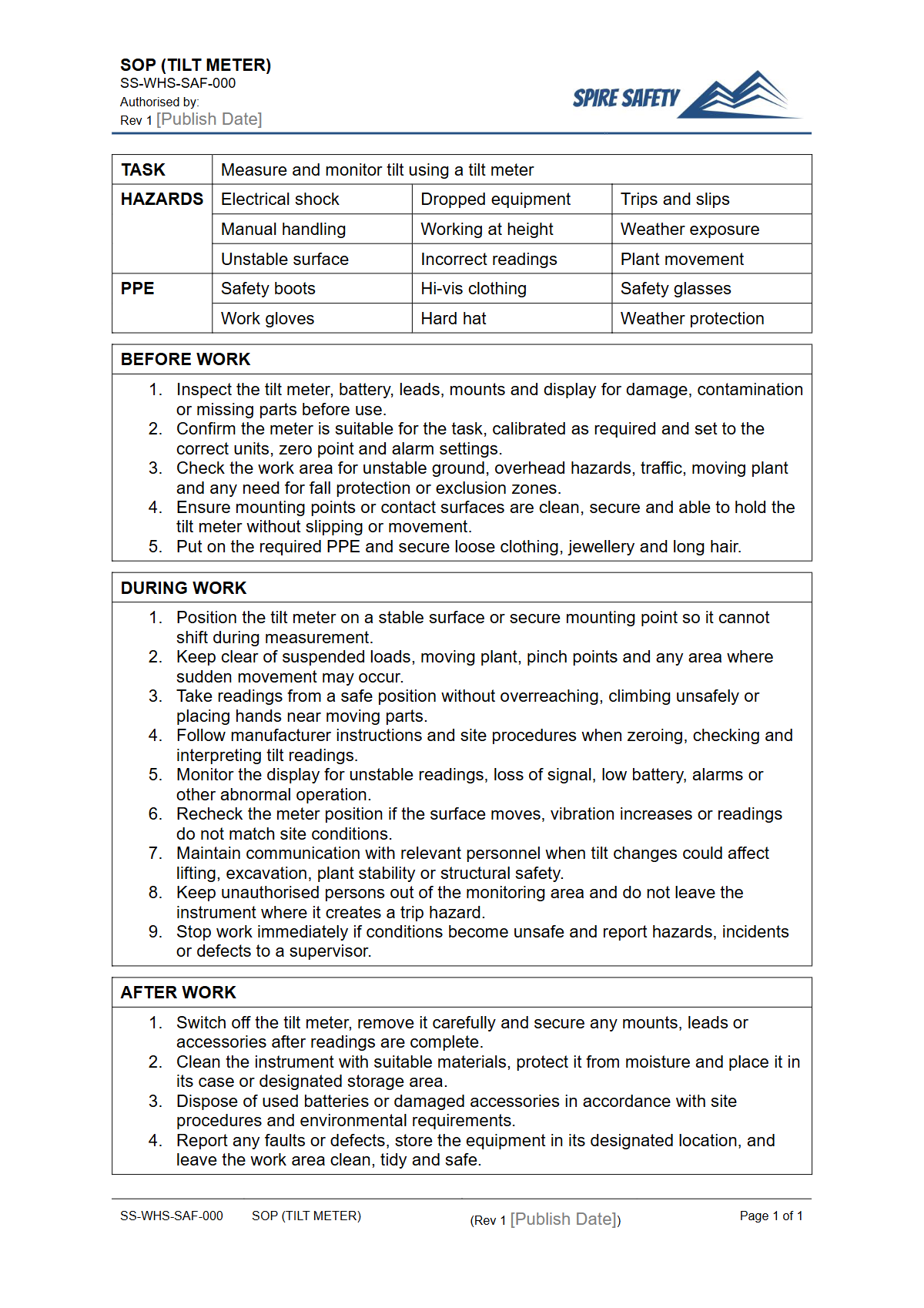
Download our free Safe Operating Procedure (Tilt Meter) Template to document safe work methods for using tilt meters. Get your customisable DOCX and PDF now.
Free Safe Operating Procedure (Tilt Meter) Template
DOCX • 126 KB + PDF
Updated Oct 2026
No signup required
Purpose of the Free Safe Operating Procedure (Tilt Meter) Template
A tilt meter, also known as an inclinometer, is a precision instrument used to measure tilt in structures or on the ground. While often small, its application can be in high-risk environments, making safe operation critical.
This Free Safe Operating Procedure (Tilt Meter) Template provides a structured starting point for your organisation to document the hazards, risks, and control measures associated with using this equipment. Formalising these steps helps ensure consistent, safe work practices, accurate data collection, and a reduction in potential incidents related to incorrect installation or use.
Developing a comprehensive SOP is a key part of managing plant and equipment safety. A documented procedure ensures that all personnel understand the requirements for tasks like calibration, installation in potentially hazardous locations (like near excavations or on tall structures), and data interpretation.
It also forms a crucial training document for new workers. For equipment operating on variable terrain, such as those covered in a Safe Operating Procedure for telehandler use, tilt monitoring is an essential related safety function.
Video walkthrough
How to use the Free Safe Operating Procedure (Tilt Meter) Template
This template is provided in both DOCX and PDF formats for your convenience. To use it effectively, download the DOCX file and adapt it to your specific operational context.
You must systematically work through each section, replacing the placeholder text with information relevant to your workplace, the specific model of tilt meter used, and the findings of your site-specific risk assessment. This customisation is not just recommended; it is essential for creating a meaningful and effective safety document.
Important: We have provided this document as a starting point. You must customise this Safe Operating Procedure to the unique circumstances of your workplace.
Consultation with your workers is required to identify all relevant hazards and determine appropriate risk controls. This SOP should be integrated into your broader WHS management systems to ensure it is reviewed, updated, and implemented effectively as part of your overall safety framework.
When to use a Safe Operating Procedure for a Tilt Meter
A documented SOP for a tilt meter should be used whenever the device is deployed as part of a work activity. This is particularly important in applications where inaccurate readings or unsafe installation could lead to significant risks. Key scenarios include:
- Structural Monitoring: Monitoring deflection and tilt in buildings, bridges, dams, and retaining walls.
- Geotechnical Applications: Assessing the stability of slopes, embankments, and excavation walls.
- Construction: Verifying verticality and levelness during the erection of structures or the operation of heavy equipment.
- Plant and Equipment Safety: Using tilt sensors on mobile plant like cranes or elevated work platforms to prevent rollovers. Procedures for this equipment, such as our Safe Operating Procedure for trencher use, often rely on data from such sensors.
Who should use this SOP
This procedure is intended for use by all personnel involved with the specification, installation, use, and maintenance of tilt meters. Specific roles include:
- Site Engineers and Surveyors: Responsible for correct installation, calibration, and data interpretation.
- Geotechnical Engineers: Use the data to assess ground stability and structural integrity.
- Construction Workers and Equipment Operators: May be responsible for installing devices or operating machinery fitted with tilt sensors.
- Work Health and Safety (WHS) Officers: Responsible for ensuring safety procedures are in place and being followed.
- Supervisors and Managers: Accountable for providing a safe system of work and ensuring workers are trained and competent. Regular checks, similar to those performed during WHS compliance auditing, help verify that these procedures are effective in practice.
What's included in the template?
Our tilt meter SOP template provides a comprehensive framework to guide your documentation. It prompts you to detail essential safety information in a logical sequence, making it easy for workers to follow. Key sections include:
- Associated Risks and Hazards: A section to list all identified hazards, such as working at heights, electrical risks, or manual handling during installation.
- Required Personal Protective Equipment (PPE): Specifies the necessary PPE, like hard hats, safety glasses, and high-visibility clothing.
- Pre-Operational Checks: A checklist of actions to perform before use, including battery checks, equipment inspection, and calibration verification.
- Step-by-Step Operating Procedure: A clear sequence for safely installing, operating, and reading the tilt meter. This section is the core of the SOP and requires detailed, site-specific input, much like the process for documenting tasks in a FREE Scraper SOP for heavy machinery.
- Post-Operational Tasks: Outlines procedures for data download, equipment cleaning, and secure storage.
- Emergency Procedures: Details the response required in case of an incident or equipment malfunction.
By using this template, your organisation can streamline the development of a robust SOP. You can find more templates and checklists in our complete free WHS resources library to support your safety management efforts.
Common mistakes
Common mistakes to avoid
- Failing to properly calibrate the device according to manufacturer specifications before use.
- Installing the meter on an unstable, non-representative, or unsuitable surface, leading to flawed data.
- Neglecting to account for environmental factors like temperature changes that can affect readings.
- Not documenting readings, observations, and any maintenance activities consistently.
Legal references
Legal considerations
The following legal requirements may be relevant to this type of work.
- Work Health and Safety Act (Harmonised) — Provides the primary duties for protecting workers and other people from work health and safety risks.
- Work Health and Safety Regulations (Harmonised) — Sets out requirements supporting the management of workplace hazards and risks.
The following codes may be relevant to this type of work.
- Managing WHS Risks Code of Practice — Provides practical guidance on identifying hazards, assessing risks and applying effective controls.
- Work Health and Safety Consultation, Cooperation and Coordination Code of Practice — Provides practical guidance on consulting workers and coordinating with other duty holders.
- Managing the Work Environment and Facilities Code of Practice — Provides practical guidance on safe work environments, workplace facilities and related controls.
Did you know
Precision Measurement
High-precision tilt meters can detect changes in angle as small as one arcsecond, which is 1/3600th of a degree. This accuracy is vital for monitoring the long-term stability of large structures like dams and bridges.
Early Warning System
Tilt meters are a key component of structural health monitoring (SHM) systems. They can provide early warnings of potential failures in buildings, tunnels, and earthworks, allowing engineers to take preventative action before a catastrophic event occurs.
FAQ
Frequently asked questions
01What is a tilt meter and why is an SOP important for it?
02Can this template be used for any type of tilt meter?
03Who is responsible for reviewing and updating the Tilt Meter SOP?
04Does using this template make my workplace compliant?
Share this resource
Free Safe Operating Procedure (Tilt Meter) Template
Browse Categories
How To Use It
- 1Download and open in Word or PDF.
- 2Replace the placeholders with your business details.
- 3Get it reviewed by a WHS specialist before rollout.
Need it customised?
Our WHS consultants can adapt this template to your site, run a gap analysis, or audit what you already have in place.
Book a Free Consultation WHS consulting servicesor call 1300 156 382
Related templates
- Free Safe Operating Procedure (Toaster) Template
- Free Safe Operating Procedure (Toilet Cubicle Clean) Template
- Free Safe Operating Procedure (Torque Multiplier) Template
- Free Safe Operating Procedure (Torque Wrench) Template
- Free Safe Operating Procedure (Total Station) Template
- Free Safe Operating Procedure (Towel Collection) Template