
Free Safe Operating Procedure (Torque Wrench) Template
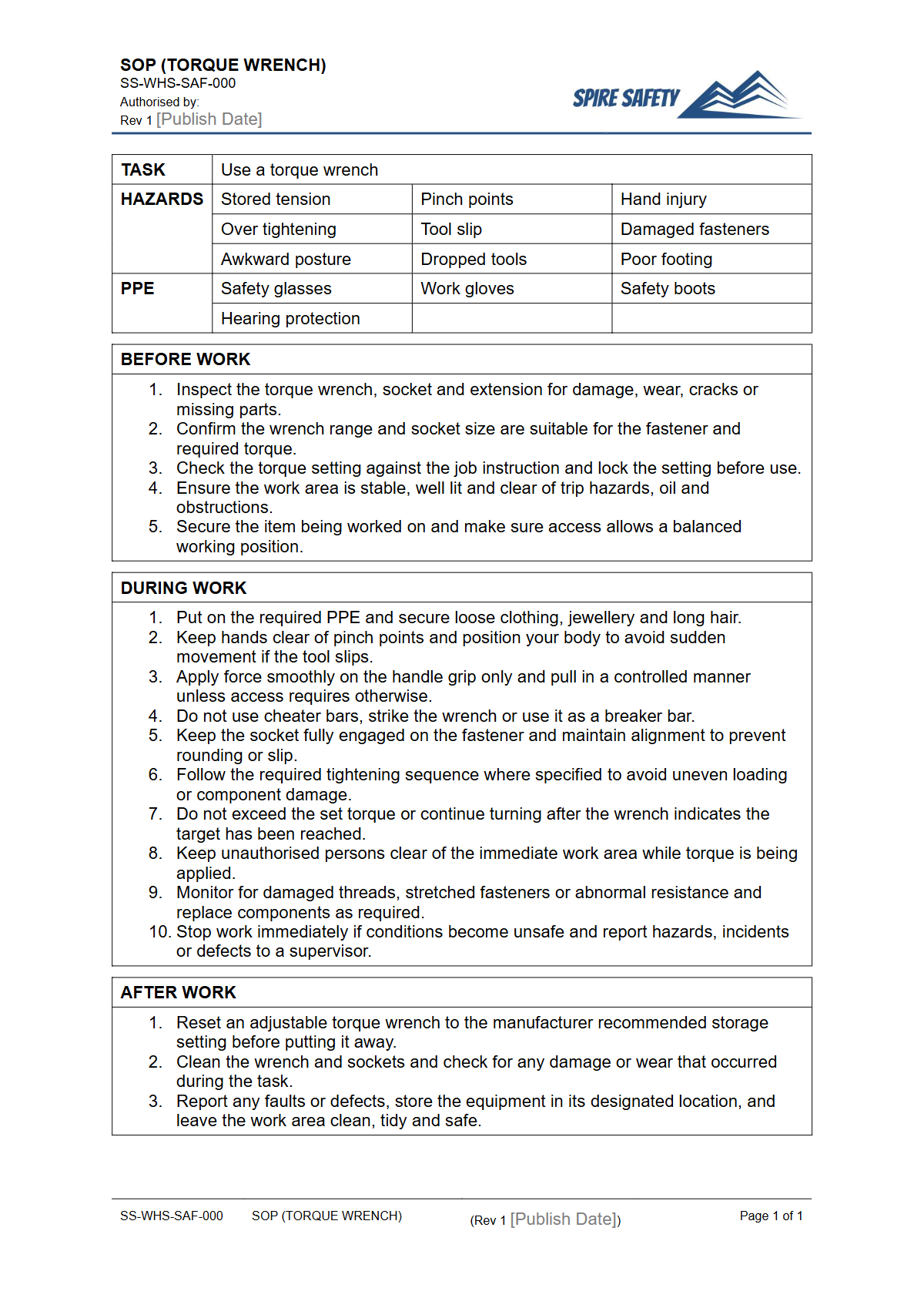
Formalise safety protocols for precise fastening tasks with our free Safe Operating Procedure (Torque Wrench) template. Download the customisable DOCX now.
Free Safe Operating Procedure (Torque Wrench) Template
DOCX • 126 KB + PDF
Updated Oct 2026
No signup required
Purpose of the Free Safe Operating Procedure (Torque Wrench) Template
A torque wrench is a precision tool designed to apply a specific torque to a fastener, such as a nut or bolt. Using it correctly is critical for safety and structural integrity in automotive, manufacturing, and construction industries.
This free Safe Operating Procedure (Torque Wrench) template provides a structured starting point for developing your own site-specific procedure. It helps your organisation document a clear, step-by-step process for workers to follow, covering everything from pre-start checks to correct operation and storage.
Formalising this process is a fundamental part of managing risks, such as under-tightening that can lead to component failure, or over-tightening that can damage threads and cause material stress.
Implementing robust SOPs is a practical way to meet your safety obligations and demonstrates a commitment to a proactive safety culture. These documents form a critical component of a company's overall WHS management system, providing a consistent framework for training, competency assessment, and incident investigation.
An effective SOP helps ensure every worker performs the task to the same high standard of safety, every time.
Video walkthrough
How to use the Free Safe Operating Procedure (Torque Wrench) Template
This resource is available as a DOCX file, which you can easily edit and adapt, and a PDF for simple printing and distribution. To use the template, download the file and begin integrating your workplace's specific details.
This includes listing the makes and models of torque wrenches used on site, identifying the personal protective equipment (PPE) required for the task, and detailing your specific emergency procedures. You should also add details about required calibration schedules and responsibilities.
IMPORTANT: This document is a template that must be customised. To be effective and useful, it needs to reflect the unique equipment, tasks, environment, and risks in your specific workplace.
We accept no liability for any incident arising from the use of an unmodified or improperly adapted template. You should conduct a risk assessment for torque wrench use and ensure the controls are accurately captured in your final SOP. For instance, your workshop may have additional hazards to consider, such as those covered in our Free Air Compressor SOP (Safe Operating Procedure) Template.
When to Use a Torque Wrench SOP
A Safe Operating Procedure for torque wrenches should be developed, implemented, and readily available for any task requiring its use. It is not just for high-risk applications; consistent, safe use should be standard practice.
The SOP is a crucial reference during worker training, induction for new employees, and for refresher training sessions to prevent procedural drift. It should also be consulted before undertaking non-routine or critical maintenance tasks where precise torque is essential for safety and reliability. For example, during equipment servicing, workers may need to consult procedures for multiple tools, reinforcing the need for clear documentation like our FREE Circular Saw SOP (Safe Operating Procedure) Template.
Who Should Use This Procedure
This Safe Operating Procedure is intended for all personnel required to operate a torque wrench as part of their job duties. This includes mechanics, fitters, technicians, apprentices, and maintenance workers.
Supervisors and managers also have a key role; they are responsible for ensuring that workers are trained on the SOP's contents, have demonstrated competency, and follow the procedure consistently. It's vital that only trained and authorised individuals operate this type of equipment, just as with other specialised tools that require specific safety knowledge, such as those detailed in our FREE Oxy Acetylene SOP (Safe Operating Procedure) Template. Workers should feel empowered to stop work if they cannot follow the SOP safely for any reason.
Reviewing and Maintaining Your SOP
An SOP is a dynamic document. It should be reviewed regularly—at least annually, or following any incident, near miss, or change in legislation, equipment, or work processes.
Regular reviews ensure the procedure remains current and effective. This process of review and verification is a key activity that can be assessed during a WHS compliance audit to confirm that safety systems are being actively managed.
Assigning responsibility for the review process to a specific person or role helps ensure it is completed on schedule.
By using this template and embedding a robust SOP into your daily operations, you take a significant step towards ensuring the safety of your workers and the reliability of your work. Explore our complete free WHS resources library for more templates and guides to support your safety management system.
Common mistakes
Common mistakes to avoid
- Using the wrench as a breaker bar to loosen tight fasteners, which can damage the calibration mechanism.
- Applying an extension bar or 'cheater bar' to the handle, which makes the applied torque inaccurate.
- Failing to store a 'click-type' torque wrench at its lowest setting, which keeps the spring under tension and leads to calibration loss.
- Jerking or 'bouncing' the wrench to reach the torque setting, rather than applying slow, steady pressure until it clicks or indicates.
Legal references
Legal considerations
The following legal requirements may be relevant to this type of work.
- Work Health and Safety Act (Harmonised) — Provides the primary duties for protecting workers and other people from work health and safety risks.
- Work Health and Safety Regulations (Harmonised) — Sets out requirements supporting the management of workplace hazards and risks.
The following codes may be relevant to this type of work.
- Managing WHS Risks Code of Practice — Provides practical guidance on identifying hazards, assessing risks and applying effective controls.
- Work Health and Safety Consultation, Cooperation and Coordination Code of Practice — Provides practical guidance on consulting workers and coordinating with other duty holders.
- Managing the Work Environment and Facilities Code of Practice — Provides practical guidance on safe work environments, workplace facilities and related controls.
Did you know
Invention for Safety
The torque wrench was invented by Conrad Bahr in 1918 while working for the New York City Water Department. He was concerned about workers over-tightening and breaking bolts on underground water main and steam pipes, so he created a tool to ensure consistent, safe tightening.
FAQ
Frequently asked questions
01What should be included in a torque wrench SOP?
02How often does a torque wrench need to be calibrated?
03Is an SOP mandatory for using a torque wrench in Australia?
04What are the main risks associated with using a torque wrench?
Share this resource
Free Safe Operating Procedure (Torque Wrench) Template
Browse Categories
How To Use It
- 1Download and open in Word or PDF.
- 2Replace the placeholders with your business details.
- 3Get it reviewed by a WHS specialist before rollout.
Need it customised?
Our WHS consultants can adapt this template to your site, run a gap analysis, or audit what you already have in place.
Book a Free Consultation WHS consulting servicesor call 1300 156 382
Related templates
- Free Safe Operating Procedure (Total Station) Template
- Free Safe Operating Procedure (Towel Collection) Template
- Free Safe Operating Procedure (Towel Folding) Template
- Free Safe Operating Procedure (Towel Laundry Handling) Template
- Free Safe Operating Procedure (Tower Crane Access) Template
- Free Safe Operating Procedure (Track Surface Cleaning) Template