
Free Safe Operating Procedure (Torque Multiplier) Template
Document the safe use of high-torque equipment with our free Safe Operating Procedure (Torque Multiplier) Template.
Free Safe Operating Procedure (Torque Multiplier) Template
DOCX • 126 KB + PDF
Updated Oct 2026
No signup required
Purpose of the Free Safe Operating Procedure (Torque Multiplier) Template
Effectively managing the risks associated with high-torque applications is critical for workplace safety. Our Free Safe Operating Procedure (Torque Multiplier) Template provides a structured framework to help your organisation document the correct and safe use of this powerful tool.
This template is designed as a starting point, aligned with Australian WHS principles, to help you define clear operational steps, identify potential hazards, and specify essential control measures. A well-developed SOP helps prevent serious injuries, ensures equipment is used correctly, and provides a consistent training resource for workers.
Using a torque multiplier introduces significant forces and specific hazards, such as crushing and musculoskeletal strain. This Safe Operating Procedure template guides you in formally addressing these risks.
It prompts you to outline pre-start checks, a logical work sequence, and emergency responses. Implementing a documented procedure demonstrates a commitment to a proactive safety culture and helps meet your primary duty of care under WHS legislation.
It's a fundamental component of robust WHS management systems, ensuring that high-risk tasks are performed in a controlled and repeatable manner.
Video walkthrough
How to use the Free Safe Operating Procedure (Torque Multiplier) Template
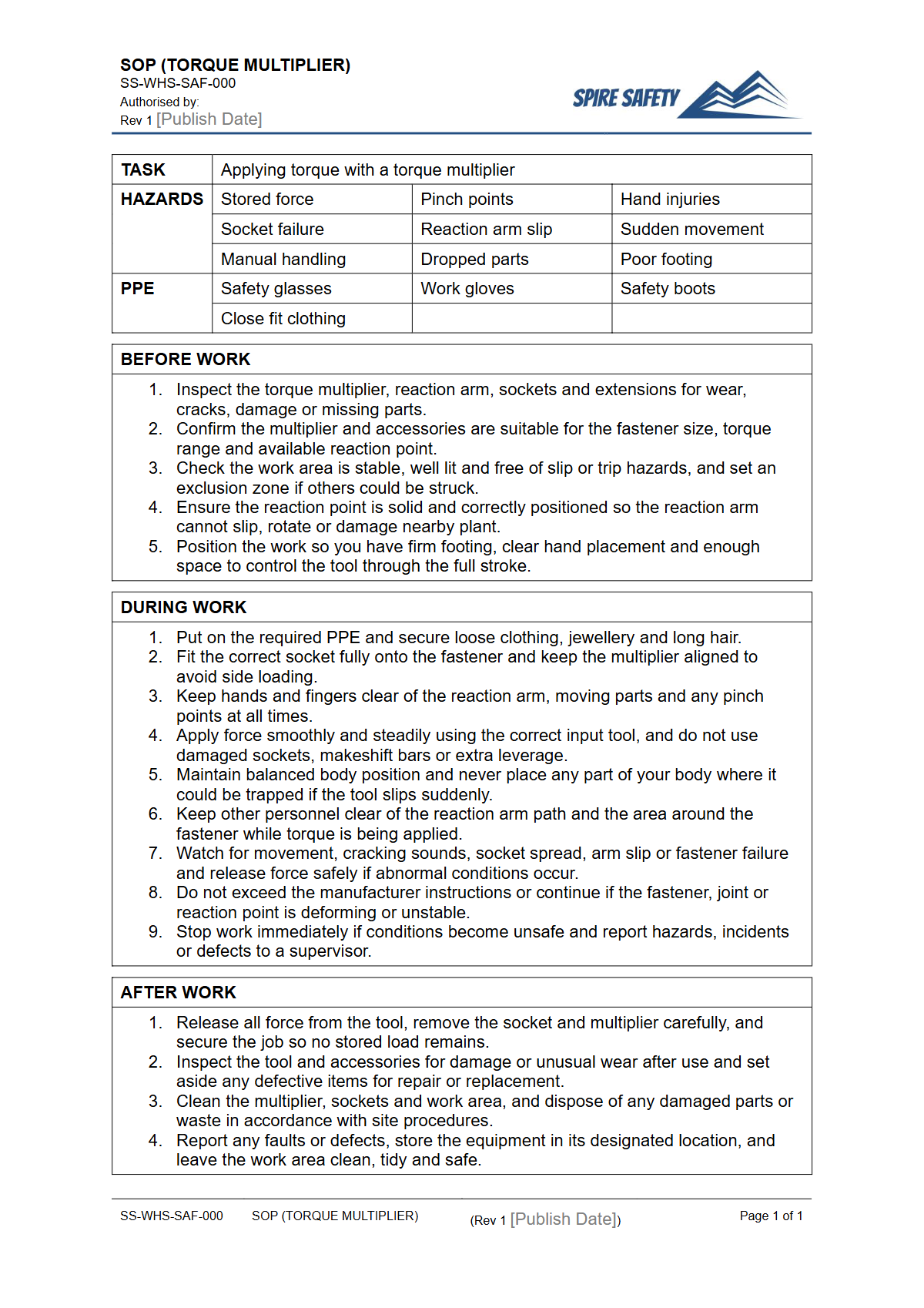
Begin by downloading the template in either DOCX for easy editing or PDF for straightforward printing. The next critical step is to adapt the document to your specific workplace conditions.
Generic procedures are insufficient; your SOP must reflect your unique environment, the exact model of torque multiplier in use, and the specific tasks your team performs. This customisation process is essential for creating a meaningful and effective safety document that your workers can follow.
Key Sections to Customise
- Hazard Identification and Risk Assessment: Detail the specific hazards associated with your tasks (e.g., pinch points from the reaction bar, ergonomic strain, incorrect torque application) and the control measures you have implemented.
- Personal Protective Equipment (PPE): List the mandatory PPE required for the task, such as impact-resistant gloves, safety glasses, and steel-capped boots.
- Pre-Operational Checks: Customise the checklist to match your equipment. Include checks for damage to the gearbox, reaction arm, sockets, and any power source (e.g., pneumatic lines). For related equipment, you might find our free Air Compressor SOP useful.
- Operating Sequence: Write a clear, step-by-step guide for setting up and using the torque multiplier. Include instructions on selecting the correct reaction point, setting the torque, and applying force safely.
- Post-Operational Procedures: Define the steps for cleaning, inspecting, and storing the tool correctly after use.
- Emergency Procedures: Outline the response to potential incidents, such as equipment failure or injury.
Important Note: This document is a template and must be customised by a competent person. We are not WHS consultants, and the use of this template does not supports your compliance efforts.
You must tailor it to the specific risks and operational context of your workplace to meet your legal obligations.
When to Use a Torque Multiplier SOP
A Safe Operating Procedure for a torque multiplier should be an active part of your daily operations. It is not a document to be filed away and forgotten.
It should be used in several key situations, including worker training and inductions to ensure new employees understand the correct and safe method before they first use the tool. It also serves as the basis for competency assessments.
The SOP should be readily available in the work area for easy reference during tasks. Furthermore, it should be a central document in toolbox talks, especially before conducting non-routine or complex bolting jobs.
Following an incident or near-miss involving a torque multiplier, the SOP must be reviewed as part of the investigation to identify any gaps or necessary improvements. The process is similar for other high-risk tools, as outlined in documents like our free Oxy Acetylene SOP template.
Who Should Use This Safe Operating Procedure
This SOP is intended for a range of personnel within an organisation to ensure a consistent approach to safety. Operators and tradespeople who use torque multipliers are the primary users and must be trained on the procedure's content.
Supervisors and line managers are responsible for ensuring workers follow the SOP and for conducting periodic checks and observations. WHS managers and safety officers use the SOP as part of their safety management system, using it to inform risk assessments, training plans, and incident investigations.
Regular reviews of such procedures are a key part of the verification process, which can be formalised through WHS compliance auditing to ensure ongoing effectiveness and alignment with legislation. Finally, trainers and assessors should use the SOP as the benchmark for delivering training and verifying worker competency.
You can find more helpful documents in our free WHS resources library to support your team.
Common mistakes
Common mistakes to avoid
- Using an incorrect or unstable reaction point, leading to tool slippage or unexpected movement.
- Failing to inspect the tool, socket, and reaction arm for wear, cracks, or damage before use.
- Applying the tool without understanding the correct torque specifications for the fastener.
- Placing hands or other body parts near the reaction bar or pinch points during operation.
Legal references
Legal considerations
The following legal requirements may be relevant to this type of work.
- Work Health and Safety Act (Harmonised) — Provides the primary duties for protecting workers and other people from work health and safety risks.
- Work Health and Safety Regulations (Harmonised) — Sets out requirements supporting the management of workplace hazards and risks.
The following codes may be relevant to this type of work.
- Managing WHS Risks Code of Practice — Provides practical guidance on identifying hazards, assessing risks and applying effective controls.
- Work Health and Safety Consultation, Cooperation and Coordination Code of Practice — Provides practical guidance on consulting workers and coordinating with other duty holders.
- Managing the Work Environment and Facilities Code of Practice — Provides practical guidance on safe work environments, workplace facilities and related controls.
Did you know
The Reaction Bar
The reaction bar on a torque multiplier absorbs the counter-rotational force. Improper placement or using a non-approved reaction point is one of the leading causes of serious hand and finger injuries during operation.
Force Amplification
Torque multipliers use an epicyclic gear train to amplify the force applied by an operator, often by a ratio of 5:1 up to 125:1 or more. This allows for precise, high-torque tightening without excessive physical effort or long lever arms.
FAQ
Frequently asked questions
01What are the main hazards of using a torque multiplier?
02Is a Safe Operating Procedure a legal requirement for a torque multiplier in Australia?
03How often should a torque multiplier SOP be reviewed?
04Can I use this template for a hydraulic torque wrench too?
Share this resource
Free Safe Operating Procedure (Torque Multiplier) Template
Browse Categories
How To Use It
- 1Download and open in Word or PDF.
- 2Replace the placeholders with your business details.
- 3Get it reviewed by a WHS specialist before rollout.
Need it customised?
Our WHS consultants can adapt this template to your site, run a gap analysis, or audit what you already have in place.
Book a Free Consultation WHS consulting servicesor call 1300 156 382
Related templates
- Free Safe Operating Procedure (Torque Wrench) Template
- Free Safe Operating Procedure (Total Station) Template
- Free Safe Operating Procedure (Towel Collection) Template
- Free Safe Operating Procedure (Towel Folding) Template
- Free Safe Operating Procedure (Towel Laundry Handling) Template
- Free Safe Operating Procedure (Tower Crane Access) Template