
Free Safe Operating Procedure (Toilet Cubicle Clean) Template
Download our Free Safe Operating Procedure (Toilet Cubicle Clean) Template to formalise your cleaning processes and manage associated risks.
Free Safe Operating Procedure (Toilet Cubicle Clean) Template
DOCX • 126 KB + PDF
Updated Oct 2026
No signup required
Purpose of the Free Safe Operating Procedure (Toilet Cubicle Clean) Template
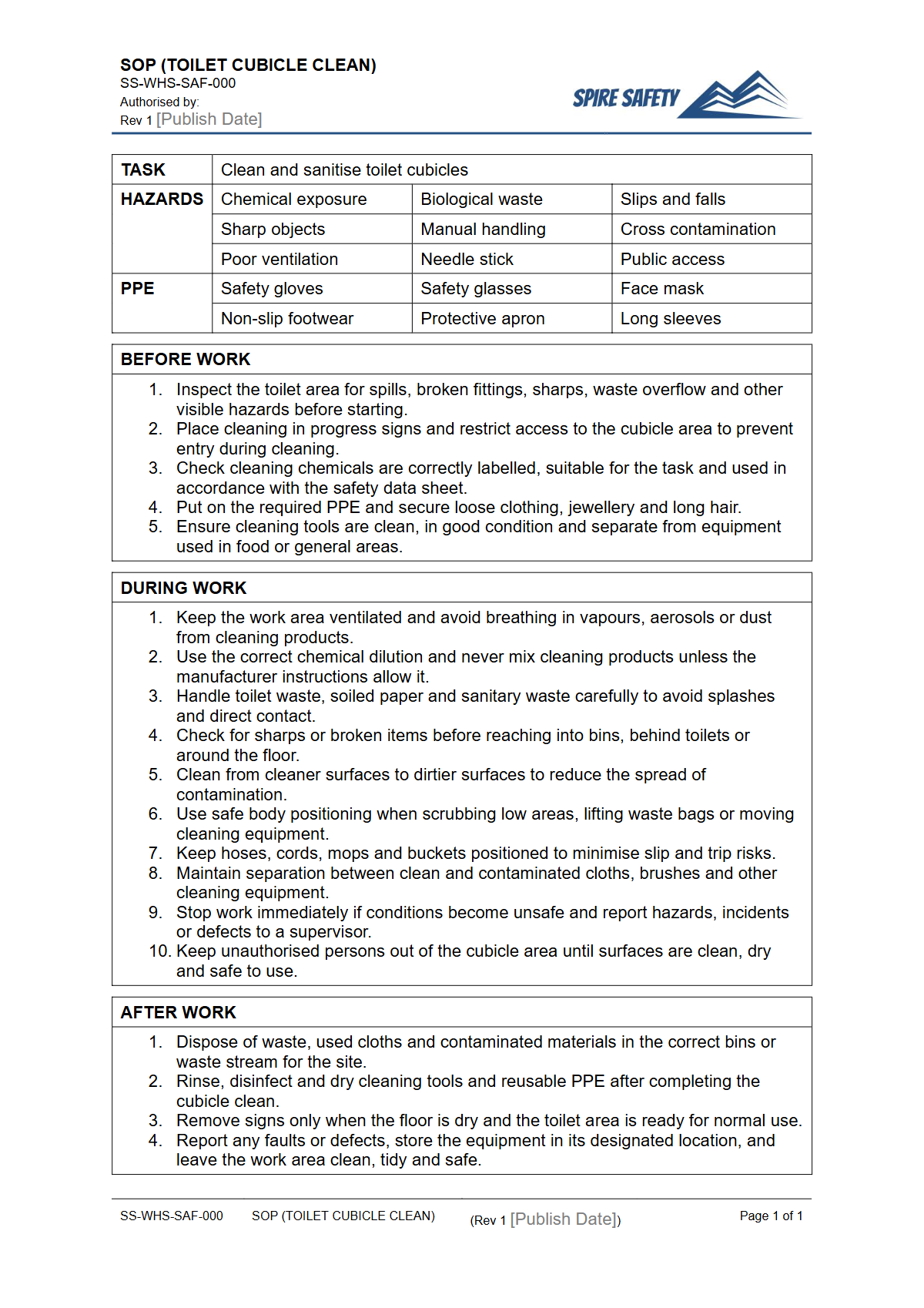
Cleaning toilet cubicles, while a routine task, involves several health and safety risks that must be managed. This Free Safe Operating Procedure (Toilet Cubicle Clean) Template provides a structured starting point for developing a documented process for your workplace.
Formalising the procedure helps to control hazards such as exposure to hazardous chemicals, biological agents, slips and trips on wet floors, and musculoskeletal injuries from manual tasks. By outlining a step-by-step method, you can ensure consistency in cleaning standards and, most importantly, provide clear safety instructions to workers, helping to fulfil your primary duty of care.
A well-drafted SOP is a critical component of your safety framework. It serves as a key training document for new staff and a reference for experienced workers, promoting a consistent and safe work methodology.
It also provides a clear record of the expected safety standards and controls, which can be reviewed during safety inspections or incident investigations. Integrating specific SOPs like this into your broader safety framework is a key part of building robust WHS management systems that protect your team and your business.
Video walkthrough
How to use the Free Safe Operating Procedure (Toilet Cubicle Clean) Template
This Safe Operating Procedure (Toilet Cubicle Clean) Template is provided in both DOCX and PDF formats for your convenience. The DOCX file is fully editable, allowing you to tailor the content to the specific environment, chemicals, and equipment used in your facility.
It is crucial to adapt the document to reflect your unique operational context and risk profile.
Follow these steps to effectively implement the SOP:
- Download the DOCX template.
- Consult with the workers who perform the cleaning tasks. Their direct experience is invaluable for identifying practical risks and effective controls.
- Conduct a risk assessment specific to the location, identifying all potential hazards.
- Customise the SOP by adding your company name and logo, and detailing the specific chemicals (including Safety Data Sheet locations), equipment, and PPE required.
- Update the step-by-step instructions to match your established cleaning process.
- Review the finalised SOP with all relevant workers and secure sign-offs to confirm they have read and understood it.
Important: This is a template document that we have created as a starting point. You must customise this SOP to the specific equipment, chemicals, environment, and risks in your workplace.
Consultation with your workers is essential.
When to use it
A Safe Operating Procedure for toilet cubicle cleaning should be used as a primary reference document in several situations. It is essential for inducting and training new cleaning staff, ensuring they learn the correct, safe method from their first day.
It should also be readily accessible in the workplace for existing staff to refer back to, particularly if there are changes to cleaning chemicals, equipment, or procedures. This SOP is also a valuable tool for supervisors conducting work observations or for auditors reviewing safety processes during a WHS compliance auditing program.
Regular reviews of the SOP, recommended annually or after any incident, ensure it remains relevant and effective.
Who should use it
This SOP is intended for a range of personnel within an organisation. Primarily, it is for the cleaners and janitorial staff who perform the task, providing them with clear, unambiguous instructions on how to work safely.
Supervisors and team leaders should use the document to manage, train, and monitor their teams effectively. Facility and operations managers are responsible for ensuring such procedures are developed, implemented, and reviewed as part of their operational oversight.
WHS managers and advisors will use this template as a foundation for building out the organisation's safety documentation, ensuring that processes are formalised and aligned with Australian WHS practice. If you require specialised assistance in developing complex procedures, consider engaging professional WHS consulting services.
Creating task-specific SOPs is a fundamental part of workplace safety. While this document covers toilet cleaning, your business may have other distinct processes requiring similar guidance, such as those covered in our free deep fryer SOP template for commercial kitchens.
You can explore our entire free WHS resources library for more templates to support your safety system.
Common mistakes
Common mistakes to avoid
- Failing to display 'Wet Floor' signs, creating a slip hazard for others.
- Using incorrect chemical dilutions, which can be ineffective or dangerously corrosive.
- Not allowing adequate ventilation when working with strong chemicals in a small, enclosed space.
- Forgetting to consult Safety Data Sheets (SDS) for new or unfamiliar cleaning products.
Legal references
Legal considerations
The following legal requirements may be relevant to this type of work.
- Work Health and Safety Act (Harmonised) — Provides the primary duties for protecting workers and other people from work health and safety risks.
- Work Health and Safety Regulations (Harmonised) — Sets out requirements supporting the management of workplace hazards and risks.
The following codes may be relevant to this type of work.
- Managing WHS Risks Code of Practice — Provides practical guidance on identifying hazards, assessing risks and applying effective controls.
- Work Health and Safety Consultation, Cooperation and Coordination Code of Practice — Provides practical guidance on consulting workers and coordinating with other duty holders.
- Managing the Work Environment and Facilities Code of Practice — Provides practical guidance on safe work environments, workplace facilities and related controls.
Did you know
Slips, Trips, and Falls
Slips, trips, and falls are a leading cause of workplace injuries in Australia. Using 'wet floor' signs and ensuring floors are left dry after mopping are critical controls that a good SOP will reinforce.
Chemical Safety
Never mix different cleaning chemicals, especially those containing bleach and ammonia. This can create toxic chloramine gas, which can cause severe respiratory damage and other serious health effects.
FAQ
Frequently asked questions
01What hazards are involved in cleaning a toilet cubicle?
02Why do I need a specific SOP for toilet cleaning?
03Do I need to provide training on this Safe Operating Procedure?
04What personal protective equipment (PPE) is needed for cleaning toilets?
Share this resource
Free Safe Operating Procedure (Toilet Cubicle Clean) Template
Browse Categories
How To Use It
- 1Download and open in Word or PDF.
- 2Replace the placeholders with your business details.
- 3Get it reviewed by a WHS specialist before rollout.
Need it customised?
Our WHS consultants can adapt this template to your site, run a gap analysis, or audit what you already have in place.
Book a Free Consultation WHS consulting servicesor call 1300 156 382
Related templates
- Free Safe Operating Procedure (Torque Multiplier) Template
- Free Safe Operating Procedure (Torque Wrench) Template
- Free Safe Operating Procedure (Total Station) Template
- Free Safe Operating Procedure (Towel Collection) Template
- Free Safe Operating Procedure (Towel Folding) Template
- Free Safe Operating Procedure (Towel Laundry Handling) Template