
Free Safe Operating Procedure (Toaster) Template
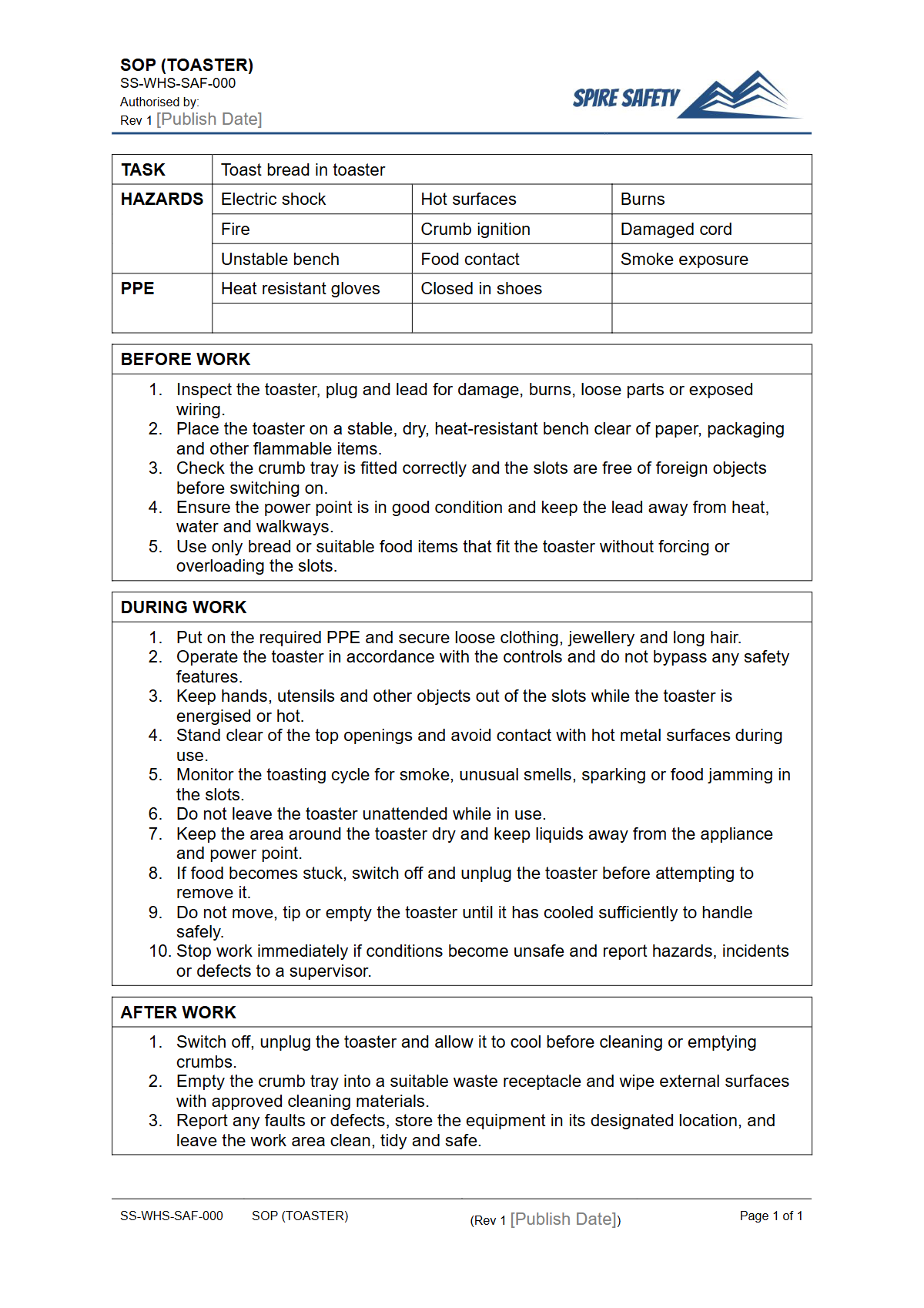
Download our free Safe Operating Procedure (Toaster) template to formalise safety protocols for kitchen appliances. This customisable DOCX is a great start.
Free Safe Operating Procedure (Toaster) Template
DOCX • 126 KB + PDF
Updated Oct 2026
No signup required
Purpose of the Free Safe Operating Procedure (Toaster) Template
Even simple workplace appliances like toasters introduce hazards that must be managed. This free Safe Operating Procedure (Toaster) template provides a structured foundation for documenting the safe use of commercial and domestic toasters in a workplace setting, such as a staff kitchen or commercial food preparation area.
Using an SOP helps standardise operator training, communicates essential safety information, and demonstrates a commitment to managing risks associated with burns, electrical faults, and fire. It formalises steps that are often overlooked due to the perceived simplicity of the task, helping to prevent common incidents.
Formalising procedures for all plant and equipment is a cornerstone of an effective safety framework. Documenting processes, even for basic equipment, helps integrate safety into daily operations and supports the development of robust WHS management systems that protect workers and the organisation.
Video walkthrough
How to use the Free Safe Operating Procedure (Toaster) Template
This document is a starting point designed for customisation. After downloading the DOCX file, you must adapt it to your specific workplace, the exact make and model of the toaster in use, and your established emergency procedures.
We have pre-filled sections covering potential hazards, pre-operational checks, operational steps, and cleaning procedures, but you MUST review and edit every section to reflect your unique risks and control measures. The goal is to create a practical tool that accurately guides a worker through the task safely.
Once customised, the SOP should be used to train workers and be readily available for reference.
This process of risk assessment and procedural documentation is similar for all kitchen equipment. For instance, managing the higher-risk environment around a deep fryer would involve customising a specific deep fryer SOP to address hazards like oil spills, filter cleaning, and severe burns.
When to use this Safe Operating Procedure
An SOP for a toaster should be used consistently as part of your day-to-day safety processes. It is a critical document during:
- Worker Induction and Training: Introduce new staff to the correct and safe method of using workplace appliances.
- Refresher Training: Periodically review the SOP with existing staff to reinforce safe behaviour and communicate any changes.
- Pre-Task Reference: Workers can consult the SOP to remind themselves of key safety checks before use.
- Incident Investigation: If an incident occurs, the SOP serves as a benchmark for expected procedure and helps identify gaps in process or training.
Regularly reviewing your SOPs is also a key activity during internal or external WHS compliance audits to ensure your documented procedures remain current and effective.
Who should use it
This Safe Operating Procedure template is intended for a range of personnel within an organisation:
- WHS Managers and Advisors: To develop and implement standardised safety documents aligned with Australian WHS principles.
- Supervisors and Kitchen Managers: To train their teams and enforce safe work practices in areas like staff rooms and commercial kitchens.
- Workers: As a practical guide for safely operating the equipment, performing cleaning tasks, and understanding the associated hazards.
Documenting procedures for diverse types of plant is essential for a comprehensive safety program. The same principles apply whether you are drafting instructions for a kitchen appliance or a more complex piece of machinery, such as that covered in our Air Compressor SOP template.
Integrating the SOP into Your Safety System
An SOP is most effective when it is part of a broader safety culture, not just a document that sits in a folder. Ensure it is referenced in your risk assessments and training plans.
For complex safety challenges or developing a full suite of operational documents, engaging external WHS consultants can provide expert guidance and help streamline the process.
This template is one of many tools available to help you build a safer workplace. Feel free to explore our complete free WHS resources library for more templates, checklists, and guides to support your safety management efforts.
Common mistakes
Common mistakes to avoid
- Forgetting to customise the template for the specific make and model of toaster.
- Failing to include detailed cleaning and maintenance procedures, a key fire risk control.
- Not training workers on the SOP, assuming the appliance is 'common sense' to use.
- Storing the SOP in a file instead of making it accessible near the point of use.
Legal references
Legal considerations
The following legal requirements may be relevant to this type of work.
- Work Health and Safety Act (Harmonised) — Provides the primary duties for protecting workers and other people from work health and safety risks.
- Work Health and Safety Regulations (Harmonised) — Sets out requirements supporting the management of workplace hazards and risks.
The following codes may be relevant to this type of work.
- Managing WHS Risks Code of Practice — Provides practical guidance on identifying hazards, assessing risks and applying effective controls.
- Work Health and Safety Consultation, Cooperation and Coordination Code of Practice — Provides practical guidance on consulting workers and coordinating with other duty holders.
- Managing the Work Environment and Facilities Code of Practice — Provides practical guidance on safe work environments, workplace facilities and related controls.
Did you know
Crumbs are a Fire Hazard
The buildup of crumbs and food debris is a leading cause of toaster fires. Regular cleaning and emptying of the crumb tray, as outlined in an SOP, is a critical and simple fire prevention control.
Electrical Testing
In Australia, electrical appliances used in a workplace environment must be regularly inspected, tested, and tagged to verify they are electrically safe, as specified in standard AS/NZS 3760.
FAQ
Frequently asked questions
01Why do I need a Safe Operating Procedure for something as simple as a toaster?
02Can I use this template for a commercial conveyor toaster?
03Is this SOP template enough to be WHS-aligned?
04How often should a Safe Operating Procedure for a toaster be reviewed?
Share this resource
Free Safe Operating Procedure (Toaster) Template
Browse Categories
How To Use It
- 1Download and open in Word or PDF.
- 2Replace the placeholders with your business details.
- 3Get it reviewed by a WHS specialist before rollout.
Need it customised?
Our WHS consultants can adapt this template to your site, run a gap analysis, or audit what you already have in place.
Book a Free Consultation WHS consulting servicesor call 1300 156 382
Related templates
- Free Safe Operating Procedure (Toilet Cubicle Clean) Template
- Free Safe Operating Procedure (Torque Multiplier) Template
- Free Safe Operating Procedure (Torque Wrench) Template
- Free Safe Operating Procedure (Total Station) Template
- Free Safe Operating Procedure (Towel Collection) Template
- Free Safe Operating Procedure (Towel Folding) Template