
Free Safe Operating Procedure (Thermal Lance) Template
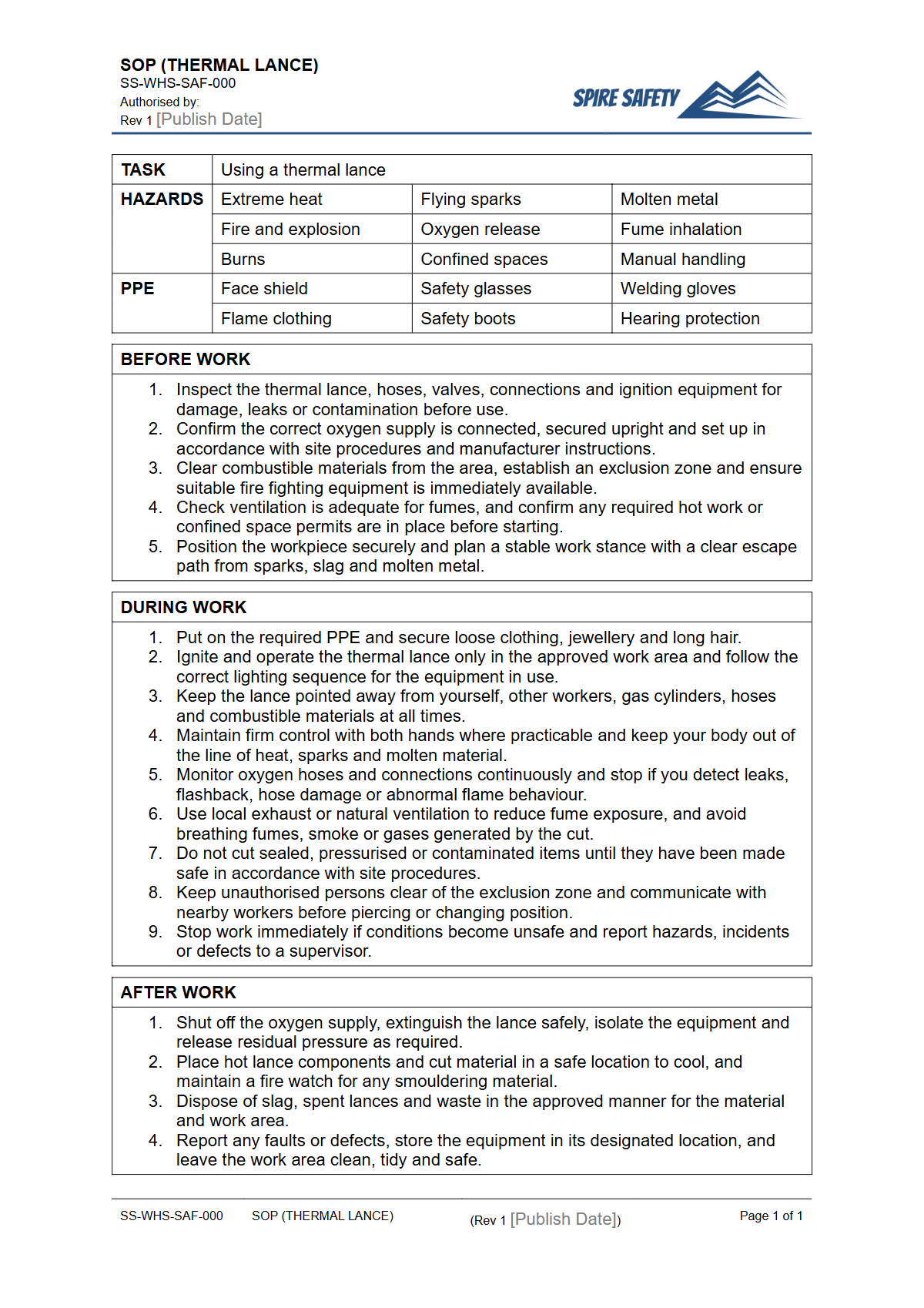
Our free Safe Operating Procedure (Thermal Lance) template helps you document safety controls for this high-risk task.
Free Safe Operating Procedure (Thermal Lance) Template
DOCX • 126 KB + PDF
Updated Oct 2026
No signup required
Purpose of the Free Safe Operating Procedure (Thermal Lance) Template
A thermal lance, also known as a thermic lance or burning bar, is a tool that uses extreme heat to cut through thick materials like steel, concrete, and rock. The process involves high-pressure oxygen and consumable steel lances, creating significant risks including severe burns, fire, explosions, and exposure to toxic fumes.
This Free Safe Operating Procedure (Thermal Lance) Template provides a structured framework for documenting the required steps to perform this task safely. It is designed to help your organisation control risks and provide clear instructions to operators.
Using a documented SOP is a fundamental part of managing WHS risks for high-risk activities. It serves as a critical training tool, a reference for operators and supervisors, and a key component of your overall safety management system.
Similar to procedures for other hot work, like our free Oxy Acetylene SOP template, this document helps standardise safe work practices across your team.
What is included in this Thermal Lance SOP?
This Safe Operating Procedure template guides you through the key elements of a comprehensive procedure, including:
- Required Personal Protective Equipment (PPE)
- Pre-operational checks for the lance, hoses, and gas supply
- Step-by-step instructions for setup and operation
- Controls for managing risks like fire, fumes, and molten metal splash
- Shutdown, cleaning, and maintenance procedures
- Emergency response actions
By implementing this SOP, you create a repeatable, auditable process that supports your duty of care obligations and contributes to a safer working environment. It forms an essential part of robust WHS management systems by embedding safe practices into your daily operations.
Video walkthrough
How to use the Free Safe Operating Procedure (Thermal Lance) Template
This resource is available as a fully editable Microsoft Word (DOCX) file, along with a ready-to-use PDF. We recommend using the DOCX version to add, remove, and modify the content to suit your specific operational context.
While this template is aligned with Australian WHS principles, it must be adapted to your unique workplace.
Important: This document is a template, not a finished procedure. To be effective, you must customise it with site-specific information.
We have drafted it to be as comprehensive as possible, but you must add details such as your specific equipment models, the types of materials being cut, unique workplace hazards, approved PPE brands, and your organisation's emergency contact numbers and procedures. This step is critical to ensure the SOP is relevant and effective.
The process of customising SOPs should involve consultation with the workers who will be using them. Their direct experience is invaluable for identifying practical controls and ensuring the procedure is workable. For other plant that may be used in conjunction with the lancing operation, such as air supply, you can refer to our free Air Compressor SOP template.
When to use this Safe Operating Procedure
A Safe Operating Procedure for thermal lancing should be developed and approved before any such work is permitted on-site. It is a proactive risk management tool used during the planning stages of a project.
It should be integrated with other safety documentation, such as a Safe Work Method Statement (SWMS) for high-risk construction work.
The SOP should be reviewed whenever there is a change in equipment, process, or legislation. It is a living document that must also be a central part of operator training, competency assessments, and routine supervision. Regular reviews ensure it remains a practical and effective tool for risk control, much like the procedures for other common tools, such as those covered in a free Circular Saw SOP template.
Who should use this Safe Operating Procedure
This SOP template is designed for use by Persons Conducting a Business or Undertaking (PCBUs), site managers, supervisors, and WHS professionals. It provides a reliable starting point for developing formal procedures that protect workers.
- PCBUs and Managers: Use this template to establish and implement a formal, documented safety system for thermal lancing, helping to meet primary duties of care under WHS law.
- Supervisors: Use the finalised SOP to induct and train operators, monitor work on the ground, and enforce safety standards. The SOP provides a clear benchmark for correct performance.
- Operators: Workers who perform thermal lancing must be trained in the specific steps and precautions outlined in the final, customised SOP. It is their guide to working safely.
- WHS Advisors: Utilise this template as a tool to assist operational teams in risk management and procedural development. It can also be used as a reference point during safety inspections and WHS compliance auditing.
By customising and implementing this SOP, your organisation demonstrates a commitment to a systematic approach to health and safety. You can explore more templates and checklists in our free WHS resources library to support your safety management efforts.
Common mistakes
Common mistakes to avoid
- Using oxygen at incorrect pressures, which can cause the lance to burn too quickly or dangerously eject material.
- Failing to establish adequate fire prevention measures, such as removing all combustible materials from the area and having a designated fire watch.
- Working in a poorly ventilated space without appropriate respiratory protection, leading to fume inhalation.
- Not securing the work area from other personnel who may be unaware of the extreme hazards present.
Legal references
Legal considerations
The following legal requirements may be relevant to this type of work.
- Work Health and Safety Act (Harmonised) — Provides the primary duties for protecting workers and other people from work health and safety risks.
- Work Health and Safety Regulations (Harmonised) — Sets out requirements supporting the management of workplace hazards and risks.
The following codes may be relevant to this type of work.
- Managing WHS Risks Code of Practice — Provides practical guidance on identifying hazards, assessing risks and applying effective controls.
- Work Health and Safety Consultation, Cooperation and Coordination Code of Practice — Provides practical guidance on consulting workers and coordinating with other duty holders.
- Managing the Work Environment and Facilities Code of Practice — Provides practical guidance on safe work environments, workplace facilities and related controls.
Did you know
Extreme Temperatures
The tip of a thermal lance operates at temperatures exceeding 4,000°C, significantly hotter than the melting point of steel (around 1,500°C) and even hotter than a standard oxy-acetylene torch.
FAQ
Frequently asked questions
01What are the main hazards of thermal lancing?
02Is a Safe Work Method Statement (SWMS) the same as an SOP for thermal lancing?
03What PPE is required for thermal lancing?
04Why is ventilation so important during thermal lancing?
Share this resource
Free Safe Operating Procedure (Thermal Lance) Template
Browse Categories
How To Use It
- 1Download and open in Word or PDF.
- 2Replace the placeholders with your business details.
- 3Get it reviewed by a WHS specialist before rollout.
Need it customised?
Our WHS consultants can adapt this template to your site, run a gap analysis, or audit what you already have in place.
Book a Free Consultation WHS consulting servicesor call 1300 156 382
Related templates
- Free Safe Operating Procedure (Thickness Planer) Template
- Free Safe Operating Procedure (Tile Grout Cleaning) Template
- Free Safe Operating Procedure (Tile Saw) Template
- Free Safe Operating Procedure (Till Drawer Removal) Template
- Free Safe Operating Procedure (Tilt Meter) Template
- Free Safe Operating Procedure (Toaster) Template