
Free Safe Operating Procedure (Tile Saw) Template
Control the risks associated with wet tile saws using our structured procedure template. Download your free DOCX and PDF to get started on your documentation.
Free Safe Operating Procedure (Tile Saw) Template
DOCX • 126 KB + PDF
Updated Oct 2026
No signup required
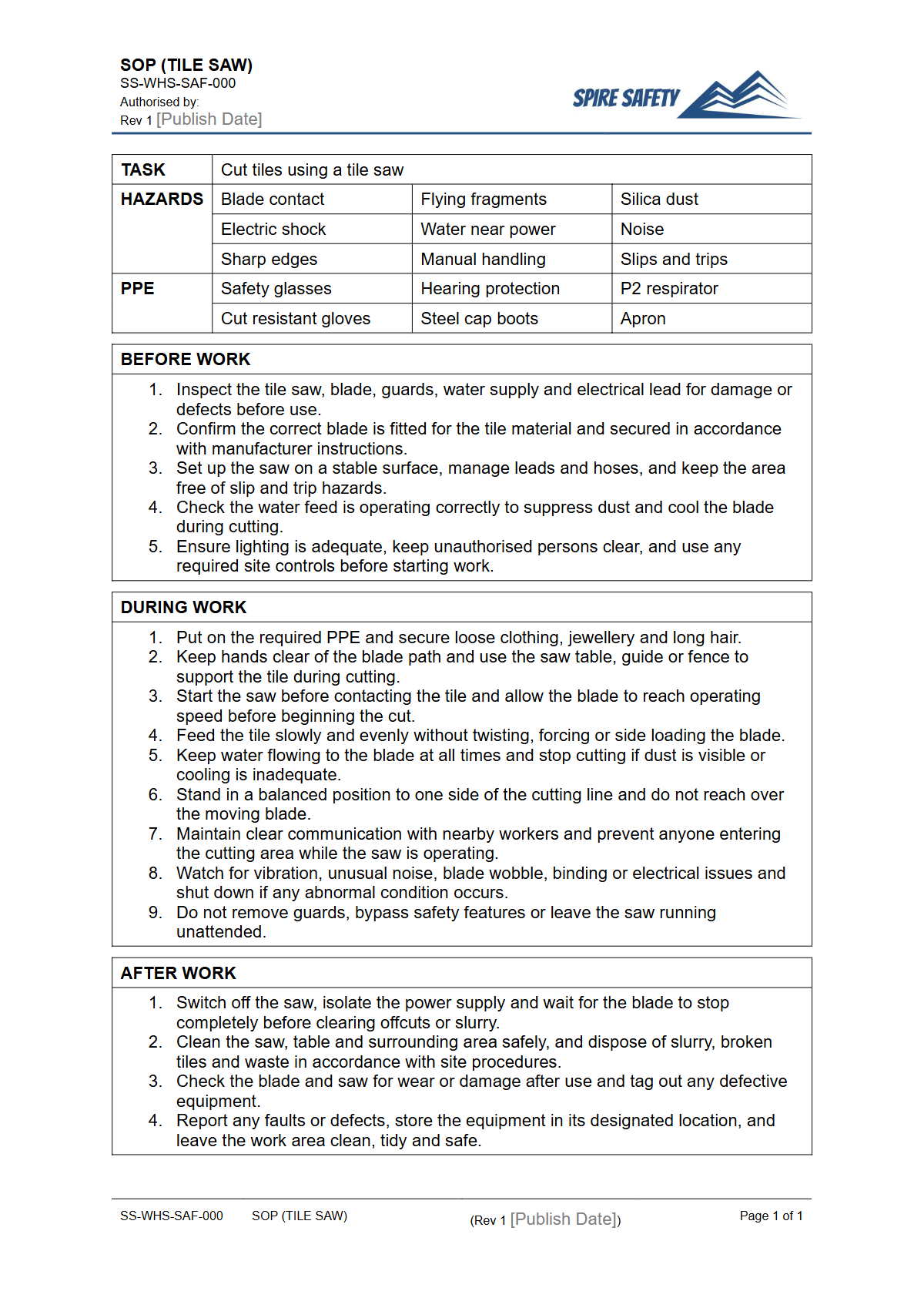
Purpose of this Free Safe Operating Procedure (Tile Saw) Template
This free Safe Operating Procedure (Tile Saw) Template provides a structured framework for documenting the safe use of wet tile saws in your workplace. Developing a formal SOP is a key step in managing health and safety risks associated with power tools, helping your organisation meet its duties under Australian WHS legislation.
It helps you to systematically identify hazards, establish robust control measures, and outline step-by-step instructions to protect workers from injury.
Using a tile saw introduces significant risks, including electric shock, serious lacerations, hearing loss, and respiratory diseases from silica dust. This template guides you in addressing these hazards directly, creating a safer work environment and ensuring operational consistency.
Similar to procedures for other cutting tools, like our circular saw Safe Operating Procedure, a well-defined SOP is a fundamental part of your safety toolkit, providing a clear reference for training, supervision, and incident investigation.
Video walkthrough
How to use the Free Safe Operating Procedure (Tile Saw) Template
This downloadable document is provided as a starting point. It is formatted in Microsoft Word (DOCX) for easy editing and is also available as a PDF for universal access.
To make it effective, you must adapt it to the specific context of your business and worksite. This involves reviewing and modifying the content to align with your unique equipment, environment, and tasks.
Important: This template must be customised to your workplace. We recommend the Person Conducting a Business or Undertaking (PCBU) or their representative completes this customisation in consultation with the workers who will be operating the machinery. This collaborative process ensures the final SOP is practical, relevant, and effective, forming a crucial part of your overall WHS management systems.
Key Customisation Steps:
- Incorporate the specific make and model of the tile saws used at your site.
- Conduct a site-specific risk assessment for tile-cutting tasks and integrate the findings.
- List the exact Personal Protective Equipment (PPE) required, such as specific respirator types (e.g., P2) for silica dust.
- Detail your workplace's specific emergency procedures, including locations of first aid kits and emergency shut-offs.
- Reference any relevant internal permits or additional safety documents required before work begins.
When to use a Tile Saw SOP
A Safe Operating Procedure for a tile saw should be a living document used throughout the equipment's lifecycle. It is not a document to be filed and forgotten.
It should be used during worker induction and training for new employees, as a practical guide for operators before they begin a task, and as a tool for refresher training to prevent complacency. The SOP should also be reviewed and updated following any incident or near-miss, or when new equipment or processes are introduced that could affect worker safety.
Who should use it
This SOP is intended for several key roles within an organisation. Primarily, it is for the workers who operate the tile saw, providing them with clear, step-by-step guidance on how to perform their tasks safely.
Supervisors and managers should also use the document to oversee work, ensure procedures are being followed, and conduct safety observations or toolbox talks. Furthermore, WHS personnel and trainers will find it an essential resource for developing training programs and ensuring consistent safety messaging across the business.
Having documented procedures for all high-risk plant, including this SOP and others like our Air Compressor SOP, demonstrates a proactive approach to safety management.
Regularly reviewing the implementation and effectiveness of your SOPs is a critical part of the safety lifecycle. These reviews can be done internally or as part of formal WHS compliance audits to verify that documented procedures match actual work practices.
Spire Safety's extensive free WHS resources library offers a range of templates to support your organisation in building a robust safety framework.
Common mistakes
Common mistakes to avoid
- Failing to use a Residual Current Device (RCD) with the power supply.
- Performing 'dry cutting', which generates significantly more hazardous silica dust.
- Using a damaged or incorrect type of diamond blade for the material being cut.
- Neglecting to inspect the water pump and supply lines before starting work.
Legal references
Legal considerations
The following legal requirements may be relevant to this type of work.
- Work Health and Safety Act (Harmonised) — Provides the primary duties for protecting workers and other people from work health and safety risks.
- Work Health and Safety Regulations (Harmonised) — Sets out requirements supporting the management of workplace hazards and risks.
The following codes may be relevant to this type of work.
- Managing WHS Risks Code of Practice — Provides practical guidance on identifying hazards, assessing risks and applying effective controls.
- Work Health and Safety Consultation, Cooperation and Coordination Code of Practice — Provides practical guidance on consulting workers and coordinating with other duty holders.
- Managing the Work Environment and Facilities Code of Practice — Provides practical guidance on safe work environments, workplace facilities and related controls.
Did you know
Silica Dust Hazard
The dust generated from cutting tiles, concrete, or stone contains respirable crystalline silica. Uncontrolled exposure can lead to silicosis, a serious and incurable lung disease.
RCDs are Critical
Using a portable residual current device (RCD) is a critical control measure. It is designed to quickly shut off power if it detects an earth fault, significantly reducing the risk of fatal electric shock.
FAQ
Frequently asked questions
01Is a Safe Operating Procedure a legal requirement for a tile saw?
02What are the biggest risks when using a tile saw?
03How often should a Tile Saw SOP be reviewed?
04What PPE is required for using a tile saw?
Share this resource
Free Safe Operating Procedure (Tile Saw) Template
Browse Categories
How To Use It
- 1Download and open in Word or PDF.
- 2Replace the placeholders with your business details.
- 3Get it reviewed by a WHS specialist before rollout.
Need it customised?
Our WHS consultants can adapt this template to your site, run a gap analysis, or audit what you already have in place.
Book a Free Consultation WHS consulting servicesor call 1300 156 382
Related templates
- Free Safe Operating Procedure (Till Drawer Removal) Template
- Free Safe Operating Procedure (Tilt Meter) Template
- Free Safe Operating Procedure (Toaster) Template
- Free Safe Operating Procedure (Toilet Cubicle Clean) Template
- Free Safe Operating Procedure (Torque Multiplier) Template
- Free Safe Operating Procedure (Torque Wrench) Template