
Free Safe Operating Procedure (Thickness Planer) Template
Download our free Safe Operating Procedure (Thickness Planer) Template to manage woodworking risks.
Free Safe Operating Procedure (Thickness Planer) Template
DOCX • 126 KB + PDF
Updated Oct 2026
No signup required
Purpose of the Free Safe Operating Procedure (Thickness Planer) Template
A thickness planer is a high-risk piece of equipment found in workshops across Australia. Effectively managing its operational risks is essential for preventing serious injuries from kickback, blade contact, and wood dust exposure.
This Free Safe Operating Procedure (Thickness Planer) Template provides a structured framework for documenting the safe use of this machinery. It guides organisations in establishing and communicating a clear, step-by-step process that aligns with Australian WHS best practices.
Using a standardised procedure ensures that every operator, regardless of experience, follows the same safety-critical steps, minimising operational variability and enhancing workplace safety.
The purpose of this Safe Operating Procedure, or SOP, is to formalise the accepted and safest method for performing a specific task. By documenting pre-start checks, operational steps, and shutdown procedures, it serves as a vital training tool and a reference for competent operators.
It's a key administrative control that supports your broader risk management activities. For similar high-risk woodworking equipment, you might also find our circular saw SOP template a useful addition to your safety documentation library.
Video walkthrough
How to use the Free Safe Operating Procedure (Thickness Planer) Template
This template is a starting point designed for customisation. After downloading the DOCX or PDF file, you must adapt it to reflect the specific machinery, environment, and processes in your workplace.
A generic procedure is not sufficient; it must be made site-specific to be effective. The process involves consulting with the workers who actually operate the thickness planer, as their input is invaluable for creating a practical and effective document.
Follow these steps to implement the SOP:
- Customise: Add your company name, logo, and specific details about the make and model of your thickness planer.
- Consult: Work with operators, supervisors, and health and safety representatives to review and refine the steps, ensuring they are accurate and practical.
- Risk Assess: Use the document as a prompt to confirm that all identified hazards have been assessed and that the controls listed are suitable and in place.
- Approve: Have a manager or supervisor formally approve the final document.
- Train: Use the approved SOP as a primary tool for training new operators and conducting refresher training for existing staff. Ensure all operators sign off to confirm they have read, understood, and been trained in the procedure.
- Review: Schedule regular reviews of the SOP (e.g., annually, or after any incident) to ensure it remains current.
This document should form part of your overall safety framework. For businesses looking to formalise their safety processes, integrating SOPs into comprehensive WHS management systems ensures a systematic approach to managing workplace health and safety.
What's included in the template?
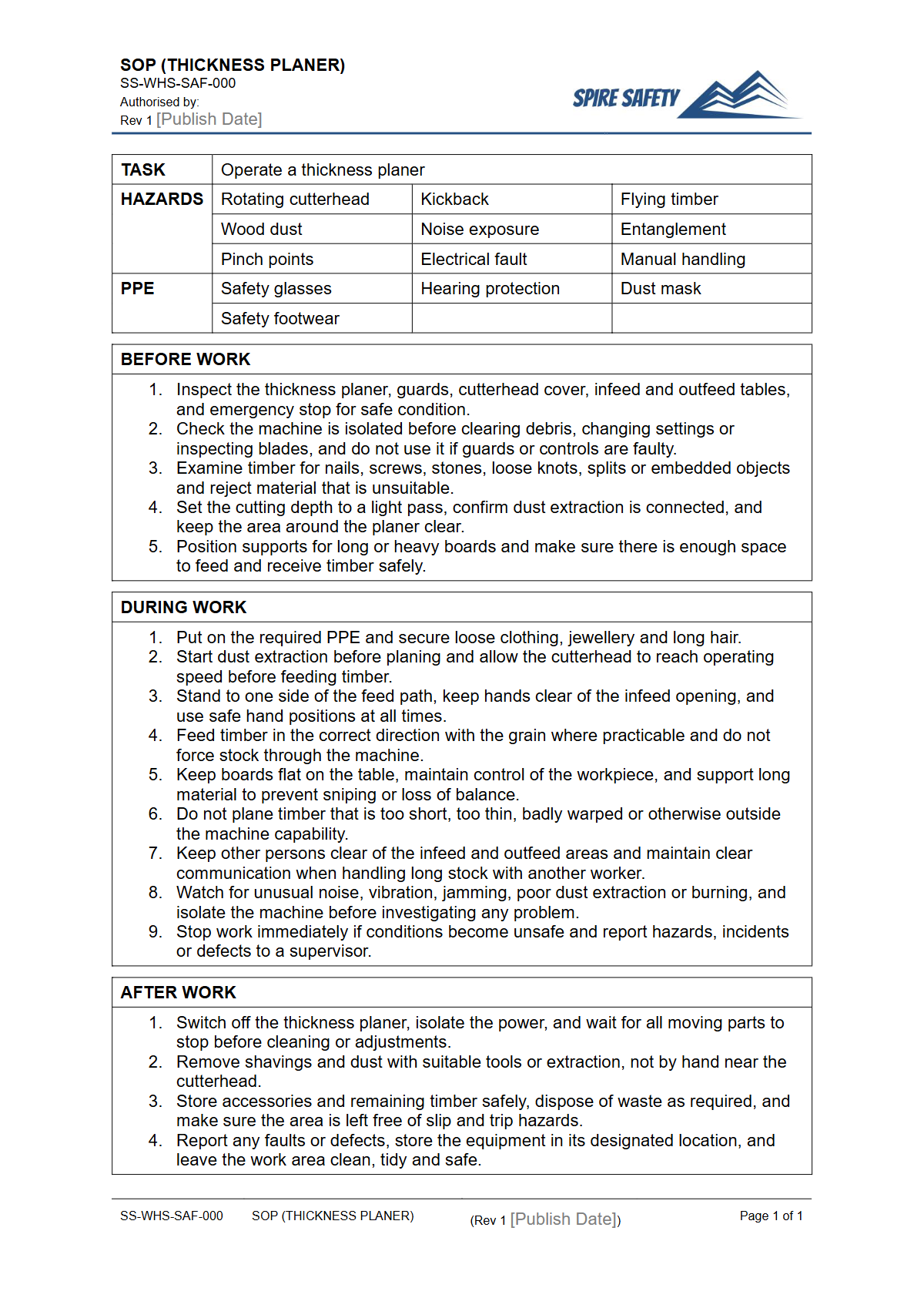
Our Safe Operating Procedure template provides a comprehensive structure for you to build upon. It prompts you to detail essential safety information, including:
- Required Personal Protective Equipment (PPE): Specifies the mandatory PPE, such as safety glasses, hearing protection, and dust masks.
- Pre-operational Safety Checks: A checklist of tasks to be completed before starting the machine, such as inspecting the power cord, ensuring guards are in place, and checking the condition of the anti-kickback fingers.
- Step-by-Step Operating Sequence: A logical flow for safely planing timber, covering workpiece inspection, setting cutting depth, feeding techniques, and managing offcuts.
- Post-operational Procedures: Outlines tasks for after use, such as cleaning the machine, waste disposal, and proper shutdown.
- Potential Hazards and Controls: A section to list identified risks (e.g., kickback, entanglement, noise, wood dust) and the control measures implemented to mitigate them.
When to use it
A Safe Operating Procedure for a thickness planer should be a living document used consistently throughout your operations. It is critical during worker induction and training, providing the authoritative guide on how to use the equipment safely from day one.
It should also be readily accessible in the work area as a quick reference for operators. Furthermore, the SOP is a key document for refresher training, especially if an operator has not used the machine for some time.
It becomes an essential review tool following a near miss or incident, helping to identify if procedural gaps contributed to the event. In many workshops, other equipment works in tandem with planers; having clear procedures for all plant, such as those outlined in our Air Compressor SOP, creates a safer environment overall.
Who should use it
This Safe Operating Procedure template is intended for any Person Conducting a Business or Undertaking (PCBU) whose workers operate a thickness planer. This includes cabinet makers, joinery shops, furniture manufacturers, school technical departments, and construction companies.
The primary users of the finalised document are the operators themselves. Supervisors and managers are also key users, as they are responsible for enforcing the procedure and ensuring workers are trained and competent.
WHS managers and Health and Safety Representatives (HSRs) will use the SOP as part of workplace inspections, risk assessments, and incident investigations. If you require assistance tailoring this document or developing a suite of SOPs for your specific needs, consider engaging our specialist WHS consulting services.
The responsibility for safety is shared, and a well-developed SOP clarifies the expectations for everyone involved. For complex production environments, clear documentation for all machinery is crucial.
A Conveyer System SOP, for instance, is vital for managing risks associated with material handling systems that might feed into or out of a woodworking area. Regular reviews and updates are critical to the ongoing effectiveness of any safety document.
Performing periodic WHS compliance auditing helps verify that documented procedures like this SOP are being followed correctly in practice. To explore more templates and tools, browse our complete free WHS resources library.
Common mistakes
Common mistakes to avoid
- Planing timber that is too short, which can cause it to become jammed or ejected from the machine.
- Failing to inspect and ensure anti-kickback fingers and pressure rollers are functioning correctly before use.
- Attempting to clear a jam or make depth adjustments while the cutterhead is still rotating.
- Neglecting to use appropriate Personal Protective Equipment (PPE), especially approved eye and hearing protection.
Legal references
Legal considerations
The following legal requirements may be relevant to this type of work.
- Work Health and Safety Act (Harmonised) — Provides the primary duties for protecting workers and other people from work health and safety risks.
- Work Health and Safety Regulations (Harmonised) — Sets out requirements supporting the management of workplace hazards and risks.
The following codes may be relevant to this type of work.
- Managing WHS Risks Code of Practice — Provides practical guidance on identifying hazards, assessing risks and applying effective controls.
- Work Health and Safety Consultation, Cooperation and Coordination Code of Practice — Provides practical guidance on consulting workers and coordinating with other duty holders.
- Managing the Work Environment and Facilities Code of Practice — Provides practical guidance on safe work environments, workplace facilities and related controls.
Did you know
Kickback Danger
Kickback is a primary hazard with thickness planers, occurring when the workpiece is suddenly thrown back towards the operator at high speed. This is often caused by feeding warped or twisted wood, or attempting to plane pieces that are too short.
Hazardous Wood Dust
Wood dust is classified as a hazardous substance that can cause serious health issues, including occupational asthma and nasal cancer. Effective dust extraction systems are a critical engineering control measure required when using a thickness planer.
FAQ
Frequently asked questions
01What should be included in a Safe Operating Procedure for a thickness planer?
02How often should a thickness planer SOP be reviewed?
03Is this template enough for WHS compliance?
04Who is responsible for developing the Safe Operating Procedure?
Share this resource
Free Safe Operating Procedure (Thickness Planer) Template
Browse Categories
How To Use It
- 1Download and open in Word or PDF.
- 2Replace the placeholders with your business details.
- 3Get it reviewed by a WHS specialist before rollout.
Need it customised?
Our WHS consultants can adapt this template to your site, run a gap analysis, or audit what you already have in place.
Book a Free Consultation WHS consulting servicesor call 1300 156 382
Related templates
- Free Safe Operating Procedure (Tile Grout Cleaning) Template
- Free Safe Operating Procedure (Tile Saw) Template
- Free Safe Operating Procedure (Till Drawer Removal) Template
- Free Safe Operating Procedure (Tilt Meter) Template
- Free Safe Operating Procedure (Toaster) Template
- Free Safe Operating Procedure (Toilet Cubicle Clean) Template