
Free Safe Operating Procedure (Tile Grout Cleaning) Template
Standardise your cleaning processes with our Free Safe Operating Procedure (Tile Grout Cleaning) Template. Download the customisable DOCX and PDF today.
Free Safe Operating Procedure (Tile Grout Cleaning) Template
DOCX • 126 KB + PDF
Updated Oct 2026
No signup required
Purpose of the Free Safe Operating Procedure (Tile Grout Cleaning) Template
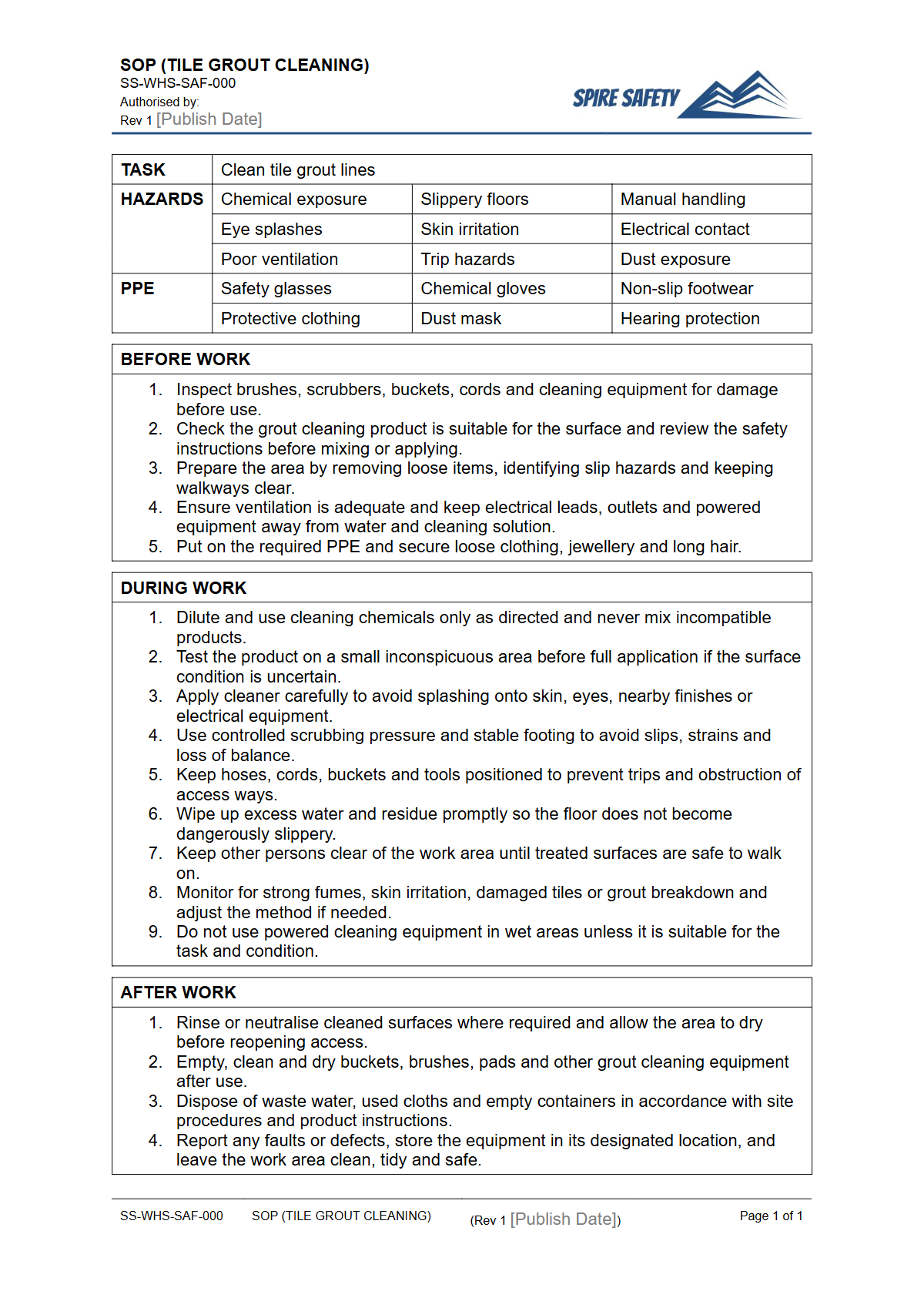
This Free Safe Operating Procedure (Tile Grout Cleaning) Template provides a structured framework for businesses to document the safe execution of tile and grout cleaning tasks. The primary purpose of an SOP is to standardise a process, ensuring every worker performs the task in the safest, most effective way possible, every time.
It serves as a critical tool for risk management, helping to identify and control hazards inherent in cleaning operations. These hazards can include chemical exposure from cleaning agents, slips and falls on wet surfaces, manual handling injuries from scrubbing or moving equipment, and electrical risks from powered cleaning tools.
By clearly outlining steps, required personal protective equipment (PPE), and emergency procedures, this template helps organisations meet their duty of care under Australian WHS laws. Implementing robust SOPs is a fundamental part of building a proactive safety culture.
It demonstrates a commitment to worker wellbeing and forms a key component of effective WHS management systems, integrating seamlessly with risk assessments and training programs.
Video walkthrough
How to use the Free Safe Operating Procedure (Tile Grout Cleaning) Template
This template is provided as a starting point. To use it, download the DOCX file and adapt it to the unique conditions of your workplace.
You must replace the placeholder text with specific details about the cleaning agents used, the types of equipment operated (e.g., brand and model of floor polishers or steamers), the specific locations, and your organisation's emergency contacts and procedures. This customisation is not optional; a generic document is insufficient for ensuring safety.
Important Note: This template is a tool to assist you. It is your responsibility to ensure the final document is accurate and reflects the specific risks and control measures relevant to your workplace.
We are not WHS consultants giving advice with this template; we are providing a foundation for you to build upon and take ownership of.
Once customised, the SOP should be used to train workers. It should be made readily accessible in the work area for reference.
Regular review and updates are essential, especially when new chemicals, equipment, or processes are introduced. An independent check can help verify its effectiveness as part of a scheduled WHS compliance auditing program.
When to use a Safe Operating Procedure
A Safe Operating Procedure for tile grout cleaning should be developed, implemented, and used before any work begins. It is a proactive document integral to the planning phase of any cleaning schedule.
It should be a core part of worker induction and ongoing training, ensuring competency before an employee is permitted to perform the task unsupervised. The SOP should also be referenced during pre-start meetings or toolbox talks to refresh workers' knowledge of hazards and controls.
Following any incident, near-miss, or identified hazard related to tile cleaning, the SOP must be reviewed and updated to prevent recurrence.
Who should use this document
This SOP is intended for use by anyone involved in the tile grout cleaning process. This includes:
- Workers and Cleaning Staff: To guide them in performing their tasks safely and consistently.
- Supervisors and Team Leaders: To train their teams, supervise work, and enforce safety standards.
- Managers and Persons Conducting a Business or Undertaking (PCBUs): To fulfil their duty of care by providing safe systems of work.
For organisations with diverse cleaning responsibilities, it's beneficial to maintain a library of task-specific SOPs. For example, a restaurant would complement this document with a Safe Operating Procedure for deep fryer cleaning to cover all its specialised cleaning needs.
Developing and implementing these documents can sometimes require specialist knowledge; our WHS consulting services can provide expert guidance tailored to your business needs.
The principles of documenting safe work methods extend to all equipment used on site. If pressurised equipment is used for cleaning or drying, a specific SOP for that plant is necessary, similar to this free Air Compressor SOP template. Having a full suite of SOPs ensures clarity and safety across all operations.
You can explore our complete free WHS resources library for more templates to support your safety management system.
Common mistakes
Common mistakes to avoid
- Failing to adequately ventilate the work area, leading to inhalation of hazardous fumes.
- Using incorrect chemical dilutions, increasing risk and potentially damaging surfaces.
- Forgetting to display 'Caution: Wet Floor' signs, creating a slip hazard for others.
- Neglecting to customise the generic template with site-specific chemicals, equipment, and emergency procedures.
Legal references
Legal considerations
The following legal requirements may be relevant to this type of work.
- Work Health and Safety Act (Harmonised) — Provides the primary duties for protecting workers and other people from work health and safety risks.
- Work Health and Safety Regulations (Harmonised) — Sets out requirements supporting the management of workplace hazards and risks.
The following codes may be relevant to this type of work.
- Managing WHS Risks Code of Practice — Provides practical guidance on identifying hazards, assessing risks and applying effective controls.
- Work Health and Safety Consultation, Cooperation and Coordination Code of Practice — Provides practical guidance on consulting workers and coordinating with other duty holders.
- Managing the Work Environment and Facilities Code of Practice — Provides practical guidance on safe work environments, workplace facilities and related controls.
Did you know
Slips and Trips
Slips, trips and falls are a leading cause of serious injuries in Australian workplaces, making control measures like 'wet floor' signs and non-slip footwear critically important during cleaning operations.
Chemical Dilution
Using a stronger-than-recommended concentration of a cleaning chemical does not always improve performance but significantly increases health risks and can damage the surfaces being cleaned.
FAQ
Frequently asked questions
01What PPE is generally required for tile grout cleaning?
02How often should a Safe Operating Procedure for tile grout cleaning be reviewed?
03Is an SOP mandatory for tile grout cleaning in Australia?
04What are the main hazards of tile grout cleaning?
Share this resource
Free Safe Operating Procedure (Tile Grout Cleaning) Template
Browse Categories
How To Use It
- 1Download and open in Word or PDF.
- 2Replace the placeholders with your business details.
- 3Get it reviewed by a WHS specialist before rollout.
Need it customised?
Our WHS consultants can adapt this template to your site, run a gap analysis, or audit what you already have in place.
Book a Free Consultation WHS consulting servicesor call 1300 156 382
Related templates
- Free Safe Operating Procedure (Tile Saw) Template
- Free Safe Operating Procedure (Till Drawer Removal) Template
- Free Safe Operating Procedure (Tilt Meter) Template
- Free Safe Operating Procedure (Toaster) Template
- Free Safe Operating Procedure (Toilet Cubicle Clean) Template
- Free Safe Operating Procedure (Torque Multiplier) Template