
Free Safe Operating Procedure (Thermal Imaging Camera) Template
Download our free Safe Operating Procedure (Thermal Imaging Camera) template. This customisable DOCX and PDF helps you outline safe work practices.
Free Safe Operating Procedure (Thermal Imaging Camera) Template
DOCX • 126 KB + PDF
Updated Oct 2026
No signup required
Purpose of the Free Safe Operating Procedure (Thermal Imaging Camera) Template
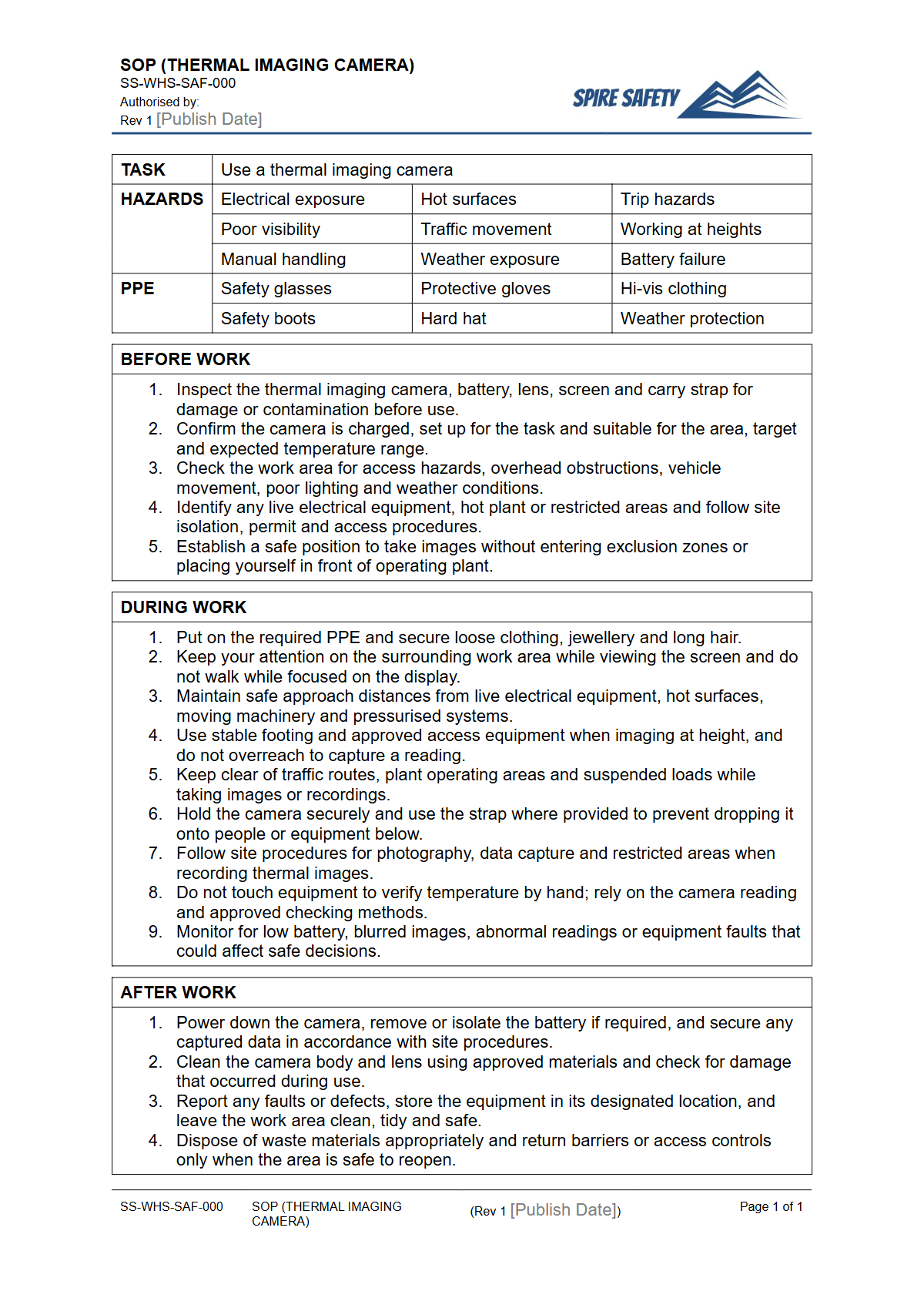
Effectively manage the risks associated with using thermal imaging equipment with our comprehensive Free Safe Operating Procedure (Thermal Imaging Camera) Template. This resource provides a structured framework for documenting step-by-step instructions for the safe operation, maintenance, and storage of thermal imaging cameras in your workplace. Using this SOP helps standardise procedures, train personnel, and demonstrate a commitment to proactive risk management, particularly during diagnostic tasks like predictive maintenance and electrical inspections.
A thermal imaging camera is a powerful non-contact tool used to detect temperature variations in equipment and infrastructure. A formal SOP ensures that operators use it correctly to identify potential hazards, such as overheating electrical components, faulty mechanical parts, or insulation deficiencies.
By outlining clear procedures, you can prevent equipment failure, reduce the risk of fire, and enhance overall operational safety. This is particularly important when inspecting complex machinery, where a consistent approach is key to reliable data, similar to the protocols outlined in our free Air Compressor SOP template.
Video walkthrough
How to use the Free Safe Operating Procedure (Thermal Imaging Camera) Template
This template is designed for easy customisation to suit your specific operational needs. To get started, download the DOCX file and integrate it into your organisation's safety management system.
The key steps are to add your company name and logo, review each section, and modify the content to align with your specific model of thermal imager, the environments where it will be used, and any unique site hazards. A crucial step is to conduct a site-specific risk assessment and incorporate its findings into the SOP.
You should also specify required Personal Protective Equipment (PPE), detail emergency shutdown procedures, and list the names or roles of authorised personnel. Training records should be maintained to ensure only competent individuals operate the equipment.
Once customised, the SOP should be used as a primary reference for training and a guide for day-to-day operations. This documentation is a vital component of holistic WHS management systems, providing clear evidence of controlled work practices.
Please note: This template provides a solid foundation, but it is not a complete solution. We strongly recommend you customise this document to reflect the specific equipment, environment, and risks present in your workplace.
When to use a Thermal Imaging Camera SOP
This Safe Operating Procedure should be implemented whenever a thermal imaging camera is used for diagnostic or inspection tasks. Its application is broad, covering predictive and preventative maintenance schedules across various industries.
Common scenarios include electrical inspections of switchboards and motor control centres, mechanical inspections of bearings and gearboxes, and building diagnostics to detect moisture or energy loss. The SOP ensures these tasks are performed consistently and safely every time.
It is also essential during the onboarding and training of new technicians or electricians who will be using the equipment. The document serves as a training aid to ensure they understand the operational steps, associated hazards, and control measures before commencing work.
Regular use of the SOP helps foster a culture of safety and precision, ensuring that the valuable data collected from inspections of assets like those in our Conveyer System SOP is both accurate and safely obtained.
Who should use this Safe Operating Procedure
This SOP is intended for use by any person required to operate a thermal imaging camera as part of their job role. This includes, but is not limited to, qualified electricians, maintenance technicians, reliability engineers, building inspectors, and WHS professionals.
It is also a valuable tool for supervisors and managers responsible for overseeing maintenance activities and ensuring safe work practices are followed.
Competency is key; individuals using this SOP should be formally trained and deemed competent not only in the procedure itself but also in the principles of thermography and the specific functions of the camera they are operating. The effectiveness of your safety procedures can be evaluated through services such as WHS compliance auditing, which can help verify that documented processes are being correctly implemented in the field.
Ultimately, anyone involved in the lifecycle of thermal imaging inspections—from planning to execution and reporting—will benefit from this structured guide. For more guidance on developing workplace-specific documentation, consider engaging with our WHS consulting team.
Common mistakes
Common mistakes to avoid
- Forgetting to adjust for emissivity and reflections, leading to inaccurate temperature readings.
- Using the camera without a solid understanding of the system being inspected.
- Failing to document findings systematically, which prevents effective trend analysis over time.
- Relying on the camera as the sole diagnostic tool without performing further investigation to confirm faults.
Legal references
Legal considerations
The following legal requirements may be relevant to this type of work.
- Work Health and Safety Act (Harmonised) — Provides the primary duties for protecting workers and other people from work health and safety risks.
- Work Health and Safety Regulations (Harmonised) — Sets out requirements supporting the management of workplace hazards and risks.
The following codes may be relevant to this type of work.
- Managing WHS Risks Code of Practice — Provides practical guidance on identifying hazards, assessing risks and applying effective controls.
- Work Health and Safety Consultation, Cooperation and Coordination Code of Practice — Provides practical guidance on consulting workers and coordinating with other duty holders.
- Managing the Work Environment and Facilities Code of Practice — Provides practical guidance on safe work environments, workplace facilities and related controls.
Did you know
Military Origins
The technology behind thermal imaging was first developed for military use, particularly for night vision and target acquisition during the Korean War, before being adapted for commercial and industrial applications.
Beyond Heat Detection
Some advanced thermal cameras can also detect and visualise gas leaks that are invisible to the naked eye, a critical function for safety in industries like oil and gas processing.
FAQ
Frequently asked questions
01What should be included in a thermal imaging camera SOP?
02Is special training required to use a thermal imaging camera?
03What are the main hazards of using a thermal imaging camera?
04How often should a thermal imaging camera SOP be reviewed?
Share this resource
Free Safe Operating Procedure (Thermal Imaging Camera) Template
Browse Categories
How To Use It
- 1Download and open in Word or PDF.
- 2Replace the placeholders with your business details.
- 3Get it reviewed by a WHS specialist before rollout.
Need it customised?
Our WHS consultants can adapt this template to your site, run a gap analysis, or audit what you already have in place.
Book a Free Consultation WHS consulting servicesor call 1300 156 382
Related templates
- Free Safe Operating Procedure (Thermal Lance) Template
- Free Safe Operating Procedure (Thickness Planer) Template
- Free Safe Operating Procedure (Tile Grout Cleaning) Template
- Free Safe Operating Procedure (Tile Saw) Template
- Free Safe Operating Procedure (Till Drawer Removal) Template
- Free Safe Operating Procedure (Tilt Meter) Template