
Free Safe Operating Procedure (Tender Boat Operation) Template
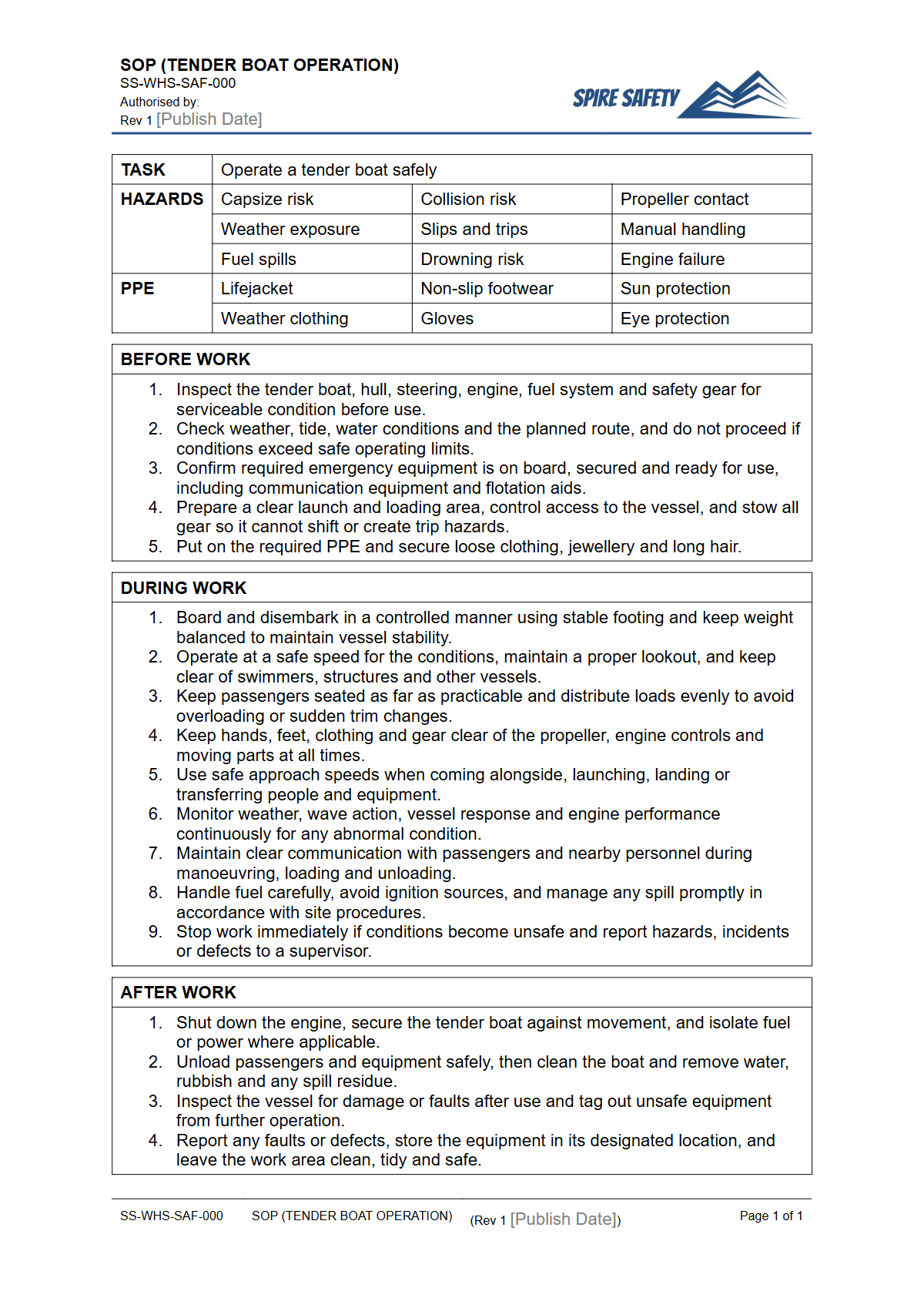
Ensure safety on the water with our Free Safe Operating Procedure for Tender Boat Operation. Download this customisable template to get started today.
Free Safe Operating Procedure (Tender Boat Operation) Template
DOCX • 126 KB + PDF
Updated Oct 2026
No signup required
Purpose of the Free Safe Operating Procedure (Tender Boat Operation) Template
Operating a tender boat, whether for transport, maintenance, or emergency response, involves significant risks that must be carefully managed. This Free Safe Operating Procedure (Tender Boat Operation) template provides a structured starting point for organisations to document the required steps for safe and effective boat handling.
An SOP formalises the process, ensuring that every operator follows a consistent, pre-approved method that minimises risks such as falls overboard, collisions, capsizing, and equipment failure. By outlining clear instructions for pre-start checks, launching, on-water conduct, and recovery, this document serves as a critical tool for training, operational consistency, and demonstrating due diligence.
It forms a key component of robust WHS management systems by turning risk assessments into actionable practice.
Video walkthrough
How to use the Free Safe Operating Procedure (Tender Boat Operation) Template
This resource is available for download as a DOCX file for easy editing and customisation, and as a PDF for straightforward printing and distribution. To use this template effectively, you must adapt it to your specific operational context.
This involves identifying the unique hazards of your workplace—such as local water conditions, vessel traffic, and environmental factors—and detailing the control measures required to manage them. The procedure should be developed in consultation with workers who operate the tender boats, as their practical experience is invaluable.
Once customised, the SOP should be used as a primary training document for new operators and a regular refresher for experienced staff.
Important: This is a template, not a finished document. We have drafted it as a starting point, but you must review, edit, and add site-specific details to reflect your unique operational environment, the specific model of tender boat, and your risk assessment findings.
A generic procedure is not sufficient to meet your safety obligations. The effectiveness of your implemented procedures can be verified through processes like WHS compliance auditing.
Key Sections to Customise
Pay close attention to the following sections to ensure the SOP is relevant and effective for your workplace:
- Hazards and Risks: Go beyond generic risks. List specific hazards relevant to your area of operation, such as strong tidal currents, submerged objects, interactions with larger vessels, or extreme weather potential.
- Pre-Operational Checks: Tailor the checklist to your specific tender boat model. Include checks for the engine, fuel levels and integrity, battery charge, steering and throttle controls, kill switch lanyard, and all onboard safety equipment.
- Personal Protective Equipment (PPE): Specify the exact type of PPE required. For example, instead of just "life jacket," specify "PFD Type 1" or another standard appropriate for your operational area. Also include requirements for footwear, sun protection, and wet weather gear.
- Emergency Procedures: Detail the step-by-step actions for emergencies like man overboard, fire, engine failure, loss of steering, and medical incidents. Include contact details for emergency services and vessel-to-shore communication protocols. Implementing a systematic approach, such as those guided by ISO 45001 consulting, can help ensure all potential emergency scenarios are considered and planned for.
When to use a Safe Operating Procedure
A Safe Operating Procedure for tender boat operation should be used for all work-related activities involving the vessel. It is not just for high-risk manoeuvres but for the entire operational cycle, from pre-launch preparations to post-use cleaning and stowage.
It should be readily accessible to operators at all times, either in a waterproof document holder on the vessel or at the launch point. The SOP is a mandatory reference during operator training and competency assessments and should be reviewed before undertaking any non-routine tasks.
Who should use it
This Safe Operating Procedure is intended for use by several key roles within an organisation:
- Boat Operators: As a direct guide for performing their duties safely and consistently.
- Supervisors and Managers: To induct and train workers, conduct competency assessments, and supervise operations to ensure they align with documented procedures.
- WHS Managers and Safety Officers: To develop and integrate into the organisation's overall safety management system, use in risk assessments, and assist in incident investigations.
For businesses needing expert guidance on developing and implementing these critical safety documents, our WHS consulting services provide tailored support. If you found this template helpful, you may find other useful documents in our comprehensive free WHS resources library.
Common mistakes
Common mistakes to avoid
- Neglecting thorough pre-start checks of the engine, fuel, and safety equipment.
- Failing to check weather forecasts and tide charts before and during operation.
- Overloading the vessel with personnel or equipment beyond its rated capacity.
- Not wearing the engine kill switch lanyard, leading to a runaway boat if the operator falls overboard.
Legal references
Legal considerations
The following legal requirements may be relevant to this type of work.
- Work Health and Safety Act (Harmonised) — Provides the primary duties for protecting workers and other people from work health and safety risks.
- Work Health and Safety Regulations (Harmonised) — Sets out requirements supporting the management of workplace hazards and risks.
The following codes may be relevant to this type of work.
- Managing WHS Risks Code of Practice — Provides practical guidance on identifying hazards, assessing risks and applying effective controls.
- Work Health and Safety Consultation, Cooperation and Coordination Code of Practice — Provides practical guidance on consulting workers and coordinating with other duty holders.
- Managing the Work Environment and Facilities Code of Practice — Provides practical guidance on safe work environments, workplace facilities and related controls.
Did you know
Kill Switch Lanyards
In many Australian states, it is a legal requirement for the operator of a powerboat under 4.8m with a tiller-steered engine to have the kill switch lanyard attached to their person while the engine is running.
Alcohol Limits
The legal blood alcohol limit for recreational boat operators in Australia is under 0.05, the same as for driving a car. For commercial operators, the limit is a strict 0.00.
FAQ
Frequently asked questions
01What should be included in a Tender Boat Operation SOP?
02Is formal training required to operate a tender boat for work?
03How often should a Safe Operating Procedure for tender boats be reviewed?
04What personal protective equipment (PPE) is essential for tender boat operations?
Share this resource
Free Safe Operating Procedure (Tender Boat Operation) Template
Browse Categories
How To Use It
- 1Download and open in Word or PDF.
- 2Replace the placeholders with your business details.
- 3Get it reviewed by a WHS specialist before rollout.
Need it customised?
Our WHS consultants can adapt this template to your site, run a gap analysis, or audit what you already have in place.
Book a Free Consultation WHS consulting servicesor call 1300 156 382
Related templates
- Free Safe Operating Procedure (Tennis Court Cleaning) Template
- Free Safe Operating Procedure (Terminal Tractor) Template
- Free Safe Operating Procedure (Theatre Backstage Clean) Template
- Free Safe Operating Procedure (Thermal Imaging Camera) Template
- Free Safe Operating Procedure (Thermal Lance) Template
- Free Safe Operating Procedure (Thickness Planer) Template