
Free Safe Operating Procedure (Terminal Tractor) Template
Formalise your worksite's safety protocols with our free Safe Operating Procedure (Terminal Tractor) Template. Download the DOCX and start customising today.
Free Safe Operating Procedure (Terminal Tractor) Template
DOCX • 126 KB + PDF
Updated Oct 2026
No signup required
Purpose of the Free Safe Operating Procedure (Terminal Tractor) Template
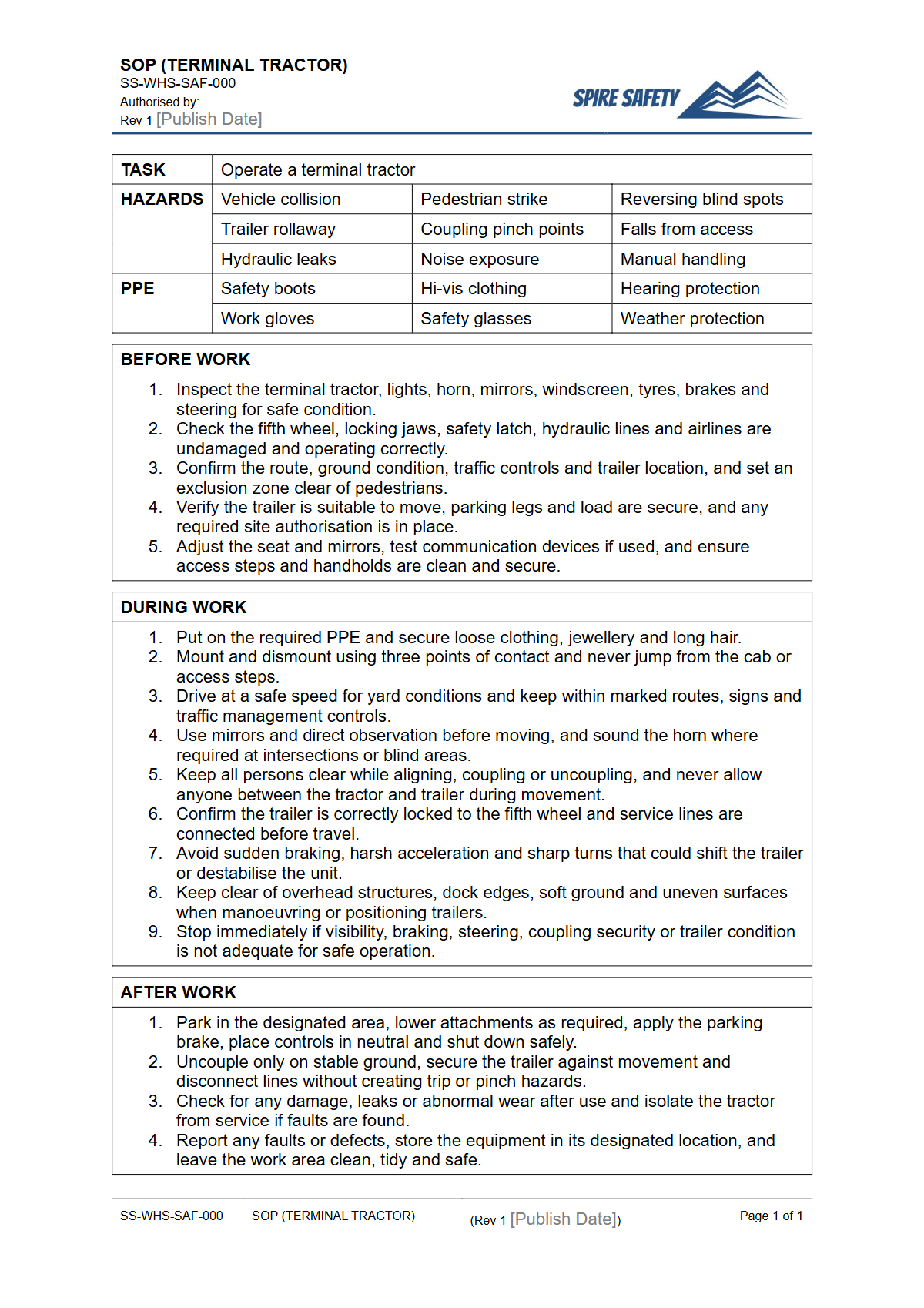
Operating a terminal tractor, also known as a yard dog or shunt truck, involves significant risks due to the vehicle's power and the often-congested environments of ports, distribution centres, and rail yards. This Safe Operating Procedure (SOP) template provides a structured framework for documenting the safe methods of performing tasks associated with terminal tractor operations.
It helps your organisation identify hazards, assess risks, and implement effective control measures to protect workers and visitors.
A comprehensive SOP is a key component of effective WHS management systems. This template guides you through detailing critical safety steps, including pre-operational checks, safe driving techniques within a traffic management plan, procedures for coupling and uncoupling semi-trailers, and shutdown protocols. It also prompts consideration of environmental hazards, such as interactions with other vehicles, pedestrians, and fixed structures like a conveyer system. By formalising these procedures, you create a clear, consistent standard for all operators to follow, reducing the likelihood of incidents and demonstrating due diligence.
What is a Safe Operating Procedure?
A Safe Operating Procedure is a written document that provides step-by-step instructions on how to perform a task safely. It breaks down a job into its fundamental steps, identifies the associated hazards for each step, and outlines the control measures required to eliminate or minimise the risk of injury or illness.
An SOP is an essential administrative control used to standardise performance and support worker training.
Video walkthrough
How to use the Free Safe Operating Procedure (Terminal Tractor) Template
This resource is provided as a fully editable DOCX file to serve as a starting point. It is not a complete, out-of-the-box solution.
You must systematically review and adapt the content to align with the specific context of your workplace.
Important: We have provided a comprehensive but generic foundation. You must customise this document with details specific to your site, including the makes and models of your terminal tractors, your site’s traffic management plan, emergency procedures, and specific personal protective equipment (PPE) requirements.
Involve your experienced operators and supervisors in this customisation process to ensure the final SOP is practical, accurate, and reflects how work is actually done. This collaborative approach also improves worker buy-in and ownership of safety processes, similar to the development of procedures for other mobile plant like our FREE Telehandler SOP Template.
When to use a Terminal Tractor Safe Operating Procedure
A documented SOP for terminal tractor use is a versatile tool that should be integrated into your daily safety practices. It is not a document to be filed away and forgotten.
It should be actively used during key phases of the employment and operational lifecycle.
Primary uses include:
- Induction and Training: Use the SOP as a core training document for all new operators to ensure they understand the established safe work method from day one.
- Refresher Training: Provide the SOP to experienced operators as part of periodic refresher training to reinforce correct procedures and communicate any updates.
- Risk Assessments: Refer to the SOP when conducting or reviewing risk assessments for terminal tractor operations.
- Incident Investigations: Use the SOP as a benchmark to determine if procedures were followed correctly during an incident investigation.
- Audits and Inspections: A well-maintained and implemented SOP serves as crucial evidence of a functioning safety system during internal or external WHS compliance auditing.
Who should use this Safe Operating Procedure
The responsibility for using and maintaining the terminal tractor SOP extends across multiple roles within an organisation. It is a tool for management, supervisors, and operators alike, each playing a distinct part in its successful implementation.
- WHS Managers/Coordinators: Responsible for developing, implementing, and reviewing the SOP as part of the overall safety management system. They ensure it is based on a thorough risk assessment and aligns with legal requirements.
- Supervisors and Team Leaders: Responsible for ensuring operators are trained on the SOP, understand its contents, and follow it consistently. They use it for direct observation, competency assessments, and providing performance feedback.
- Terminal Tractor Operators: The primary users of the SOP. They must understand and follow the documented procedures during every shift to ensure their own safety and the safety of others around them.
Developing robust SOPs for all high-risk plant is a cornerstone of good safety practice. This process is equally important for other heavy equipment, and you can adapt the same principles used here when creating documents like a FREE Scraper SOP Template for earthmoving activities.
For professional guidance on tailoring this document or developing a complete safety framework for your operations, consider our expert WHS consulting services. You can also explore our extensive free WHS resources library for more templates and guides to support your safety objectives.
Common mistakes
Common mistakes to avoid
- Failing to customise the template with site-specific details like traffic flow rules and yard layout.
- Neglecting to include pre-start check and shutdown procedures specific to the make and model of the tractor.
- Using the SOP as a one-off training document instead of an active, ongoing reference for operators and supervisors.
- Not involving experienced operators in the drafting and review process, leading to a procedure that is impractical or ignored.
Legal references
Legal considerations
The following legal requirements may be relevant to this type of work.
- Work Health and Safety Act (Harmonised) — Provides the primary duties for protecting workers and other people from work health and safety risks.
- Work Health and Safety Regulations (Harmonised) — Sets out requirements supporting the management of workplace hazards and risks.
The following codes may be relevant to this type of work.
- Managing WHS Risks Code of Practice — Provides practical guidance on identifying hazards, assessing risks and applying effective controls.
- Work Health and Safety Consultation, Cooperation and Coordination Code of Practice — Provides practical guidance on consulting workers and coordinating with other duty holders.
- Managing the Work Environment and Facilities Code of Practice — Provides practical guidance on safe work environments, workplace facilities and related controls.
Did you know
Also Known As...
Terminal tractors are commonly referred to by various names depending on the region and industry, including yard dogs, shunt trucks, terminal tugs, or jockey trucks.
High-Risk Environment
These vehicles operate almost exclusively in congested, high-traffic areas like ports, intermodal facilities, and distribution centres, making robust traffic management plans and operator vigilance essential for safety.
FAQ
Frequently asked questions
01What is a Safe Operating Procedure for a terminal tractor?
02Who is responsible for writing a terminal tractor SOP?
03Does this terminal tractor SOP template meet WHS regulations?
04How often should a terminal tractor SOP be reviewed?
Share this resource
Free Safe Operating Procedure (Terminal Tractor) Template
Browse Categories
How To Use It
- 1Download and open in Word or PDF.
- 2Replace the placeholders with your business details.
- 3Get it reviewed by a WHS specialist before rollout.
Need it customised?
Our WHS consultants can adapt this template to your site, run a gap analysis, or audit what you already have in place.
Book a Free Consultation WHS consulting servicesor call 1300 156 382
Related templates
- Free Safe Operating Procedure (Theatre Backstage Clean) Template
- Free Safe Operating Procedure (Thermal Imaging Camera) Template
- Free Safe Operating Procedure (Thermal Lance) Template
- Free Safe Operating Procedure (Thickness Planer) Template
- Free Safe Operating Procedure (Tile Grout Cleaning) Template
- Free Safe Operating Procedure (Tile Saw) Template