
Free Safe Operating Procedure (Tailgate Delivery) Template
Manage delivery risks with our Free Safe Operating Procedure (Tailgate Delivery) Template. Download your customisable DOCX and PDF to improve safety now.
Free Safe Operating Procedure (Tailgate Delivery) Template
DOCX • 126 KB + PDF
Updated Oct 2026
No signup required
Purpose of the Free Safe Operating Procedure (Tailgate Delivery) Template
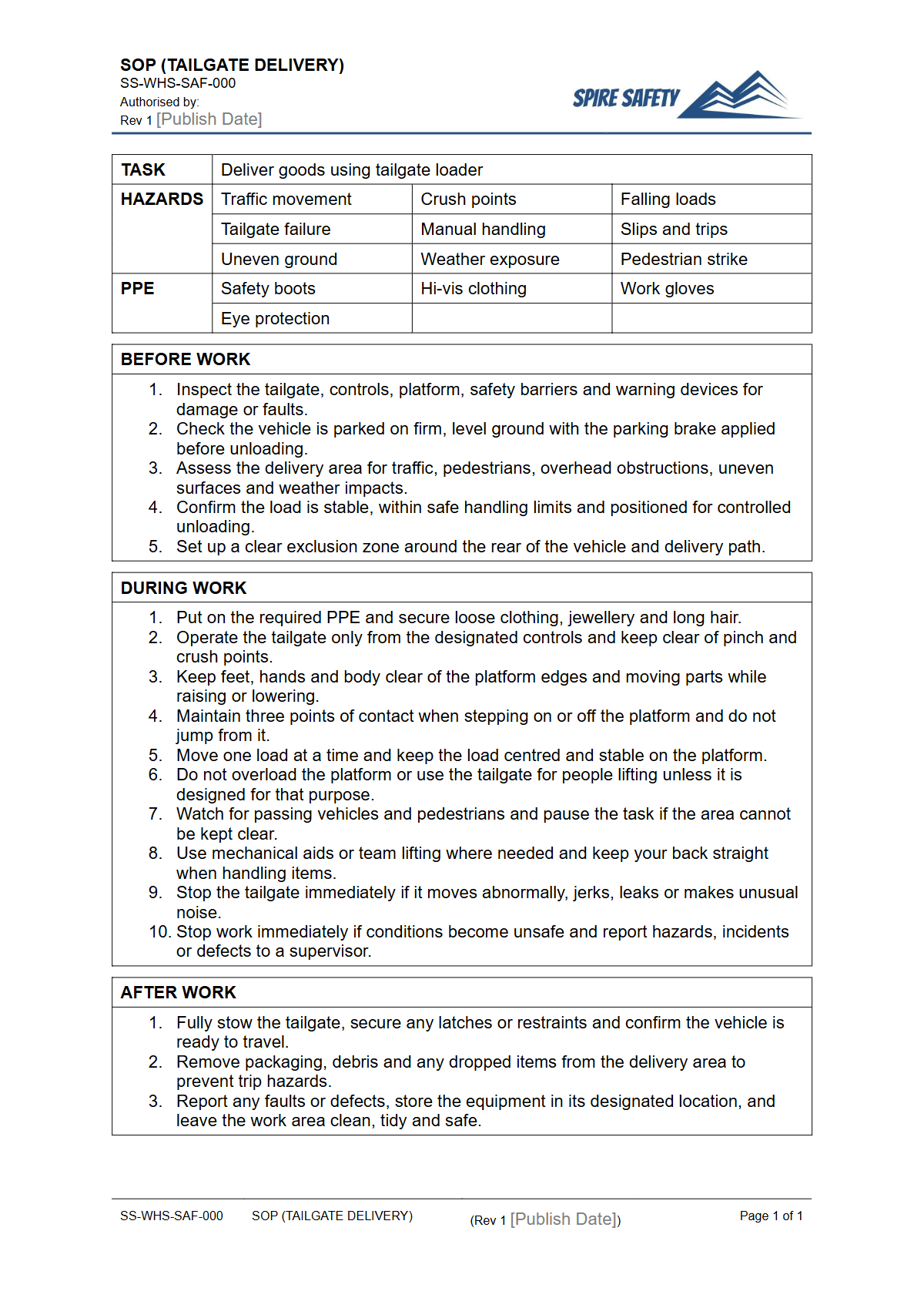
Tailgate deliveries present numerous safety risks, from falls from height to musculoskeletal injuries and traffic incidents. This Free Safe Operating Procedure (Tailgate Delivery) Template provides a structured starting point for your business to formalise and standardise its processes for receiving and dispatching goods from the rear of vehicles.
By documenting a clear, step-by-step method, you can effectively communicate safety requirements to all personnel involved, including drivers, warehouse staff, and supervisors.
A documented Safe Operating Procedure (SOP) is a fundamental tool for hazard management. It helps your organisation identify potential dangers before they cause harm and implement robust control measures.
Integrating this procedure is a key part of developing comprehensive WHS management systems that protect your workers and demonstrate due diligence.
What this Safe Operating Procedure covers
This template is designed to guide you through documenting the critical stages of a tailgate delivery, including:
- Pre-operational checks and site preparation
- Vehicle positioning and securing
- Establishing exclusion zones
- Safe loading and unloading practices (both mechanical and manual)
- Communication protocols between drivers and site personnel
- Post-operation clean-up and vehicle departure
Video walkthrough
How to use the Free Safe Operating Procedure (Tailgate Delivery) Template
IMPORTANT: This document is a template only. We have designed it as a starting point, but you must customise it to reflect the specific equipment, environment, and procedures of your workplace.
A generic procedure is not sufficient to meet your safety obligations.
To implement this SOP effectively, follow these steps:
- Download the DOCX file and save it to your system.
- Conduct a site-specific risk assessment for all tasks associated with tailgate deliveries at your premises.
- Modify the template with details from your risk assessment. This includes specifying the types of vehicles you service, the loading equipment used (e.g., pallet jacks, forklifts, cranes), your site layout, traffic flow, and emergency procedures.
- Consult with your workers, including delivery drivers and warehouse staff, during the customisation process. Their direct experience is invaluable for creating a practical and effective procedure.
- Once finalised, use the SOP as a primary document for training all relevant personnel. Ensure everyone understands their roles and responsibilities.
If your loading processes involve specific heavy machinery, you must also have SOPs for that equipment. For example, if a telehandler is used to move pallets, you should integrate controls from a FREE Telehandler SOP Template into your overall workflow.
When to use it
This Safe Operating Procedure should be the standard for every delivery or dispatch that occurs via a vehicle's tailgate, particularly at sites that lack dedicated, built-in loading docks. It establishes a baseline for safe behaviour that applies regardless of the frequency of deliveries.
Use the finalised document for:
- Worker Training: As a core part of training new and existing employees on safe delivery practices.
- Site Inductions: To inform visiting drivers and contractors of your site's specific safety rules.
- Toolbox Talks: As a reference for short, focused safety discussions on logistics-related hazards.
- Incident Investigations: To review whether established procedures were followed in the event of a near miss or accident.
For large logistics hubs where goods are moved from the truck to other areas, this procedure works alongside others. For instance, processes for transferring items onto an automated system would be detailed in a separate document like a FREE Conveyer System SOP (Safe Operating Procedure) Template.
Who should use it
This procedure is relevant to a wide range of roles within any organisation that handles freight. Primary users include:
- Warehouse Staff & Storepersons: Those physically loading or unloading the goods.
- Forklift and Plant Operators: Personnel using machinery to move items to and from the vehicle.
- Delivery Drivers: Who are responsible for their vehicle and their own safety while on your site.
- Supervisors and Managers: Who must ensure the procedure is understood, implemented, and consistently followed.
Ultimately, a successful safety culture requires that everyone understands their part. Regular checks can confirm that procedures are being correctly applied, which can be formalised through a program of WHS compliance auditing. This verifies that the controls you have documented are working effectively in practice.
To ensure a safe working environment, procedures for all ancillary equipment used in the loading area must also be available. This can include items covered in a Free Air Compressor SOP (Safe Operating Procedure) Template if pneumatic tools or systems are in use. To see what other procedures can help strengthen your safety framework, you can browse our complete free WHS resources library.
Common mistakes
Common mistakes to avoid
- Failing to create a designated exclusion zone around the vehicle during loading/unloading.
- Assuming the delivery driver is solely responsible for safety, ignoring site-specific responsibilities.
- Using the SOP as a 'tick-and-flick' exercise without proper worker training and consultation.
- Not updating the procedure after a near miss or incident occurs.
Legal references
Legal considerations
The following legal requirements may be relevant to this type of work.
- Work Health and Safety Act (Harmonised) — Provides the primary duties for protecting workers and other people from work health and safety risks.
- Work Health and Safety Regulations (Harmonised) — Sets out requirements supporting the management of workplace hazards and risks.
The following codes may be relevant to this type of work.
- Managing WHS Risks Code of Practice — Provides practical guidance on identifying hazards, assessing risks and applying effective controls.
- Work Health and Safety Consultation, Cooperation and Coordination Code of Practice — Provides practical guidance on consulting workers and coordinating with other duty holders.
- Managing the Work Environment and Facilities Code of Practice — Provides practical guidance on safe work environments, workplace facilities and related controls.
Did you know
Significant Risk
Falls from trucks are a leading cause of serious injuries in the transport and logistics industry. A significant portion of these incidents occur during loading and unloading activities at the rear of the vehicle.
Not Just For Drivers
The 'chain of responsibility' under the Heavy Vehicle National Law (HVNL) means that parties other than the driver, such as consignors and receivers, also have a legal duty to ensure the safety of transport activities.
FAQ
Frequently asked questions
01What hazards should a tailgate delivery SOP address?
02Is a Safe Operating Procedure for tailgate delivery a legal requirement in Australia?
03How often should we review our Tailgate Delivery SOP?
04Who is responsible for enforcing the tailgate delivery SOP on site?
Share this resource
Free Safe Operating Procedure (Tailgate Delivery) Template
Browse Categories
How To Use It
- 1Download and open in Word or PDF.
- 2Replace the placeholders with your business details.
- 3Get it reviewed by a WHS specialist before rollout.
Need it customised?
Our WHS consultants can adapt this template to your site, run a gap analysis, or audit what you already have in place.
Book a Free Consultation WHS consulting servicesor call 1300 156 382
Related templates
- Free Safe Operating Procedure (Tanning Bed Cleaning) Template
- Free Safe Operating Procedure (Tea Urn Cleaning) Template
- Free Safe Operating Procedure (Temperature Calibrator) Template
- Free Safe Operating Procedure (Temporary Handrail) Template
- Free Safe Operating Procedure (Temporary Power) Template
- Free Safe Operating Procedure (Tender Boat Operation) Template