
Free Safe Operating Procedure (Tea Urn Cleaning) Template
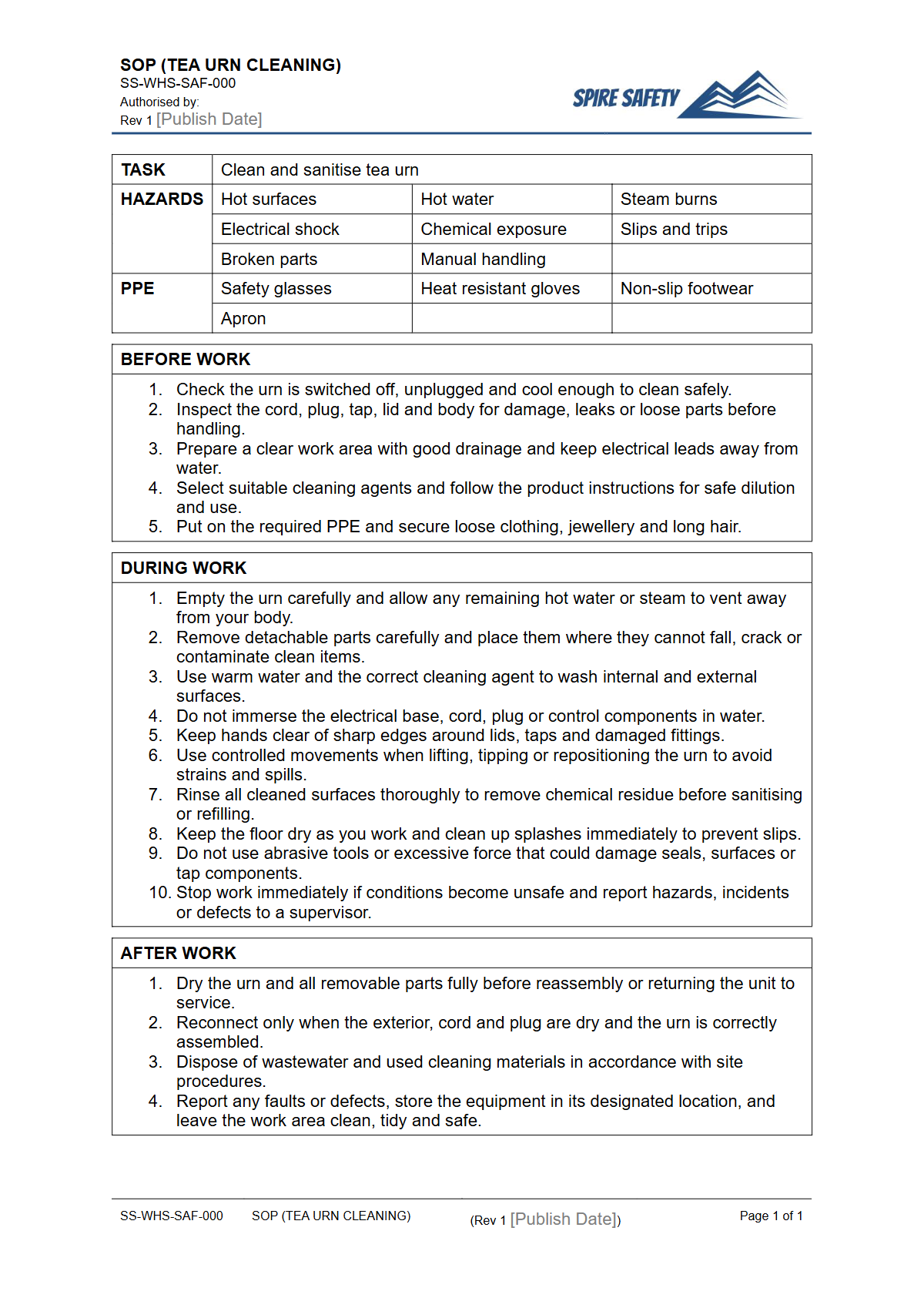
Download our free Safe Operating Procedure (Tea Urn Cleaning) Template. This customisable document helps you outline key safety steps for your workplace.
Free Safe Operating Procedure (Tea Urn Cleaning) Template
DOCX • 126 KB + PDF
Updated Oct 2026
No signup required
Purpose of the Free Safe Operating Procedure (Tea Urn Cleaning) Template
Effectively managing workplace health and safety involves addressing all potential risks, even those associated with seemingly simple tasks. This Free Safe Operating Procedure (Tea Urn Cleaning) Template provides a structured framework for documenting the safest way to clean and maintain a commercial tea urn.
While it might seem like a low-risk activity, cleaning a tea urn involves specific hazards, including burns from hot water or steam, electrical shocks, manual handling injuries from lifting heavy, water-filled units, and slips from spills. Using a formal SOP ensures that all workers follow a consistent, safe process every time.
By formalising the procedure, you create a clear training tool for new employees and a reliable reference for existing staff. A documented SOP demonstrates a commitment to proactive risk management and helps build a stronger safety culture within your organisation.
It forms a crucial part of broader comprehensive WHS management systems, ensuring that every task, no matter how small, is assessed for risk. This structured approach is essential for any business aiming to meet its duty of care under Australian WHS legislation.
Video walkthrough
How to use the Free Safe Operating Procedure (Tea Urn Cleaning) Template
This template is provided as a starting point. It is not a complete, universally applicable document.
You must customise it to reflect the specific equipment, chemicals, and environmental conditions of your workplace. Download the DOCX file and edit it to include details specific to your tea urn model, the approved cleaning agents you use, and any site-specific hazards.
We recommend a collaborative approach: consult with the workers who perform this task regularly to ensure the procedure is practical, accurate, and reflects how the job is actually done.
The template guides you through key sections, including:
- Personal Protective Equipment (PPE): Specify required PPE, such as heat-resistant gloves and enclosed, non-slip footwear.
- Pre-Operational Checks: Detail steps to take before starting, such as ensuring the urn is switched off and unplugged.
- Step-by-Step Procedure: Outline the entire process from draining the urn to washing, rinsing, and sanitising it safely.
- Post-Cleaning Checks: List final actions, like ensuring the area is clean and dry to prevent slip hazards.
While this SOP covers a specific kitchen appliance, the principles can be applied to other equipment. For instance, the process of risk assessment and procedural documentation is similar to what's outlined in our deep fryer SOP.
When to use it
A Safe Operating Procedure for tea urn cleaning should be used as a primary reference document in several scenarios. It is essential during the induction and training of new staff members who will be responsible for the task.
It should also be readily available in the workplace (e.g., in the kitchen or staff room) for workers to consult whenever they are unsure of a step. The SOP serves as a benchmark for supervisors conducting safety observations or performance reviews.
Furthermore, regular WHS compliance audits can use the SOP as a checklist to verify that correct procedures are being followed consistently. The document should be reviewed and potentially updated after any incident or near-miss, or whenever there's a change in equipment or cleaning products.
Who should use it
This SOP is intended for multiple audiences within an organisation. Primarily, it is for the workers who are assigned the task of cleaning the tea urn.
It provides them with clear, unambiguous instructions to perform their job safely. Secondly, supervisors and managers should use this document to train their teams, enforce safety standards, and investigate any incidents.
Finally, WHS managers and business owners (PCBUs) use the SOP as evidence that they have provided a safe system of work, fulfilling a key part of their legal obligations. The principles of documenting safe work methods are universal, whether for a simple appliance or a complex piece of machinery covered by a Conveyer System SOP. You can find many other examples in our complete free WHS resources library to support your safety efforts.
Common mistakes
Common mistakes to avoid
- Failing to unplug the appliance from the power source before cleaning begins.
- Attempting to move the urn while it is still full of hot water or is too heavy.
- Using generic cleaning chemicals not approved for food-grade surfaces or the urn's material.
- Not providing specific training on the SOP after it has been written and implemented.
Legal references
Legal considerations
The following legal requirements may be relevant to this type of work.
- Work Health and Safety Act (Harmonised) — Provides the primary duties for protecting workers and other people from work health and safety risks.
- Work Health and Safety Regulations (Harmonised) — Sets out requirements supporting the management of workplace hazards and risks.
The following codes may be relevant to this type of work.
- Managing WHS Risks Code of Practice — Provides practical guidance on identifying hazards, assessing risks and applying effective controls.
- Work Health and Safety Consultation, Cooperation and Coordination Code of Practice — Provides practical guidance on consulting workers and coordinating with other duty holders.
- Managing the Work Environment and Facilities Code of Practice — Provides practical guidance on safe work environments, workplace facilities and related controls.
Did you know
The Burn Risk
Water at 70°C can cause a full-thickness burn in just one second. A commercial tea urn holds water at well above this temperature, making safe handling procedures critical.
Consultation is Key
Under Australian WHS laws, employers have a duty to consult with workers on matters that directly affect their health and safety. This includes developing Safe Operating Procedures for the tasks they perform.
FAQ
Frequently asked questions
01Is a Safe Operating Procedure legally required for cleaning a tea urn?
02What are the main hazards when cleaning a tea urn?
03Who is responsible for writing a tea urn cleaning SOP?
04How often should we review our tea urn cleaning SOP?
Share this resource
Free Safe Operating Procedure (Tea Urn Cleaning) Template
Browse Categories
How To Use It
- 1Download and open in Word or PDF.
- 2Replace the placeholders with your business details.
- 3Get it reviewed by a WHS specialist before rollout.
Need it customised?
Our WHS consultants can adapt this template to your site, run a gap analysis, or audit what you already have in place.
Book a Free Consultation WHS consulting servicesor call 1300 156 382
Related templates
- Free Safe Operating Procedure (Temperature Calibrator) Template
- Free Safe Operating Procedure (Temporary Handrail) Template
- Free Safe Operating Procedure (Temporary Power) Template
- Free Safe Operating Procedure (Tender Boat Operation) Template
- Free Safe Operating Procedure (Tennis Court Cleaning) Template
- Free Safe Operating Procedure (Terminal Tractor) Template