
Free Safe Operating Procedure (Temporary Handrail) Template
Establish safe work practices for temporary handrail systems with our free template. Download the customisable DOCX and PDF to improve your site safety.
Free Safe Operating Procedure (Temporary Handrail) Template
DOCX • 126 KB + PDF
Updated Oct 2026
No signup required
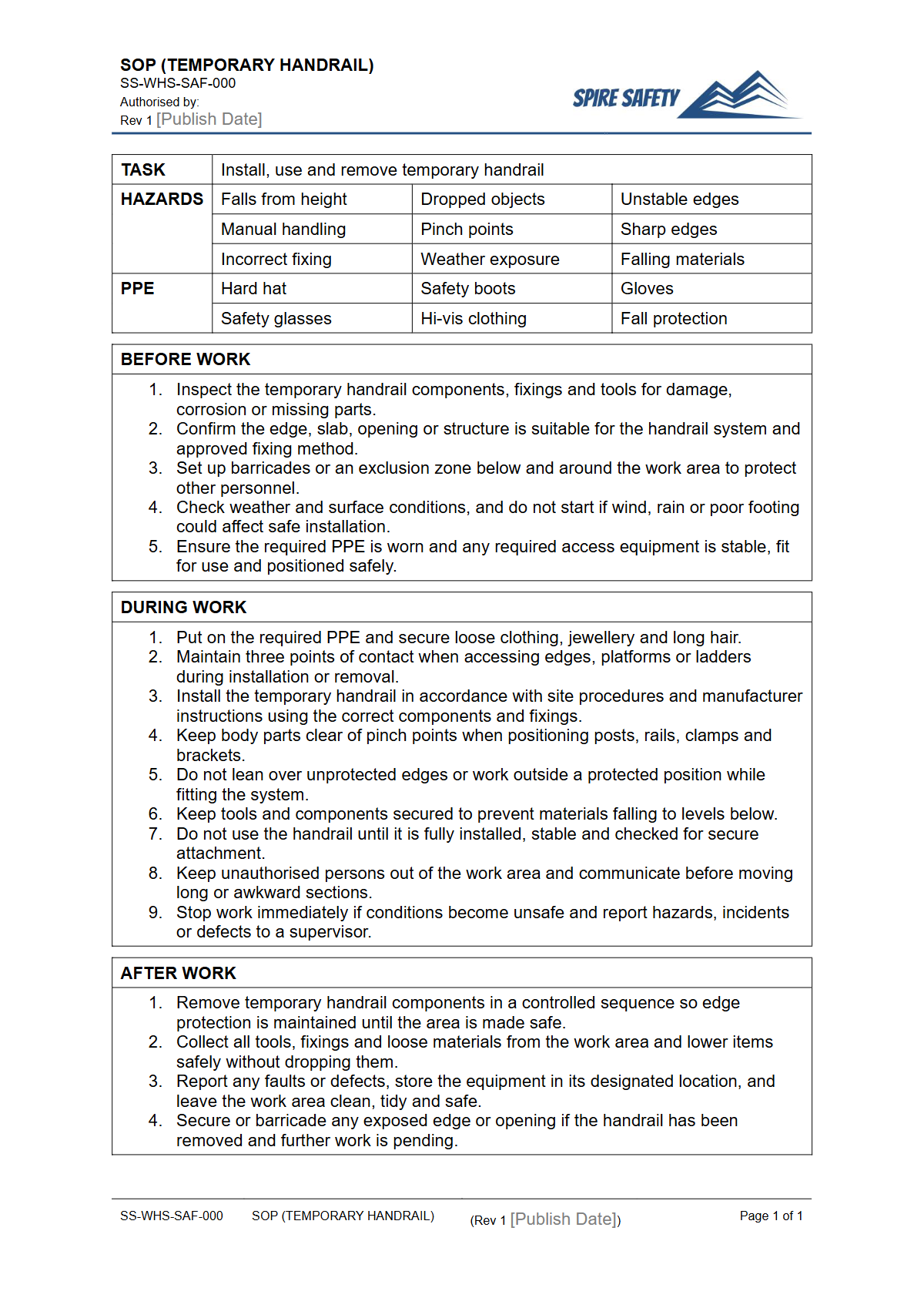
Purpose of the Free Safe Operating Procedure (Temporary Handrail) Template
Installing, using, and dismantling temporary handrails is a critical safety task on many Australian worksites. This free Safe Operating Procedure (Temporary Handrail) template provides a structured starting point for documenting the required process and safety controls.
It is designed to help your organisation standardise the installation, inspection, and removal of temporary edge protection systems, significantly reducing the risk of falls from height. Using this SOP helps ensure that all workers involved are aware of the hazards, required controls, and their specific responsibilities.
An SOP is a foundational document that outlines safe work instructions for a specific task. For it to be effective, it must be integrated into broader comprehensive WHS management systems. This ensures that procedures are supported by clear policies, training programs, and performance monitoring.
This template helps formalise one crucial aspect of your overall safety framework, contributing to a safer work environment for everyone on site.
Key Objectives of This Safe Operating Procedure
- To provide a clear, step-by-step guide for the safe installation and removal of temporary handrail systems.
- To define the personal protective equipment (PPE) required for the task.
- To outline pre-start checks and routine inspection requirements to ensure system integrity.
- To establish clear communication and authorisation protocols for modifying or removing edge protection.
- To assist in meeting your duties under Australian WHS legislation regarding fall prevention.
Video walkthrough
How to use the Free Safe Operating Procedure (Temporary Handrail) Template
This template is available for immediate download in both DOCX and PDF formats. The DOCX file is fully editable, allowing you to adapt it to your specific operational needs.
The procedure should not be implemented as-is; it requires careful customisation by a competent person familiar with your workplace's unique risks and legal obligations. Effective procedures are never a one-size-fits-all solution.
Important Note: We've provided a solid foundation aligned with Australian WHS principles, but you must customise this template to reflect your specific handrail system, site conditions, personnel competencies, and the findings of your site-specific risk assessment. Your final document should be a practical tool that reflects how work is actually done at your site. A key part of this process involves verifying that the documented steps are followed in practice, often confirmed through regular WHS compliance auditing.
When to use a Temporary Handrail Safe Operating Procedure
A documented SOP for temporary handrails should be used whenever temporary edge protection is required to control the risk of a fall. Common scenarios on construction, industrial, and maintenance sites include:
- Working on open-sided floors, mezzanines, or balconies.
- Protecting workers near unprotected roof edges.
- Securing the perimeter of floor openings, penetrations, or excavations.
- Creating safe access ways across a work area.
- When other tasks, such as those covered in our free Circular Saw SOP, are performed near an unprotected edge.
This SOP is particularly crucial on dynamic sites where conditions change frequently. Having a standardised procedure ensures that as work progresses and edge protection needs to be moved or altered, it is always done safely and correctly, maintaining protection for all workers. This is similar to the need for a documented procedure when using specific machinery, as seen in our free Telehandler SOP template.
Who should use this Safe Operating Procedure
This Safe Operating Procedure is intended for use by multiple roles within an organisation. Project Managers and Site Supervisors will use it to plan work, induct workers, and ensure the correct safety standards are being enforced.
WHS Advisors can use it as a baseline for developing site-specific documentation and for conducting inspections and audits. Most importantly, the workers tasked with installing, inspecting, and dismantling the handrails must be trained in the procedure and follow it every time to ensure their own safety and the safety of others.
Implementing effective safety procedures can be a complex task. If you need assistance tailoring this document or developing a broader safety framework for your projects, Spire Safety offers expert WHS consulting services to help you meet your obligations.
For more ready-to-use templates and guides, browse our free WHS resources library for a wide range of documents covering various tasks and hazards.
Common mistakes
Common mistakes to avoid
- Using non-compliant or damaged materials (e.g., splintered wood, bent posts).
- Incorrectly spacing posts or fixing points, compromising structural integrity.
- Failing to include toe-boards, allowing objects to fall onto people below.
- Leaving gaps in the system or removing sections without proper authorisation.
Legal references
Legal considerations
The following legal requirements may be relevant to this type of work.
- Work Health and Safety Act (Harmonised) — Provides the primary duties for protecting workers and other people from work health and safety risks.
- Work Health and Safety Regulations (Harmonised) — Sets out requirements supporting the management of workplace hazards and risks.
The following codes may be relevant to this type of work.
- Managing WHS Risks Code of Practice — Provides practical guidance on identifying hazards, assessing risks and applying effective controls.
- Work Health and Safety Consultation, Cooperation and Coordination Code of Practice — Provides practical guidance on consulting workers and coordinating with other duty holders.
- Managing the Work Environment and Facilities Code of Practice — Provides practical guidance on safe work environments, workplace facilities and related controls.
Did you know
Fall Statistics
Falls from height are a leading cause of fatalities and serious injuries in Australian construction. Properly installed temporary edge protection is a critical control measure.
Load Requirements
Australian Standard AS/NZS 4994.1 specifies minimum load requirements that temporary handrail systems must be able to withstand to be considered effective and compliant.
FAQ
Frequently asked questions
01What is the difference between a SWMS and an SOP for temporary handrails?
02Are temporary handrails required by law in Australia?
03How often should temporary handrails be inspected?
04Can I use this template for permanent guardrails?
Share this resource
Free Safe Operating Procedure (Temporary Handrail) Template
Browse Categories
How To Use It
- 1Download and open in Word or PDF.
- 2Replace the placeholders with your business details.
- 3Get it reviewed by a WHS specialist before rollout.
Need it customised?
Our WHS consultants can adapt this template to your site, run a gap analysis, or audit what you already have in place.
Book a Free Consultation WHS consulting servicesor call 1300 156 382
Related templates
- Free Safe Operating Procedure (Temporary Power) Template
- Free Safe Operating Procedure (Tender Boat Operation) Template
- Free Safe Operating Procedure (Tennis Court Cleaning) Template
- Free Safe Operating Procedure (Terminal Tractor) Template
- Free Safe Operating Procedure (Theatre Backstage Clean) Template
- Free Safe Operating Procedure (Thermal Imaging Camera) Template