
Free Safe Operating Procedure (Temperature Calibrator) Template
Ensure safety and precision when using temperature calibrators with our free template. Download this customisable Safe Operating Procedure to get started.
Free Safe Operating Procedure (Temperature Calibrator) Template
DOCX • 126 KB + PDF
Updated Oct 2026
No signup required
Purpose of the Free Safe Operating Procedure (Temperature Calibrator) Template
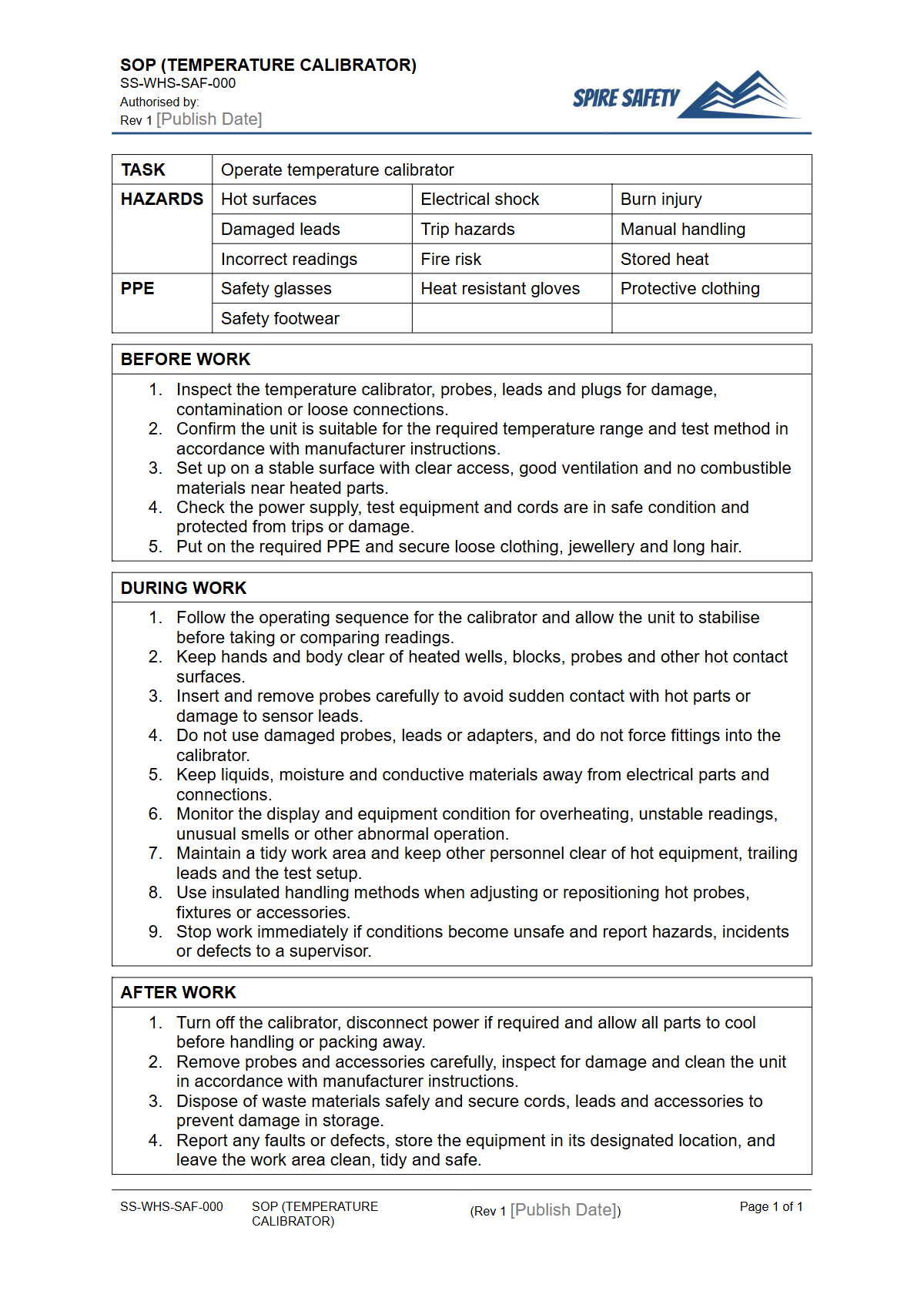
Operating a temperature calibrator, whether a dry-block, liquid bath, or infrared model, requires precision and a strict adherence to safety protocols. This free Safe Operating Procedure (Temperature Calibrator) Template provides a structured framework for documenting the steps required to use this equipment safely and effectively.
The primary purpose is to minimise risks to personnel, such as electrical shock, burns from hot surfaces, or exposure to hazardous materials used in some calibration baths. A well-defined SOP is a critical tool for hazard identification and risk control.
By clearly outlining pre-start checks, operational steps, and shutdown procedures, this document helps standardise work practices and ensures that all operators have access to the same critical safety information. Implementing robust SOPs is a cornerstone of building effective and systematic WHS management systems, promoting a proactive safety culture within your organisation.
It serves as an essential training aid for new employees and a reference for experienced technicians, reinforcing correct and safe work behaviours every time the task is performed.
Video walkthrough
How to use the Free Safe Operating Procedure (Temperature Calibrator) Template
This template is provided as a fully editable DOCX file, allowing for complete customisation, along with a ready-to-print PDF. To use it effectively, you must adapt its contents to reflect the specific circumstances of your workplace.
This involves identifying the exact make and model of the temperature calibrator in use, detailing the unique hazards present in your operational environment, and listing the specific Personal Protective Equipment (PPE) required for the task.
Important: This is a template, not a finished document. We have designed it to be a comprehensive starting point, but it cannot cover every specific hazard or control measure for your site.
You must consult the manufacturer's instructions, conduct a site-specific risk assessment, and incorporate your company's internal safety policies. The effectiveness of any SOP relies on its customisation and subsequent implementation, including worker training and regular reviews.
Integrating this process with activities like WHS compliance auditing helps ensure your procedures remain current and effective.
When to use it
A Safe Operating Procedure for a temperature calibrator should be a central part of the task lifecycle. It is not a document to be filed away and forgotten.
It should be actively used during worker training and competency assessments to ensure a baseline understanding of safe operation is established before any work begins. It also serves as a critical pre-start checklist for operators to review before powering on the equipment, reminding them of key checks like equipment condition and environmental suitability.
Furthermore, the SOP is an invaluable tool for supervisors conducting workplace inspections or observations. It should also be referenced during incident investigations to determine if procedural non-conformance was a contributing factor.
Regular, scheduled reviews of the SOP—at least annually or following any change in equipment, process, or regulation—are essential to maintaining its relevance and accuracy.
Who should use it
This SOP is intended for any person required to operate, maintain, or supervise the use of temperature calibrators. This includes instrumentation technicians, maintenance engineers, quality assurance personnel, and process control specialists.
It is particularly relevant in industries where precise temperature control is critical, such as food and beverage manufacturing, pharmaceuticals, oil and gas, power generation, and HVAC services.
Managers and supervisors are responsible for ensuring these procedures are implemented, understood, and followed by their teams. For workplaces with diverse equipment, this SOP can be used alongside other specific guides.
For instance, in a commercial kitchen setting, it would complement a free deep fryer SOP by ensuring the instruments that measure cooking temperatures are themselves accurate and safe to use.
Similarly, in an industrial maintenance context, technicians might work with a variety of equipment. Having standardised procedures for each piece of machinery is vital.
This temperature calibrator SOP would fit into a library of documents that might also include our free Air Compressor SOP, ensuring a consistent approach to safety across different tasks.
For tasks involving extreme temperatures or energy sources, the principles of isolation and hazard control are paramount. The structured approach in this SOP mirrors the safety logic required for other high-risk equipment, as detailed in resources like our free Oxy Acetylene SOP template.
Ultimately, anyone whose work involves ensuring the accuracy of temperature sensors has a vested interest in this procedure. You can explore our complete free WHS resources library for more templates to support your organisation's safety framework.
Common mistakes
Common mistakes to avoid
- Using a calibrator without verifying its own certification is current and valid.
- Failing to allow the equipment to thermally stabilise at ambient temperature before use.
- Neglecting to wear appropriate PPE, such as heat-resistant gloves for hot blocks or safety glasses.
- Not isolating the system or de-pressurising lines before removing a sensor for calibration.
Legal references
Legal considerations
The following legal requirements may be relevant to this type of work.
- Work Health and Safety Act (Harmonised) — Provides the primary duties for protecting workers and other people from work health and safety risks.
- Work Health and Safety Regulations (Harmonised) — Sets out requirements supporting the management of workplace hazards and risks.
The following codes may be relevant to this type of work.
- Managing WHS Risks Code of Practice — Provides practical guidance on identifying hazards, assessing risks and applying effective controls.
- Work Health and Safety Consultation, Cooperation and Coordination Code of Practice — Provides practical guidance on consulting workers and coordinating with other duty holders.
- Managing the Work Environment and Facilities Code of Practice — Provides practical guidance on safe work environments, workplace facilities and related controls.
Did you know
The Science of Measurement
Metrology, the science of measurement, is one of the oldest sciences. Ancient Egyptians used precise cubits based on the Pharaoh's forearm length to build the pyramids, a form of early standardisation.
How Thermocouples Work
Many temperature calibrators work by simulating the tiny voltage signal produced by a thermocouple, a common sensor made from two dissimilar metals joined at a single point.
FAQ
Frequently asked questions
01What are the main hazards of using a temperature calibrator?
02How often should a Safe Operating Procedure be reviewed?
03Is this temperature calibrator SOP template enough for WHS compliance?
04What training should accompany this SOP?
Share this resource
Free Safe Operating Procedure (Temperature Calibrator) Template
Browse Categories
How To Use It
- 1Download and open in Word or PDF.
- 2Replace the placeholders with your business details.
- 3Get it reviewed by a WHS specialist before rollout.
Need it customised?
Our WHS consultants can adapt this template to your site, run a gap analysis, or audit what you already have in place.
Book a Free Consultation WHS consulting servicesor call 1300 156 382
Related templates
- Free Safe Operating Procedure (Temporary Handrail) Template
- Free Safe Operating Procedure (Temporary Power) Template
- Free Safe Operating Procedure (Tender Boat Operation) Template
- Free Safe Operating Procedure (Tennis Court Cleaning) Template
- Free Safe Operating Procedure (Terminal Tractor) Template
- Free Safe Operating Procedure (Theatre Backstage Clean) Template