
Free Safe Operating Procedure (Table Clearing) Template
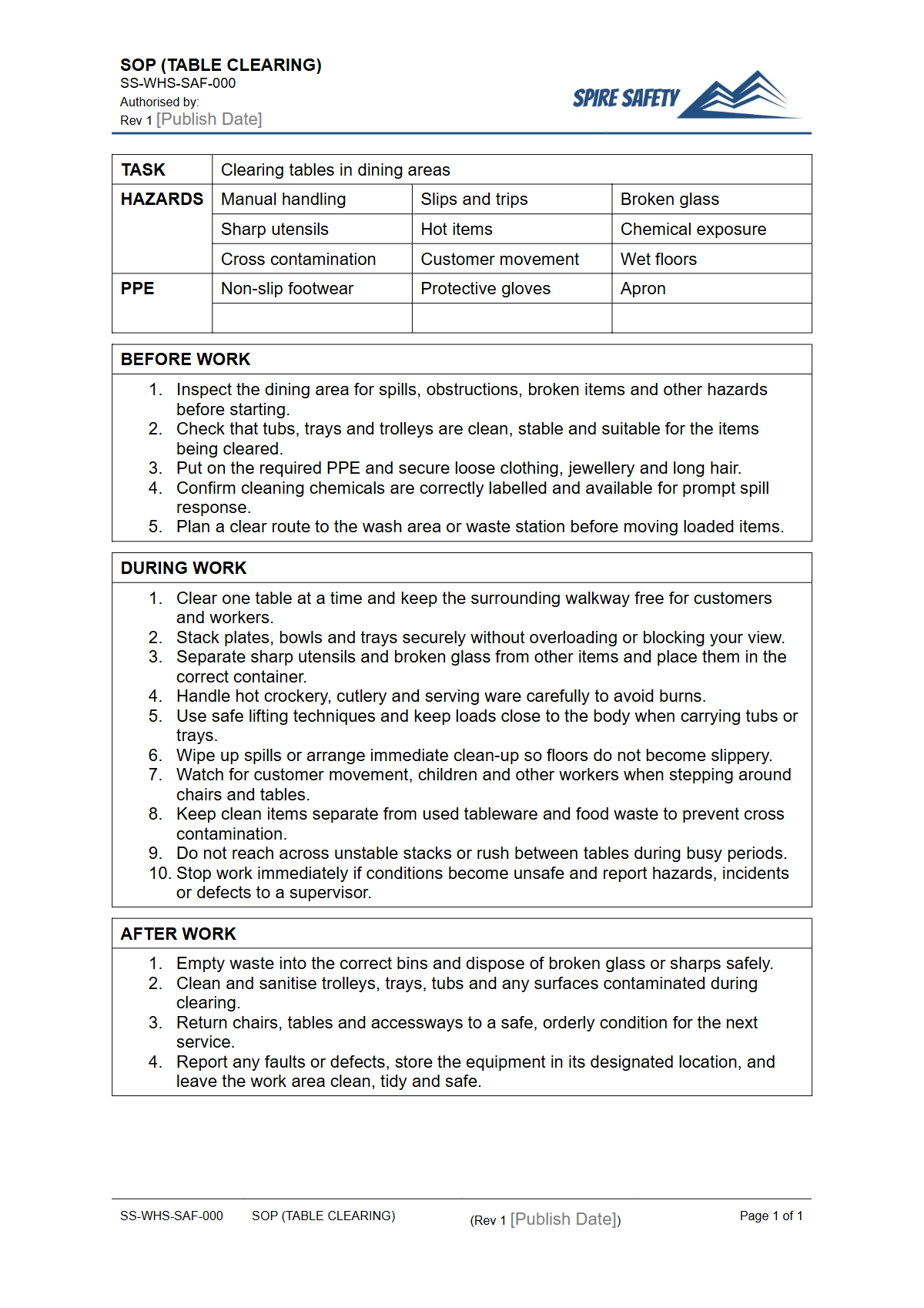
Download our free Safe Operating Procedure for table clearing to establish consistent safety protocols. Customise this template to suit your hospitality venue.
Free Safe Operating Procedure (Table Clearing) Template
DOCX • 126 KB + PDF
Updated Oct 2026
No signup required
Purpose of the Free Safe Operating Procedure (Table Clearing) Template
Establishing a clear and documented process for routine tasks is fundamental to workplace safety, especially in fast-paced environments like hospitality. This Free Safe Operating Procedure (SOP) for Table Clearing provides a structured starting point for cafes, restaurants, and function centres to define the safest way to clear and clean tables.
Using a standardised procedure helps minimise common risks such as musculoskeletal injuries from manual handling, slips and trips from spillages, and incorrect handling of cleaning chemicals. It ensures all staff, from new trainees to experienced team members, follow a consistent, safety-focused method every time.
Implementing documented procedures like this SOP is a core component of demonstrating due diligence and forms an essential part of effective WHS management systems. It helps create a proactive safety culture where risks are identified, assessed, and controlled before an incident occurs. A well-defined SOP for table clearing not only protects your workers but also enhances operational efficiency and service standards by outlining clear expectations and processes.
Video walkthrough
How to use the Free Safe Operating Procedure (Table Clearing) Template
This template is designed for ease of use and customisation. After downloading the DOCX file, you should begin by populating the document with your specific business details, including company name, site location, and the names of individuals responsible for authoring and approving the procedure.
The main body of the template lists a logical sequence of steps for clearing tables, from assessing the area to final sanitisation. Review these pre-filled steps and adapt them to match your venue's specific layout, equipment (e.g., trolleys, bus tubs), and types of cleaning products used.
It is crucial that this document is not used 'as is'. We strongly recommend that you customise this template to reflect the specific equipment, chemicals, and environment of your workplace.
Consultation is a key part of this process; involve the workers who perform the task daily to ensure the SOP is practical, accurate, and reflects how work is actually done. This collaborative approach also improves staff buy-in and adherence.
Once customised, ensure the final SOP is used in staff training and made easily accessible in the work area.
Many kitchen and hospitality environments involve a range of tasks that require documented procedures. For related activities, you might find our Free Safe Operating Procedure (Deep Fryer - Standard Operation) Template a useful addition to your safety documentation.
When to use a Safe Operating Procedure
A Safe Operating Procedure for table clearing should be a living document, integrated into several key business activities. It is essential for the induction and training of all new front-of-house staff to ensure they learn the correct, safe method from their first day.
The SOP should also be used for refresher training for existing employees to prevent complacency and bad habits from forming. Furthermore, the document serves as a benchmark for workplace observations and performance reviews.
In the unfortunate event of an incident or near miss related to table clearing, the SOP should be reviewed as part of the investigation to identify any gaps or areas for improvement.
Who should use this resource
This SOP template is primarily intended for business owners, managers, and supervisors in the hospitality industry who are responsible for the health and safety of their staff. This includes restaurant managers, cafe owners, function centre coordinators, and team leaders.
Workplace Health and Safety (WHS) officers and consultants will also find it a valuable tool for developing site-specific procedures for their clients. For organisations needing more comprehensive support in developing their safety frameworks, engaging professional WHS consulting can provide expert guidance and ensure your systems are robust and effective.
Ultimately, the end-users of the finalised procedure are the workers themselves. The SOP should be written in clear, simple language that is easy for every staff member to understand and follow, regardless of their experience level or primary language.
Pictograms and visual aids can be added during customisation to enhance understanding. For more templates and safety tools to build out your safety system, you can browse our complete free WHS resources library.
Common mistakes
Common mistakes to avoid
- Failing to customise the template with site-specific details like cleaning chemical names and trolley types.
- Not training workers on the finalised procedure, making the document ineffective.
- Neglecting to list the specific Personal Protective Equipment (PPE) required, such as gloves or non-slip shoes.
- Storing the SOP in an office where staff who perform the task cannot easily access it for reference.
Legal references
Legal considerations
The following legal requirements may be relevant to this type of work.
- Work Health and Safety Act (Harmonised) — Provides the primary duties for protecting workers and other people from work health and safety risks.
- Work Health and Safety Regulations (Harmonised) — Sets out requirements supporting the management of workplace hazards and risks.
The following codes may be relevant to this type of work.
- Managing WHS Risks Code of Practice — Provides practical guidance on identifying hazards, assessing risks and applying effective controls.
- Work Health and Safety Consultation, Cooperation and Coordination Code of Practice — Provides practical guidance on consulting workers and coordinating with other duty holders.
- Managing the Work Environment and Facilities Code of Practice — Provides practical guidance on safe work environments, workplace facilities and related controls.
Did you know
A Common Hazard
Slips, trips, and falls are one of the leading causes of serious injury in the Australian hospitality industry, often resulting from spilt food and drink or wet floors during cleaning.
Manual Tasks
Carrying multiple plates, heavy bus tubs, or trays can lead to hazardous manual task injuries. An SOP helps control this risk by specifying load limits and the use of trolleys.
FAQ
Frequently asked questions
01What should a Safe Operating Procedure for table clearing include?
02Is a SOP for table clearing legally required in Australia?
03How often should we review our table clearing SOP?
04Can this template be used for training new staff?
Share this resource
Free Safe Operating Procedure (Table Clearing) Template
Browse Categories
How To Use It
- 1Download and open in Word or PDF.
- 2Replace the placeholders with your business details.
- 3Get it reviewed by a WHS specialist before rollout.
Need it customised?
Our WHS consultants can adapt this template to your site, run a gap analysis, or audit what you already have in place.
Book a Free Consultation WHS consulting servicesor call 1300 156 382
Related templates
- Free Safe Operating Procedure (Tag Line Use) Template
- Free Safe Operating Procedure (Tagging Gun Use) Template
- Free Safe Operating Procedure (Tailgate Delivery) Template
- Free Safe Operating Procedure (Tanning Bed Cleaning) Template
- Free Safe Operating Procedure (Tea Urn Cleaning) Template
- Free Safe Operating Procedure (Temperature Calibrator) Template