
Free Safe Operating Procedure (Synthetic Sling Use) Template
Download our free Safe Operating Procedure (Synthetic Sling Use) template to formalise your lifting operations. Get your customisable DOCX and PDF now.
Free Safe Operating Procedure (Synthetic Sling Use) Template
DOCX • 126 KB + PDF
Updated Oct 2026
No signup required
Purpose of the Free Safe Operating Procedure (Synthetic Sling Use) Template
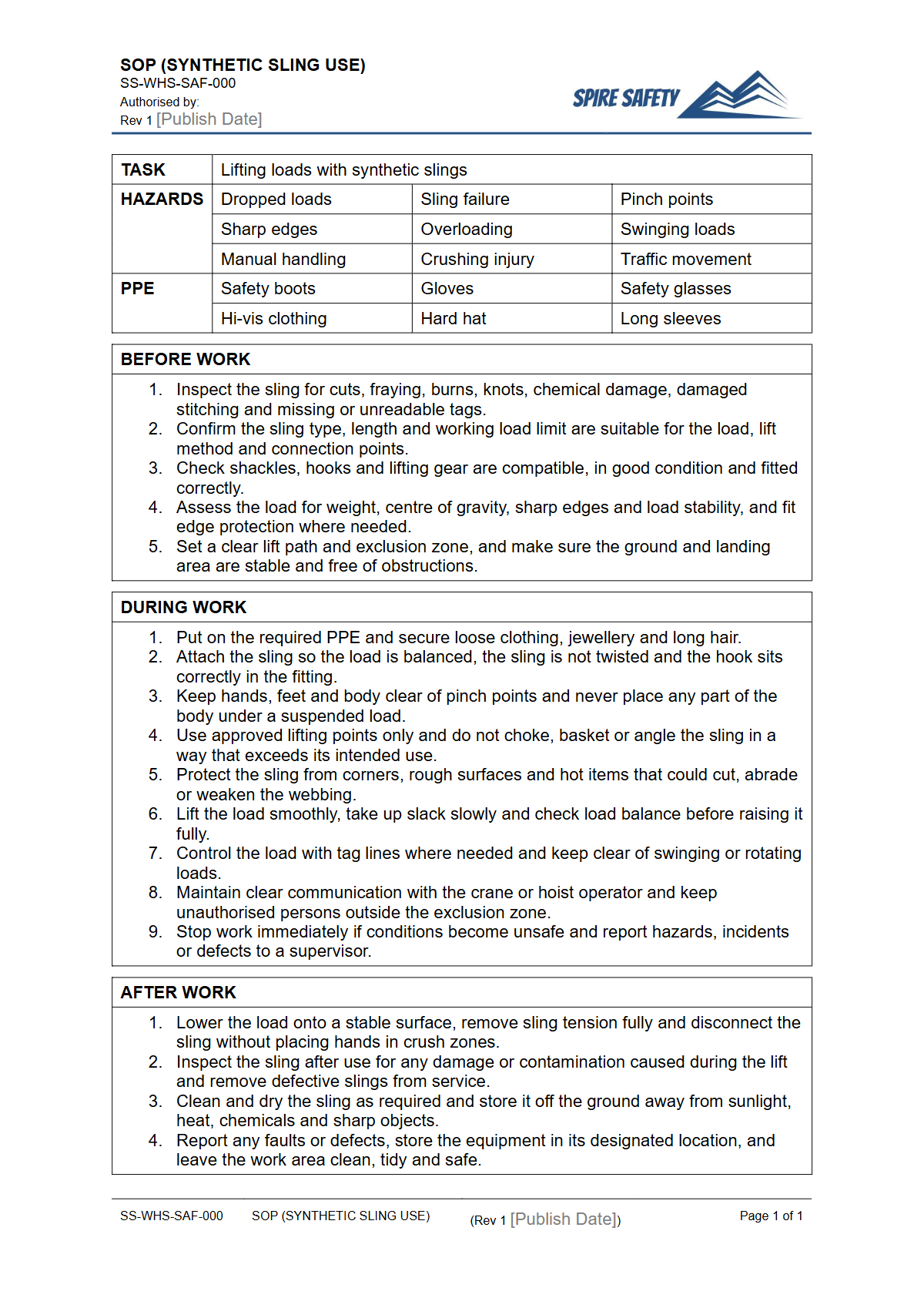
This Free Safe Operating Procedure (Synthetic Sling Use) Template provides a structured starting point for documenting the required steps to safely use synthetic webbing and roundslings for lifting operations. Using synthetic slings, while common, introduces significant risks if not managed correctly.
A formal SOP is a critical tool for controlling these risks, ensuring every worker follows a standardised, safe process. Implementing clear procedures helps your organisation meet its primary duty of care under WHS legislation.
It defines responsibilities, outlines pre-start checks, details safe lifting techniques, and specifies post-use inspection and storage requirements. This document is a foundational component of effective WHS management systems, demonstrating a proactive approach to workplace safety.
A well-drafted SOP serves as a key training resource for new employees and a refresher for experienced operators. It standardises behaviour, reduces the likelihood of incidents caused by improvisation or forgotten steps, and provides a clear benchmark for supervision and performance monitoring.
By formalising the process, you create a safer work environment and a clear record of your organisation's safety commitments.
Video walkthrough
How to use the Free Safe Operating Procedure (Synthetic Sling Use) Template
Our Free Safe Operating Procedure (Synthetic Sling Use) Template is available in both DOCX and PDF formats for your convenience. The DOCX version is fully editable, allowing you to tailor the content to the specific slings, loads, and environmental conditions at your workplace.
It is crucial that you customise this document. No two workplaces are identical, and an effective SOP must reflect your unique operational risks and control measures.
We strongly advise that you consult with your operators, supervisors, and safety committee during the customisation process to ensure the procedure is practical and comprehensive.
Important: This template is a guide, not a finished document. You must adapt it with your site-specific details, including machinery models, personnel roles, emergency contacts, and specific risk controls relevant to your operations.
Simply adding your company logo is not enough to ensure the procedure is effective or aligns with your duties. Once finalised, this SOP can be integrated with other procedures, such as our free Oxy Acetylene SOP template for workshops where lifting is part of maintenance or fabrication tasks. You can find more templates like this in our free WHS resources library.
When to use it
A Safe Operating Procedure for synthetic sling use should be referenced in several key situations. It forms the basis of all training and competency assessments for personnel involved in rigging and lifting.
Before any lifting task begins, operators should refer to the SOP as part of their pre-start checks and risk assessment process, often documented in a Safe Work Method Statement (SWMS) for high-risk construction work. This ensures they confirm the sling's integrity, verify its Working Load Limit (WLL) against the load weight, and select the appropriate hitch type.
The SOP should also be used during incident investigations to determine if procedural deviations occurred. Regular reviews of the SOP, recommended annually or after any incident, are vital for continuous improvement.
The document serves as a standard against which performance can be measured during internal safety checks or a formal WHS compliance auditing process, helping to identify gaps in training or supervision.
Who should use it
This Safe Operating Procedure is intended for a range of personnel within an organisation. Operators, riggers, and dogmen are the primary users, as it directs their day-to-day actions when selecting, inspecting, and using synthetic slings.
They must be thoroughly trained on the SOP's contents and demonstrate competency in applying it. Supervisors and team leaders must use the SOP to enforce safe work practices, monitor compliance, and provide guidance to their teams.
They are responsible for ensuring operators have the correct equipment and training as outlined in the procedure.
WHS Managers and Safety Officers will use the SOP as a tool for risk management, training development, and auditing. They are typically responsible for developing, reviewing, and updating the procedure in consultation with workers.
The principles of safe lifting detailed in this document are also relevant when managing other types of mobile plant. For instance, when lifting with a telehandler, operators would need to follow both this sling SOP and procedures detailed in resources like our free Telehandler SOP template. For complex lifting operations that fall outside the scope of this standard procedure, it may be necessary to seek external expertise through WHS consulting to develop a specialised lift plan.
Common mistakes
Common mistakes to avoid
- Using slings that are cut, frayed, burned, or have missing/illegible tags.
- Exceeding the Working Load Limit (WLL), especially by misjudging the effect of sling angles.
- Pulling slings from under a load after the lift, causing friction damage.
- Failing to protect slings from sharp edges on the load using proper padding or corner protectors.
Legal references
Legal considerations
The following legal requirements may be relevant to this type of work.
- Work Health and Safety Act (Harmonised) — Provides the primary duties for protecting workers and other people from work health and safety risks.
- Work Health and Safety Regulations (Harmonised) — Sets out requirements supporting the management of workplace hazards and risks.
The following codes may be relevant to this type of work.
- Managing WHS Risks Code of Practice — Provides practical guidance on identifying hazards, assessing risks and applying effective controls.
- Work Health and Safety Consultation, Cooperation and Coordination Code of Practice — Provides practical guidance on consulting workers and coordinating with other duty holders.
- Managing the Work Environment and Facilities Code of Practice — Provides practical guidance on safe work environments, workplace facilities and related controls.
Did you know
Colour-Coded Capacity
Most flat webbing slings follow a standardised colour code to indicate their Working Load Limit (WLL). For example, a purple sling typically has a WLL of 1 tonne, while a green one is rated for 2 tonnes.
Invisible Danger
UV radiation from sunlight causes synthetic fibres to degrade and lose strength over time. This damage is not always visible, making proper storage and regular replacement of outdoor-use slings critical.
FAQ
Frequently asked questions
01What should be included in a synthetic sling inspection checklist?
02How do you determine the correct sling for a specific lift?
03Are synthetic slings better than wire rope or chain slings?
04How often do Safe Operating Procedures need to be reviewed?
Share this resource
Free Safe Operating Procedure (Synthetic Sling Use) Template
Browse Categories
How To Use It
- 1Download and open in Word or PDF.
- 2Replace the placeholders with your business details.
- 3Get it reviewed by a WHS specialist before rollout.
Need it customised?
Our WHS consultants can adapt this template to your site, run a gap analysis, or audit what you already have in place.
Book a Free Consultation WHS consulting servicesor call 1300 156 382
Related templates
- Free Safe Operating Procedure (Table Clearing) Template
- Free Safe Operating Procedure (Tag Line Use) Template
- Free Safe Operating Procedure (Tagging Gun Use) Template
- Free Safe Operating Procedure (Tailgate Delivery) Template
- Free Safe Operating Procedure (Tanning Bed Cleaning) Template
- Free Safe Operating Procedure (Tea Urn Cleaning) Template