
Free Safe Operating Procedure (Suspension Strut Change) Template
Standardise your workshop's vehicle maintenance tasks with our free Safe Operating Procedure (Suspension Strut Change) template. Download your DOCX today.
Free Safe Operating Procedure (Suspension Strut Change) Template
DOCX • 126 KB + PDF
Updated Oct 2026
No signup required
Purpose of the Free Safe Operating Procedure (Suspension Strut Change) Template
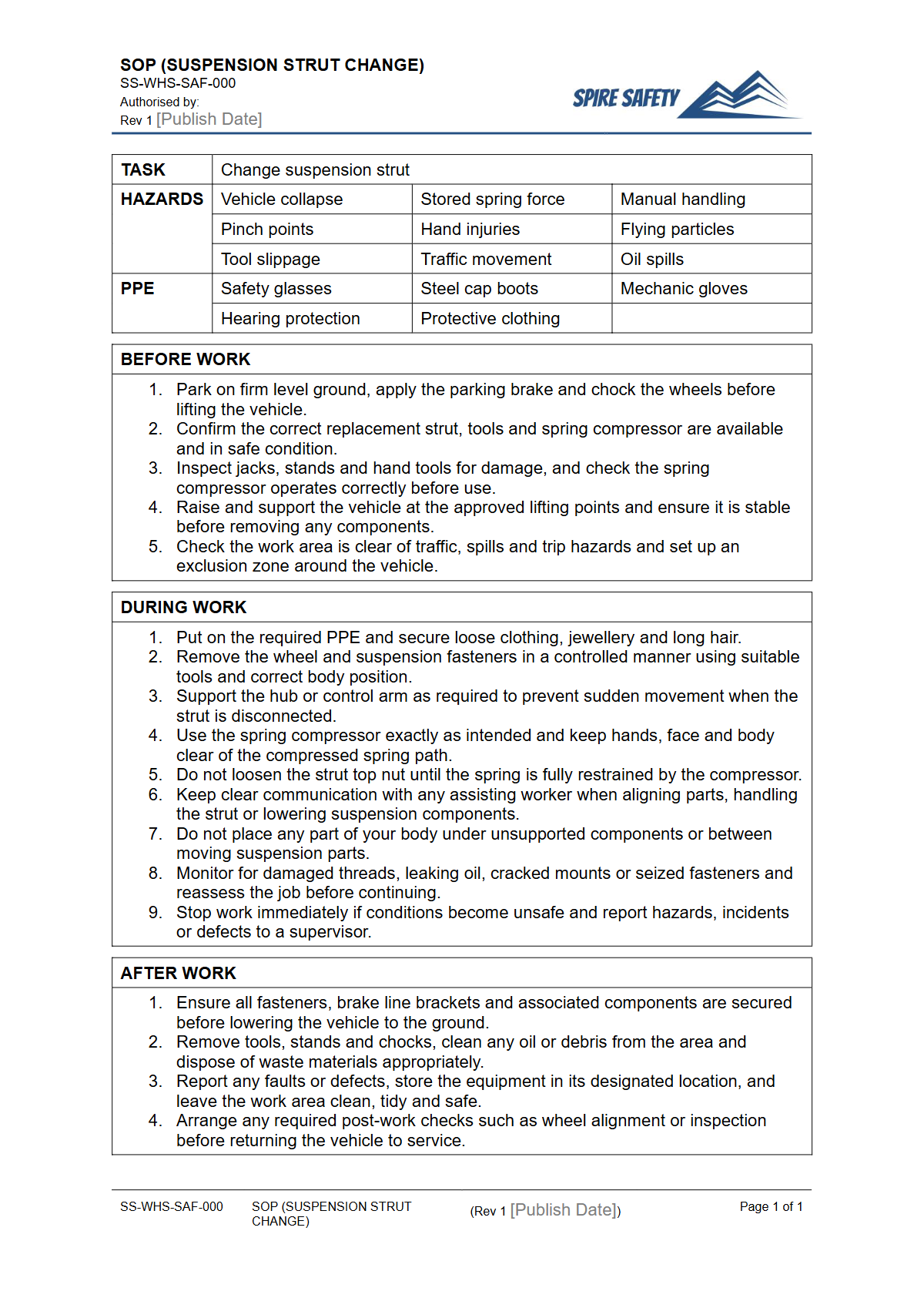
Changing a suspension strut assembly involves significant risks, including the sudden release of stored energy from compressed springs, vehicle instability, and hazardous manual tasks. This free Safe Operating Procedure (Suspension Strut Change) template provides a structured starting point for documenting a safe system of work for this common but high-risk automotive maintenance task.
It is designed to help you identify hazards, outline control measures, and ensure the procedure is performed consistently and safely by all personnel. Implementing documented procedures like this is a fundamental component of effective WHS management systems, demonstrating a commitment to proactive risk management in your workshop.
Video walkthrough
How to use the Free Safe Operating Procedure (Suspension Strut Change) Template
This template is provided in both DOCX and PDF formats for your convenience. To use it effectively, download the DOCX file and adapt it to your specific operational context.
The document is organised into logical sections including pre-operational checks, step-by-step instructions for the task itself, and post-task clean-up and reporting. You should add details specific to the tools in your workshop, such as the particular model of vehicle hoist or spring compressor used. Many workshops use compressed air for tools, so it is vital to have procedures for all equipment; you can find a useful guide in our Free Air Compressor SOP Template.
This is a template, not a finished document
Important: You must customise this Safe Operating Procedure to reflect the unique environment and equipment of your workplace. We are not familiar with your specific machinery, site conditions, or worker competencies.
A generic procedure cannot provide adequate safety controls. You must conduct your own risk assessment and modify this document to ensure it is relevant and effective for your business.
When to use it
A Safe Operating Procedure (SOP) for changing a suspension strut should be developed, approved, and communicated to workers before the task is ever performed. It must then be readily available at the point of work and used as a reference for every suspension strut change, regardless of the vehicle type or the experience level of the mechanic.
It is especially critical for high-risk maintenance tasks that involve multiple hazards or specialised equipment. Some repairs may also require cutting or heating components, which introduces further risks that must be managed through documented procedures like our FREE Oxy Acetylene SOP Template.
Who should use it
This SOP should be used by several groups within a vehicle maintenance workshop:
- Qualified Mechanics: To follow as a consistent, step-by-step guide to ensure all safety checks and procedures are completed.
- Apprentices and Trainees: As a critical training tool under the direct supervision of a competent tradesperson. It provides a clear, approved method for learning the task safely.
- Workshop Managers and Supervisors: To use as a basis for training, competency assessment, and incident investigation. The SOP forms part of the workplace's safety documentation reviewed during a WHS compliance audit.
Key Hazards to Consider
When customising your SOP, pay close attention to the primary hazards associated with changing a suspension strut:
- Stored Energy: The coil spring is under extreme compression. Incorrect use of a spring compressor can lead to its violent and uncontrolled release, causing severe or fatal injuries.
- Vehicle Stability: The vehicle must be properly supported on an approved vehicle hoist or axle stands on a firm, level surface. A failure of this support can lead to crushing injuries.
- Manual Tasks: The strut assembly can be heavy and awkward to handle, creating risks of musculoskeletal injury.
- Hazardous Substances: Contact with hydraulic fluids, grease, and cleaning solvents can cause skin irritation or other health effects.
- Unexpected Complications: Seized bolts or the need to cut components can introduce new risks, such as those associated with using power tools in a confined space. Procedures for tools like grinders or saws, such as our FREE Circular Saw SOP Template, should be cross-referenced.
By downloading this template, you are taking a proactive step towards formalising your workshop's safety processes. A well-drafted and implemented SOP is a key tool in preventing workplace incidents. For more templates and safety guides, explore our complete free WHS resources library.
Common mistakes
Common mistakes to avoid
- Using an incorrect, damaged, or poorly maintained spring compressor.
- Working under a vehicle supported only by a jack, without certified axle stands.
- Failing to chock the wheels on the ground to prevent the vehicle from rolling.
- Neglecting to wear appropriate PPE, especially safety glasses or a face shield.
Legal references
Legal considerations
The following legal requirements may be relevant to this type of work.
- Work Health and Safety Act (Harmonised) — Provides the primary duties for protecting workers and other people from work health and safety risks.
- Work Health and Safety Regulations (Harmonised) — Sets out requirements supporting the management of workplace hazards and risks.
The following codes may be relevant to this type of work.
- Managing WHS Risks Code of Practice — Provides practical guidance on identifying hazards, assessing risks and applying effective controls.
- Work Health and Safety Consultation, Cooperation and Coordination Code of Practice — Provides practical guidance on consulting workers and coordinating with other duty holders.
- Managing the Work Environment and Facilities Code of Practice — Provides practical guidance on safe work environments, workplace facilities and related controls.
Did you know
Spring Compression Force
A standard coil spring on a passenger vehicle can be compressed with thousands of newtons of force. A sudden, uncontrolled release of this energy is equivalent to a small explosion, capable of launching tools or components at high velocity.
FAQ
Frequently asked questions
01What are the main hazards when changing a suspension strut?
02Does a Safe Operating Procedure replace a risk assessment?
03How often should an SOP for suspension strut changes be reviewed?
04Is formal training required to change a suspension strut in a workplace?
Share this resource
Free Safe Operating Procedure (Suspension Strut Change) Template
Browse Categories
How To Use It
- 1Download and open in Word or PDF.
- 2Replace the placeholders with your business details.
- 3Get it reviewed by a WHS specialist before rollout.
Need it customised?
Our WHS consultants can adapt this template to your site, run a gap analysis, or audit what you already have in place.
Book a Free Consultation WHS consulting servicesor call 1300 156 382
Related templates
- Free Safe Operating Procedure (Swaging Machine) Template
- Free Safe Operating Procedure (Swing Stage) Template
- Free Safe Operating Procedure (Switchboard Testing) Template
- Free Safe Operating Procedure (Synthetic Sling Use) Template
- Free Safe Operating Procedure (Table Clearing) Template
- Free Safe Operating Procedure (Tag Line Use) Template