
Free Safe Operating Procedure (Surface Disinfection) Template
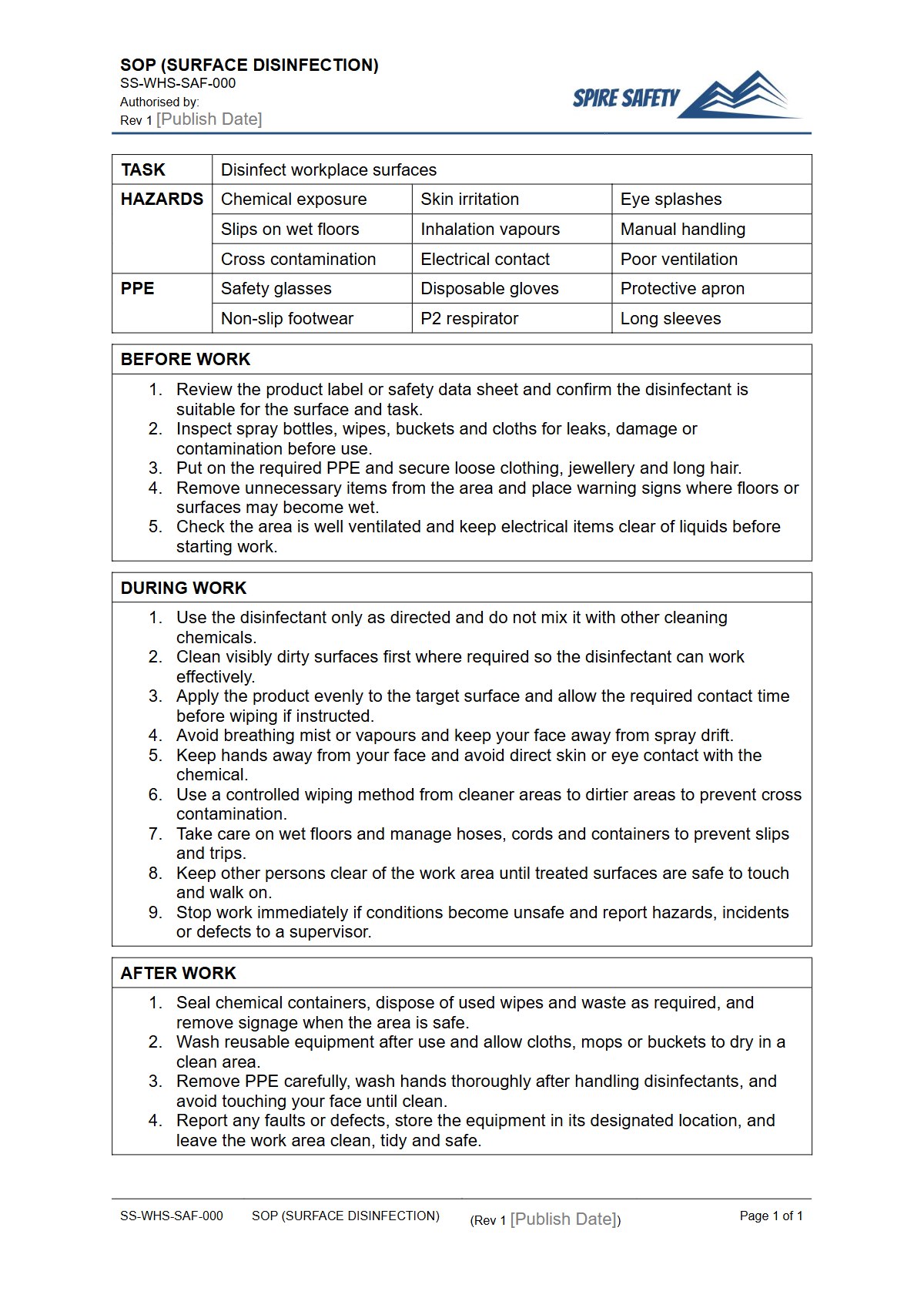
Download our free Safe Operating Procedure (Surface Disinfection) Template to document your cleaning and hygiene protocols.
Free Safe Operating Procedure (Surface Disinfection) Template
DOCX • 126 KB + PDF
Updated Oct 2026
No signup required
Purpose of the Free Safe Operating Procedure (Surface Disinfection) Template
Establishing clear, consistent protocols for cleaning and disinfecting surfaces is fundamental to managing health risks in any workplace, from offices and retail spaces to healthcare and hospitality settings. This Free Safe Operating Procedure (Surface Disinfection) Template provides a structured framework for documenting the specific steps required to safely and effectively disinfect surfaces, minimising the risk of transmitting infectious agents.
Using a formal SOP ensures that all workers follow a consistent, safe method, reducing guesswork and the potential for error.
A well-defined Safe Operating Procedure helps control hazards associated with the task, such as exposure to chemicals, and provides a reliable training tool for new and existing staff. It forms a crucial part of broader WHS management systems, demonstrating a commitment to proactive risk management and a safe working environment for everyone.
Video walkthrough
How to use the Free Safe Operating Procedure (Surface Disinfection) Template
This template is a starting point designed to be adapted to your unique operational needs. To implement it effectively, you should download the DOCX or PDF and work through each section, consulting with your team to ensure all site-specific details are captured accurately.
This includes identifying the specific surfaces to be cleaned, the approved chemical disinfectants (referencing their Safety Data Sheets), required contact times, and necessary Personal Protective Equipment (PPE).
Important: This document is a template and must be customised to suit the specific hazards, chemicals, equipment, and environment of your workplace. We are not liable for any incidents that may occur from the use of this document.
It is your responsibility as the PCBU (Person Conducting a Business or Undertaking) to ensure the procedure is safe and relevant to the tasks performed.
Once customised, the SOP should be used to train all relevant workers. Regular reviews and inspections, which can be supported by formal WHS compliance audits, ensure the procedure remains effective and is being followed correctly by all team members.
When to use a Safe Operating Procedure for Surface Disinfection
This SOP should be integrated into your organisation’s cleaning and hygiene program. It is applicable in numerous scenarios, including daily cleaning of high-touch surfaces like doorknobs, light switches, benchtops, and shared equipment controls.
It is also essential for periodic deep cleaning schedules and for decontamination procedures following a potential exposure event.
The procedure's application varies by industry. In a hospitality setting, it is vital for food preparation areas and dining spaces, complementing other safety documents like a deep fryer operation SOP. In an office, it focuses on shared workstations, meeting rooms, and kitchenettes.
This documented approach ensures standards are maintained consistently across all operational areas.
Who should use this Safe Operating Procedure
This procedure is intended for any worker tasked with cleaning and disinfection duties. This includes professional cleaning staff, maintenance personnel, and general employees responsible for the upkeep of their own or shared workspaces.
Supervisors and managers must also be familiar with the SOP to provide adequate training, oversee its implementation, and supports your compliance efforts.
Work Health and Safety (WHS) officers and committee members will find the template useful for developing and reviewing workplace-specific procedures as part of their risk management responsibilities. Documenting the process provides clear instructions and helps fulfil the PCBU's duty of care.
Key Elements in a Surface Disinfection SOP
A robust SOP for surface disinfection should be clear, concise, and cover all aspects of the task to ensure it is performed safely and effectively. Key sections to include are:
- Hazard Identification: Outlining potential risks, such as chemical exposure (skin/eye contact, inhalation of vapours), slip hazards from wet floors, and ergonomic risks from repetitive motions.
- Personal Protective Equipment (PPE): Specifying the exact PPE required based on the disinfectant's Safety Data Sheet (SDS), which typically includes chemical-resistant gloves and safety glasses.
- Procedure Steps: A sequential guide covering preparation (e.g., correct dilution), pre-cleaning to remove physical dirt, disinfectant application, required contact time (the duration the surface must remain wet), and final wiping or rinsing.
- Waste Management: Clear instructions on how to safely dispose of used cloths, contaminated PPE, and empty chemical containers in accordance with environmental and safety regulations.
- Emergency Response: Detailing first aid measures for chemical exposure and procedures for managing spills.
In industrial settings, this procedure may also apply to shared machinery. For example, cleaning the operator controls of heavy equipment is vital, and should be done in line with the equipment's own safety document, such as a FREE Telehandler SOP Template.
Similarly, in food processing or logistics, hygiene is paramount. This disinfection SOP can be adapted for cleaning critical machinery, which should already be covered by its own specific safety guide, like a Conveyer System SOP.
For more tools to support your safety management system, you can browse our complete free WHS resources library for a wide range of templates and checklists.
Common mistakes
Common mistakes to avoid
- Failing to pre-clean the surface with a detergent before applying disinfectant.
- Not allowing the disinfectant to sit for its required contact time before wiping.
- Using the wrong type of disinfectant for the surface material, causing damage.
- Neglecting to wear appropriate PPE, such as gloves and eye protection.
Legal references
Legal considerations
The following legal requirements may be relevant to this type of work.
- Work Health and Safety Act (Harmonised) — Provides the primary duties for protecting workers and other people from work health and safety risks.
- Work Health and Safety Regulations (Harmonised) — Sets out requirements supporting the management of workplace hazards and risks.
The following codes may be relevant to this type of work.
- Managing WHS Risks Code of Practice — Provides practical guidance on identifying hazards, assessing risks and applying effective controls.
- Work Health and Safety Consultation, Cooperation and Coordination Code of Practice — Provides practical guidance on consulting workers and coordinating with other duty holders.
- Managing the Work Environment and Facilities Code of Practice — Provides practical guidance on safe work environments, workplace facilities and related controls.
Did you know
Contact Time is Critical
For a disinfectant to be effective, it must remain on a surface for a specific amount of time, known as the 'contact time'. Simply spraying and immediately wiping a surface dry may not kill any germs at all.
Clean First, Then Disinfect
Disinfectants can be inactivated by organic matter like dirt and grime. Always clean a surface with a detergent-based cleaner to remove physical debris before applying a disinfectant for maximum effectiveness.
FAQ
Frequently asked questions
01What is the difference between cleaning, sanitising, and disinfecting?
02What PPE is required for surface disinfection?
03How often should high-touch surfaces be disinfected?
04Can I use any disinfectant for any surface?
Share this resource
Free Safe Operating Procedure (Surface Disinfection) Template
Browse Categories
How To Use It
- 1Download and open in Word or PDF.
- 2Replace the placeholders with your business details.
- 3Get it reviewed by a WHS specialist before rollout.
Need it customised?
Our WHS consultants can adapt this template to your site, run a gap analysis, or audit what you already have in place.
Book a Free Consultation WHS consulting servicesor call 1300 156 382
Related templates
- Free Safe Operating Procedure (Surface Etching) Template
- Free Safe Operating Procedure (Surface Grinder) Template
- Free Safe Operating Procedure (Surface Profile Gauge) Template
- Free Safe Operating Procedure (Suspension Strut Change) Template
- Free Safe Operating Procedure (Swaging Machine) Template
- Free Safe Operating Procedure (Swing Stage) Template