
Free Safe Operating Procedure (Surface Etching) Template
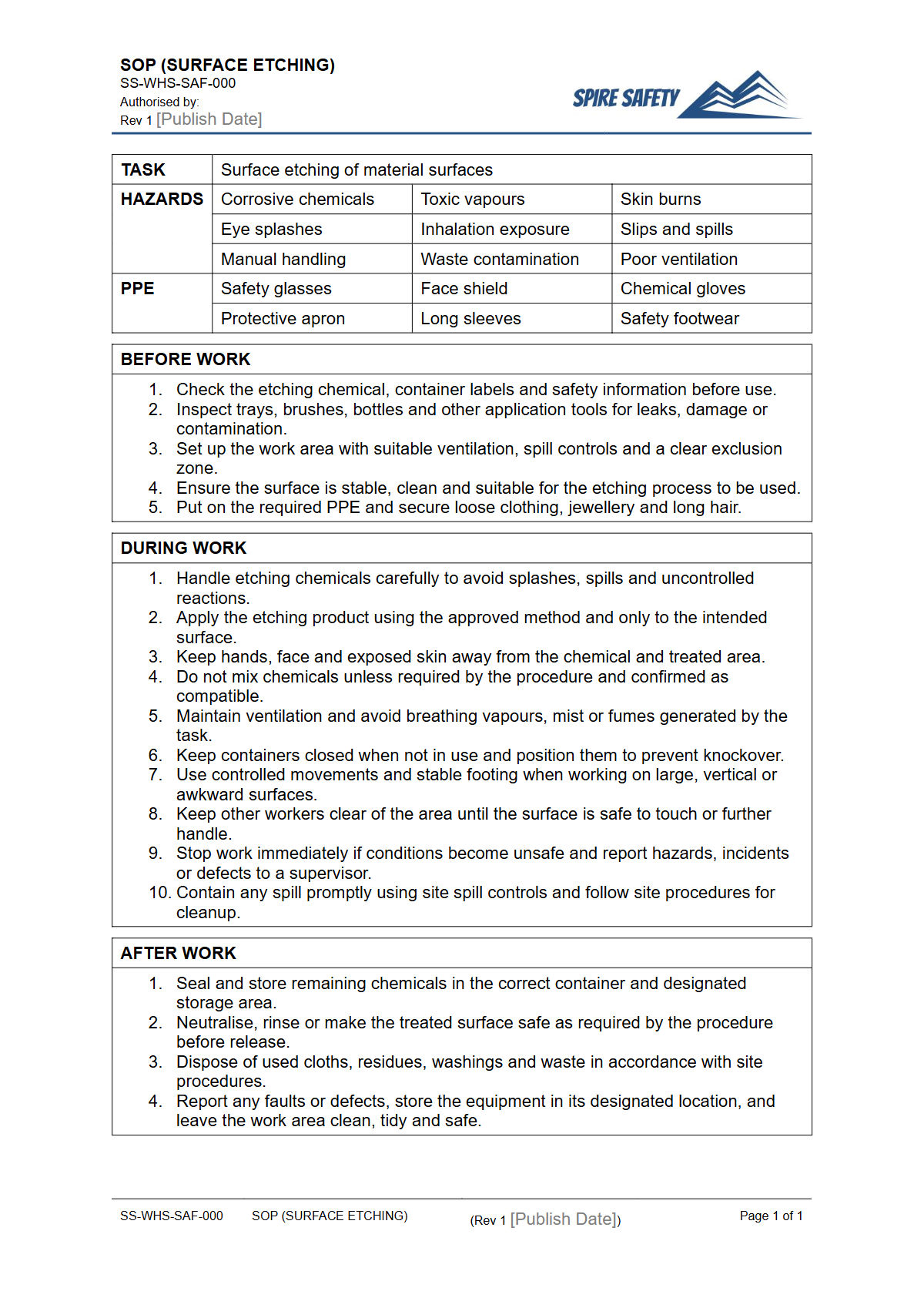
Document the risks and controls for chemical or abrasive surface etching with our free template. Download our Safe Operating Procedure to get started.
Free Safe Operating Procedure (Surface Etching) Template
DOCX • 126 KB + PDF
Updated Oct 2026
No signup required
Purpose of the Free Safe Operating Procedure (Surface Etching) Template
Surface etching, whether using chemical agents or abrasive blasting, is a high-risk activity that requires strict controls to protect workers. Our Free Safe Operating Procedure (Surface Etching) Template provides a structured framework for documenting the essential steps, hazards, and safety measures associated with this task.
Using a standardised procedure helps ensure that all workers follow a consistent, safe method, reducing the risk of chemical burns, respiratory illness, eye injuries, and other serious harm. This document is a critical component for any person conducting a business or undertaking (PCBU) aiming to fulfil their primary duty of care under Australian WHS legislation.
A well-defined SOP is more than just a document; it's a vital tool for training, supervision, and incident investigation. By clearly outlining pre-operational checks, step-by-step instructions, and emergency protocols, it forms an integral part of your overall WHS management systems. It demonstrates a commitment to proactive safety management and helps create a safer working environment for everyone involved in the process.
Video walkthrough
How to use the Free Safe Operating Procedure (Surface Etching) Template
This Safe Operating Procedure is available for download in both DOCX and PDF formats. The DOCX version is fully editable, allowing you to tailor it to the specific requirements of your worksite.
The process involves identifying the unique aspects of your surface etching tasks, including the types of substrates, the specific chemicals used (acids, alkalis, solvents), and the equipment involved, such as abrasive blasting units. When customising, it is crucial to consult the Safety Data Sheets (SDS) for all hazardous chemicals to ensure appropriate controls for storage, handling, ventilation, and PPE are included.
It is important to remember that this is a template, not a finished document. We have provided a structured starting point, but you must customise it to reflect the specific machinery, chemicals, and control measures used in your workplace.
If your process involves abrasive blasting, you may also benefit from our Free Air Compressor SOP (Safe Operating Procedure) Template to manage the associated plant risks. We recommend a thorough risk assessment is conducted and that you consult with your workers during the customisation process.
When to use a Safe Operating Procedure
A Safe Operating Procedure for surface etching should be in place and readily accessible before any worker undertakes the task. It is a foundational document for training new employees, ensuring they understand the risks and required controls from the outset.
It should also be used for refresher training for existing workers to reinforce safe work practices and communicate any changes to the procedure. Furthermore, this SOP is an essential reference during safety observations and audits.
Following an incident or near miss, the SOP should be reviewed as part of the investigation to determine if it was followed and whether it needs to be updated to prevent a recurrence. Regular reviews should be scheduled to ensure the procedure remains current with new technology, chemicals, or updated safety standards.
Who should use this Safe Operating Procedure
This template is designed for use by a range of personnel within an organisation. WHS managers and supervisors are responsible for developing, implementing, and reviewing the SOP, ensuring it accurately reflects the tasks performed on site.
Engaging a professional for WHS consulting can provide expert assistance in tailoring these documents to your specific operational needs. Workers who perform surface etching tasks must be trained in the procedure and are required to follow it meticulously to ensure their own safety and the safety of others.
The development of the SOP should not be done in isolation; consultation with the workers who perform the task is a legal requirement and is crucial for creating a practical and effective document that addresses the real-world challenges of the job.
Periodic checks are necessary to ensure the procedures documented are being followed correctly on the floor. These checks are a key part of ensuring ongoing safety and can be formalised through a program of WHS compliance auditing to verify that practice aligns with policy.
In complex workshops where etching is one of several metal fabrication processes, it's important to have clear procedures for all high-risk equipment. For instance, tasks involving hot work should be governed by their own specific procedures, such as our FREE Oxy Acetylene SOP Template.
By implementing comprehensive and tailored SOPs, your organisation can effectively manage workplace risks. For more templates and safety documents, you can browse our complete free WHS resources library.
Common mistakes
Common mistakes to avoid
- Assuming one type of glove fits all chemicals; different materials offer varying levels of protection.
- Performing etching in a poorly ventilated space, leading to the build-up of hazardous fumes and vapours.
- Failing to neutralise acidic or alkaline residues on the workpiece and equipment before cleaning or storage.
- Improper disposal of used chemicals and contaminated materials, posing environmental and health risks.
Legal references
Legal considerations
The following legal requirements may be relevant to this type of work.
- Work Health and Safety Act (Harmonised) — Provides the primary duties for protecting workers and other people from work health and safety risks.
- Work Health and Safety Regulations (Harmonised) — Sets out requirements supporting the management of workplace hazards and risks.
The following codes may be relevant to this type of work.
- Managing WHS Risks Code of Practice — Provides practical guidance on identifying hazards, assessing risks and applying effective controls.
- Work Health and Safety Consultation, Cooperation and Coordination Code of Practice — Provides practical guidance on consulting workers and coordinating with other duty holders.
- Managing the Work Environment and Facilities Code of Practice — Provides practical guidance on safe work environments, workplace facilities and related controls.
Did you know
Chemical Vapours
Many etching chemicals produce vapours that are heavier than air. These can accumulate in low-lying areas, creating a hidden and concentrated inhalation hazard if ventilation is inadequate.
Abrasive Blasting Risks
Abrasive blasting can propel particles at speeds over 600 km/h. Accidental contact can cause severe skin lacerations, eye damage, or injection of particles into the bloodstream.
FAQ
Frequently asked questions
01What key hazards should an SOP for surface etching cover?
02Is a Safe Operating Procedure legally required for surface etching in Australia?
03What PPE is essential for surface etching?
04How often should a surface etching SOP be reviewed?
Share this resource
Free Safe Operating Procedure (Surface Etching) Template
Browse Categories
How To Use It
- 1Download and open in Word or PDF.
- 2Replace the placeholders with your business details.
- 3Get it reviewed by a WHS specialist before rollout.
Need it customised?
Our WHS consultants can adapt this template to your site, run a gap analysis, or audit what you already have in place.
Book a Free Consultation WHS consulting servicesor call 1300 156 382
Related templates
- Free Safe Operating Procedure (Surface Grinder) Template
- Free Safe Operating Procedure (Surface Profile Gauge) Template
- Free Safe Operating Procedure (Suspension Strut Change) Template
- Free Safe Operating Procedure (Swaging Machine) Template
- Free Safe Operating Procedure (Swing Stage) Template
- Free Safe Operating Procedure (Switchboard Testing) Template