
Free Safe Operating Procedure (Sump Pump) Template
Download our free Safe Operating Procedure (Sump Pump) template to control risks associated with dewatering tasks. Get your DOCX or PDF copy today.
Free Safe Operating Procedure (Sump Pump) Template
DOCX • 126 KB + PDF
Updated Oct 2026
No signup required
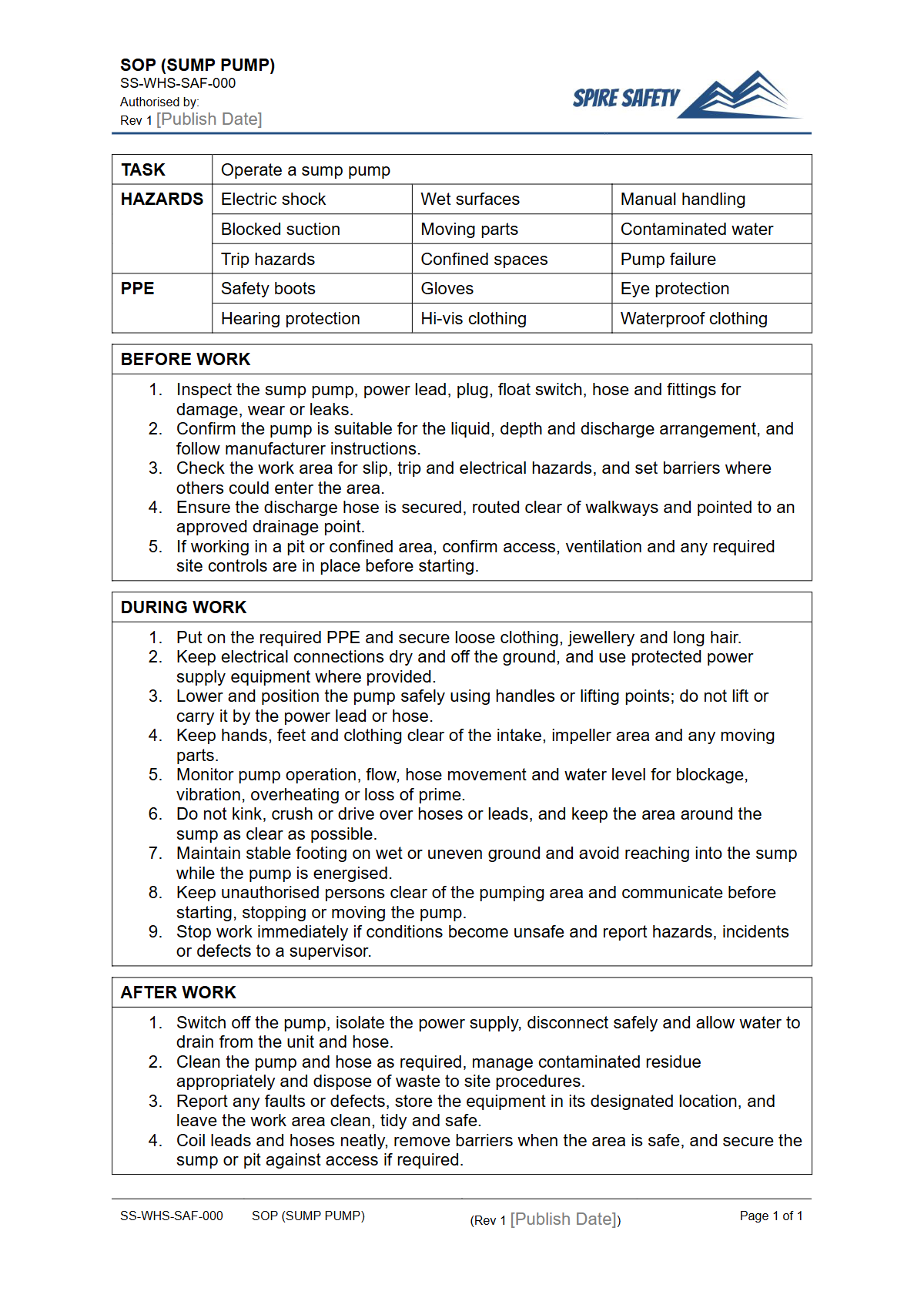
Purpose of the Free Safe Operating Procedure (Sump Pump) Template
This Safe Operating Procedure (SOP) template provides a structured framework for documenting the safe use of submersible and pedestal sump pumps. Its purpose is to help your organisation manage risks associated with dewatering activities in environments like construction sites, basements, and excavations.
By clearly outlining step-by-step instructions, pre-start checks, potential hazards, and control measures, this template helps standardise safe work practices. A well-defined SOP is a critical tool for worker induction, training, and ongoing competency verification, ensuring everyone understands the expected safe behaviour when operating the equipment.
Implementing specific SOPs for plant and equipment is a fundamental part of a robust safety framework. They are practical, on-the-ground documents that form the building blocks of comprehensive WHS management systems. This template helps a Person Conducting a Business or Undertaking (PCBU) meet their primary duty of care by providing clear instruction and information to workers, reducing the likelihood of incidents related to electrical hazards, manual handling, or improper setup.
Video walkthrough
How to use the Free Safe Operating Procedure (Sump Pump) Template
To effectively use this Safe Operating Procedure (Sump Pump) template, you must adapt it to the specific context of your workplace. Download the DOCX file and begin by customising it with your company name, logo, and other relevant details.
Conduct a site-specific risk assessment for the dewatering task, identifying all potential hazards unique to your environment and the specific model of sump pump being used. The content of this SOP should be updated to reflect the findings of your risk assessment, including any specific controls required.
It is crucial that this document is not used as a generic, off-the-shelf solution. We have provided a comprehensive starting point, but you must ensure it aligns perfectly with your operations.
Consult with operators, supervisors, and health and safety representatives during the customisation process. Once finalised, use the SOP as a training tool for all relevant personnel. On a busy site where multiple activities occur, it's also useful to have procedures for other equipment, such as our FREE Trencher SOP Template.
After customisation, the SOP should be readily accessible to all workers who may need to operate a sump pump. Regular reviews and updates are necessary, especially after an incident, a near miss, or when changes are made to the equipment or work process. Verifying that the documented procedures are being followed in practice can be achieved through regular workplace inspections and safety observations, which are often a component of formal WHS compliance auditing.
When to use a Safe Operating Procedure
A Safe Operating Procedure for a sump pump should be developed and implemented before the equipment is first used and be readily available for reference at all times. It is particularly critical in situations involving high-risk factors, such as working in or near water, confined spaces, or areas with electrical hazards.
Use this SOP as a guide for any task requiring the removal of unwanted water from pits, trenches, manholes, building sites, and flooded areas. It should be consulted during toolbox talks before a dewatering job begins, especially for new workers or those unfamiliar with the specific equipment.
This procedure is also a vital reference document during emergency situations, like unexpected flooding, to ensure that water removal is conducted safely and efficiently. The SOP supports a planned, systematic approach rather than a rushed, reactive one that can introduce new risks.
For sites using a variety of powered equipment, it's good practice to have SOPs for all major plant. For example, a sump pump might be powered by a generator, which in turn might be powered by a portable engine requiring its own separate procedures, similar to those outlined in our Free Air Compressor SOP Template.
Who should use this Safe Operating Procedure
This SOP is intended for a range of personnel within an organisation. Primarily, it is for operators—the workers who physically set up, use, and monitor the sump pump.
They must be trained on the content of the SOP and be able to follow its instructions to perform their work safely. Supervisors and site managers should also use the document to oversee operations, conduct pre-start checks, and ensure work is proceeding according to the established safe work method.
They are responsible for ensuring the SOP is understood and followed by their teams.
Health and Safety (WHS) Managers and Advisors will use this template as a foundational document within the broader safety management system. They are often responsible for facilitating its development, review, and integration with risk assessments and training programs.
Should your team need expert assistance in developing and implementing such documents, consider engaging professional WHS consulting services. Finally, maintenance personnel should refer to the SOP, particularly sections on isolation and lock-out/tag-out procedures, before conducting any inspection, cleaning, or repair work on a sump pump.
While this document focuses on submersible sump pumps, many principles apply to other dewatering tasks. For larger-scale concrete or water-moving jobs, you may need procedures for different machinery, such as the equipment covered in our FREE Boom Pump SOP. You can explore our entire collection of procedural documents in our free WHS resources library to build a complete system for your worksite.
Common mistakes
Common mistakes to avoid
- Failing to inspect the pump, hoses, and electrical cords for damage before each use.
- Using incorrect electrical extension cords that are not rated for outdoor or wet conditions.
- Placing the discharge hose where it creates a trip hazard or allows water to drain back into the work area.
- Attempting to perform maintenance or clear a blockage while the pump is still connected to a power source.
Legal references
Legal considerations
The following legal requirements may be relevant to this type of work.
- Work Health and Safety Act (Harmonised) — Provides the primary duties for protecting workers and other people from work health and safety risks.
- Work Health and Safety Regulations (Harmonised) — Sets out requirements supporting the management of workplace hazards and risks.
The following codes may be relevant to this type of work.
- Managing WHS Risks Code of Practice — Provides practical guidance on identifying hazards, assessing risks and applying effective controls.
- Work Health and Safety Consultation, Cooperation and Coordination Code of Practice — Provides practical guidance on consulting workers and coordinating with other duty holders.
- Managing the Work Environment and Facilities Code of Practice — Provides practical guidance on safe work environments, workplace facilities and related controls.
Did you know
The Dominant Risk
The majority of serious incidents and fatalities involving sump pumps are due to electrocution. This often results from using damaged extension cords, faulty wiring, or failing to use a properly functioning residual current device (RCD).
Flood Origins
The modern sump pump was developed in the United States following the Great Mississippi River Flood of 1927. The invention was driven by the urgent need for an effective way to dewater millions of flooded homes and basements.
FAQ
Frequently asked questions
01What are the main hazards of using a sump pump?
02Is a Safe Operating Procedure legally required for a sump pump in Australia?
03Who is responsible for training workers on the sump pump SOP?
04How often should a sump pump SOP be reviewed?
Share this resource
Free Safe Operating Procedure (Sump Pump) Template
Browse Categories
How To Use It
- 1Download and open in Word or PDF.
- 2Replace the placeholders with your business details.
- 3Get it reviewed by a WHS specialist before rollout.
Need it customised?
Our WHS consultants can adapt this template to your site, run a gap analysis, or audit what you already have in place.
Book a Free Consultation WHS consulting servicesor call 1300 156 382
Related templates
- Free Safe Operating Procedure (Surface Degreasing) Template
- Free Safe Operating Procedure (Surface Disinfection) Template
- Free Safe Operating Procedure (Surface Etching) Template
- Free Safe Operating Procedure (Surface Grinder) Template
- Free Safe Operating Procedure (Surface Profile Gauge) Template
- Free Safe Operating Procedure (Suspension Strut Change) Template