
Free Safe Operating Procedure (Substation Cleaning) Template
Establish clear, step-by-step instructions for the high-risk task of substation cleaning with our free template. Download your customisable DOCX document today.
Free Safe Operating Procedure (Substation Cleaning) Template
DOCX • 126 KB + PDF
Updated Oct 2026
No signup required
Purpose of the Free Safe Operating Procedure (Substation Cleaning) Template
Working in or near electrical substations presents extreme risks, including electrocution, arc flash, and fire. A systematic approach to maintenance is therefore non-negotiable.
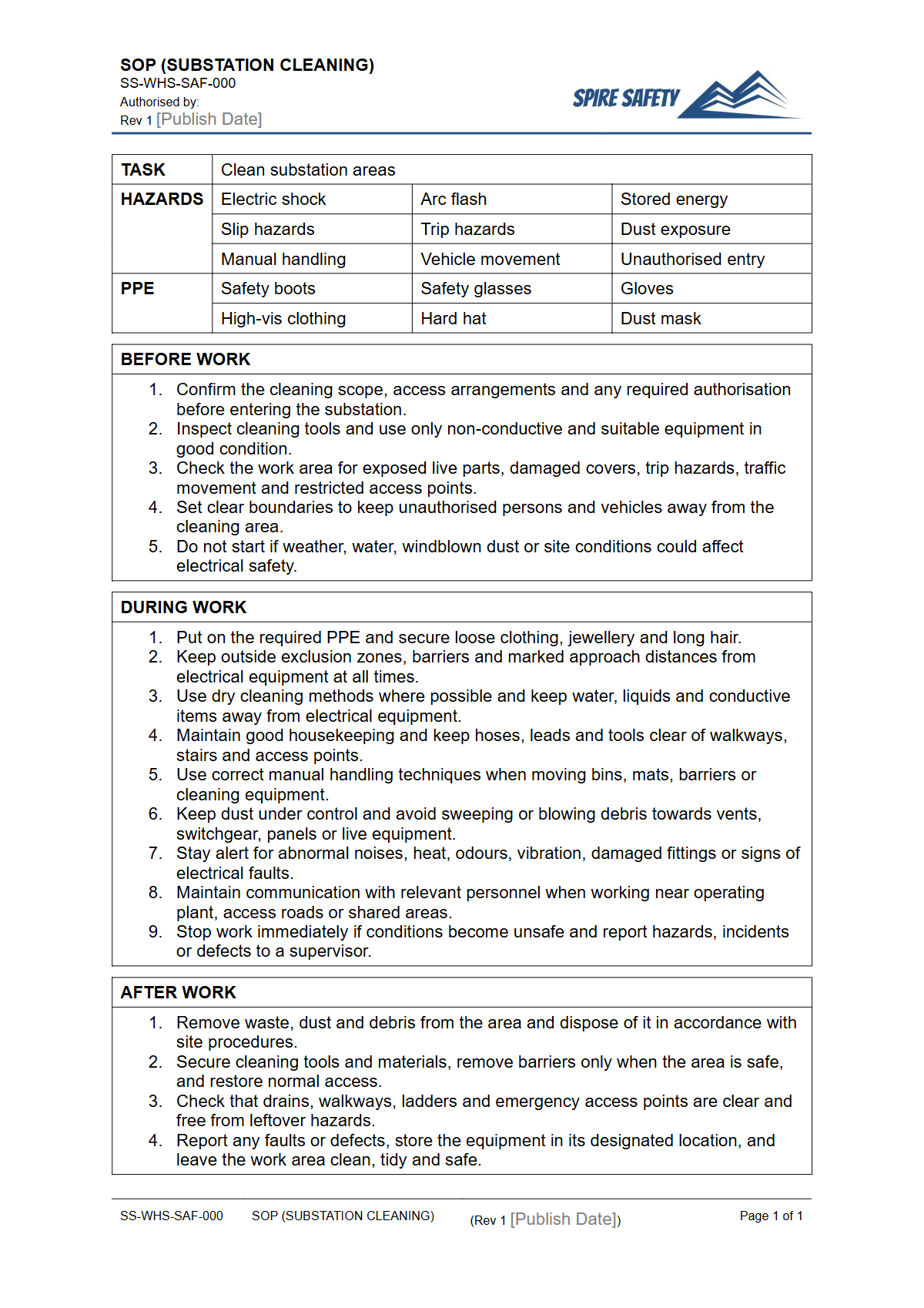
This Free Safe Operating Procedure (Substation Cleaning) Template provides a structured framework for documenting the required steps, safety controls, and responsibilities for this high-risk task. By formalising your process, you can provide clear, consistent instructions to workers, helping to minimise the likelihood of incidents and ensure all cleaning activities are completed safely and efficiently.
A documented SOP serves as a critical control measure, forming a key component of your overall safety framework. It helps ensure that all personnel understand the specific hazards, such as stored energy, unauthorised access, and potential exposure to hazardous materials.
Implementing robust procedures like this is fundamental to effective WHS management systems, demonstrating a commitment to proactive risk management and worker safety.
Video walkthrough
How to use the Free Safe Operating Procedure (Substation Cleaning) Template
This document is provided in DOCX format for easy customisation. To use it, download the file and open it in a compatible word processor.
You will need to carefully review each section and adapt the content to reflect the specific equipment, environment, and legislative requirements applicable to your workplace. Fill in the details regarding specific substation layouts, required personal protective equipment (PPE), lockout/tagout (LOTO) procedures, and emergency response plans.
It is essential that the final document is specific to your operational context. For example, the controls required for cleaning outdoor switchgear will differ from those for indoor control rooms.
Like our Oxy Acetylene SOP template, this procedure must be tailored for a specific high-risk task. Once customised, it should be approved by a competent person, such as an electrical engineer or a senior authorised person, before being issued to relevant workers.
Important Note on Customisation
Please note: This document is a template and must be customised to suit the specific equipment, environment, and risks present in your workplace. We recommend a competent person reviews and validates the final procedure before implementation.
When to use this Safe Operating Procedure
An SOP for substation cleaning should be a live document that is used consistently. Key times for its application include:
- Before any cleaning work begins: The SOP should be reviewed by the work party as part of the pre-start risk assessment or toolbox talk.
- Worker training and competency assessment: Use the SOP as a foundational document for training new personnel and for verifying the ongoing competency of experienced workers.
- Planning and scheduling maintenance: The procedure helps in planning the necessary resources, time, and isolation requirements for the job.
- Audits and inspections: This document serves as a benchmark against which actual work practices can be measured during safety audits. Regular reviews are a core part of effective WHS compliance auditing.
- Post-incident investigations: Following a near miss or incident, the SOP should be reviewed and updated to incorporate any lessons learned.
The procedure for other specialised equipment, as detailed in resources like our free Trencher SOP template, follows a similar lifecycle of application and review, ensuring it remains relevant and effective.
Who should use this Safe Operating Procedure
This SOP is intended for use by several key roles within an organisation that operates or maintains electrical substations:
- Authorised Electrical Workers: The primary users are the qualified and authorised personnel who will be carrying out the cleaning tasks.
- Supervisors and Team Leaders: Responsible for ensuring the work is conducted in accordance with the SOP and that all safety controls are in place.
- WHS/OHS Managers and Advisors: Use the SOP for risk assessment, training development, and compliance monitoring purposes.
- Asset and Maintenance Managers: Responsible for ensuring that safe and effective maintenance procedures are in place for critical infrastructure.
Defining these roles and ensuring each person has the necessary training and authority is a complex but vital task. For guidance on establishing these frameworks, organisations may benefit from specialised WHS consulting services.
Documenting procedures for all types of specialised plant is crucial for a safe workplace. You can find more examples, such as our free Telehandler SOP template, in our library.
This template is just one of many professionally developed documents available in our free WHS resources library, designed to help Australian businesses build stronger safety systems.
Common mistakes
Common mistakes to avoid
- Failing to correctly de-energise, test for dead, and apply locks and tags before starting work.
- Using conductive or inappropriate cleaning materials (e.g., water, solvents) near live parts.
- Neglecting to wear the correct arc-rated personal protective equipment (PPE).
- Inadequate assessment of worker competency and authorisation for high-voltage work.
Legal references
Legal considerations
The following legal requirements may be relevant to this type of work.
- Work Health and Safety Act (Harmonised) — Provides the primary duties for protecting workers and other people from work health and safety risks.
- Work Health and Safety Regulations (Harmonised) — Sets out requirements supporting the management of workplace hazards and risks.
The following codes may be relevant to this type of work.
- Managing WHS Risks Code of Practice — Provides practical guidance on identifying hazards, assessing risks and applying effective controls.
- Work Health and Safety Consultation, Cooperation and Coordination Code of Practice — Provides practical guidance on consulting workers and coordinating with other duty holders.
- Managing the Work Environment and Facilities Code of Practice — Provides practical guidance on safe work environments, workplace facilities and related controls.
Did you know
Arc Flash Temperatures
An arc flash can reach temperatures of up to 20,000°C, which is four times hotter than the surface of the sun. This extreme heat can cause severe burns and vaporise metal tools and equipment instantly.
FAQ
Frequently asked questions
01What should be included in a substation cleaning SOP?
02Who is responsible for developing a Safe Operating Procedure for substation cleaning?
03How often should an SOP for substation cleaning be reviewed?
04Is a Safe Work Method Statement (SWMS) required for substation cleaning?
Share this resource
Free Safe Operating Procedure (Substation Cleaning) Template
Browse Categories
How To Use It
- 1Download and open in Word or PDF.
- 2Replace the placeholders with your business details.
- 3Get it reviewed by a WHS specialist before rollout.
Need it customised?
Our WHS consultants can adapt this template to your site, run a gap analysis, or audit what you already have in place.
Book a Free Consultation WHS consulting servicesor call 1300 156 382
Related templates
- Free Safe Operating Procedure (Suction Unit) Template
- Free Safe Operating Procedure (Sump Pump) Template
- Free Safe Operating Procedure (Surface Degreasing) Template
- Free Safe Operating Procedure (Surface Disinfection) Template
- Free Safe Operating Procedure (Surface Etching) Template
- Free Safe Operating Procedure (Surface Grinder) Template