
Free Safe Operating Procedure (Stump Pulling) Template
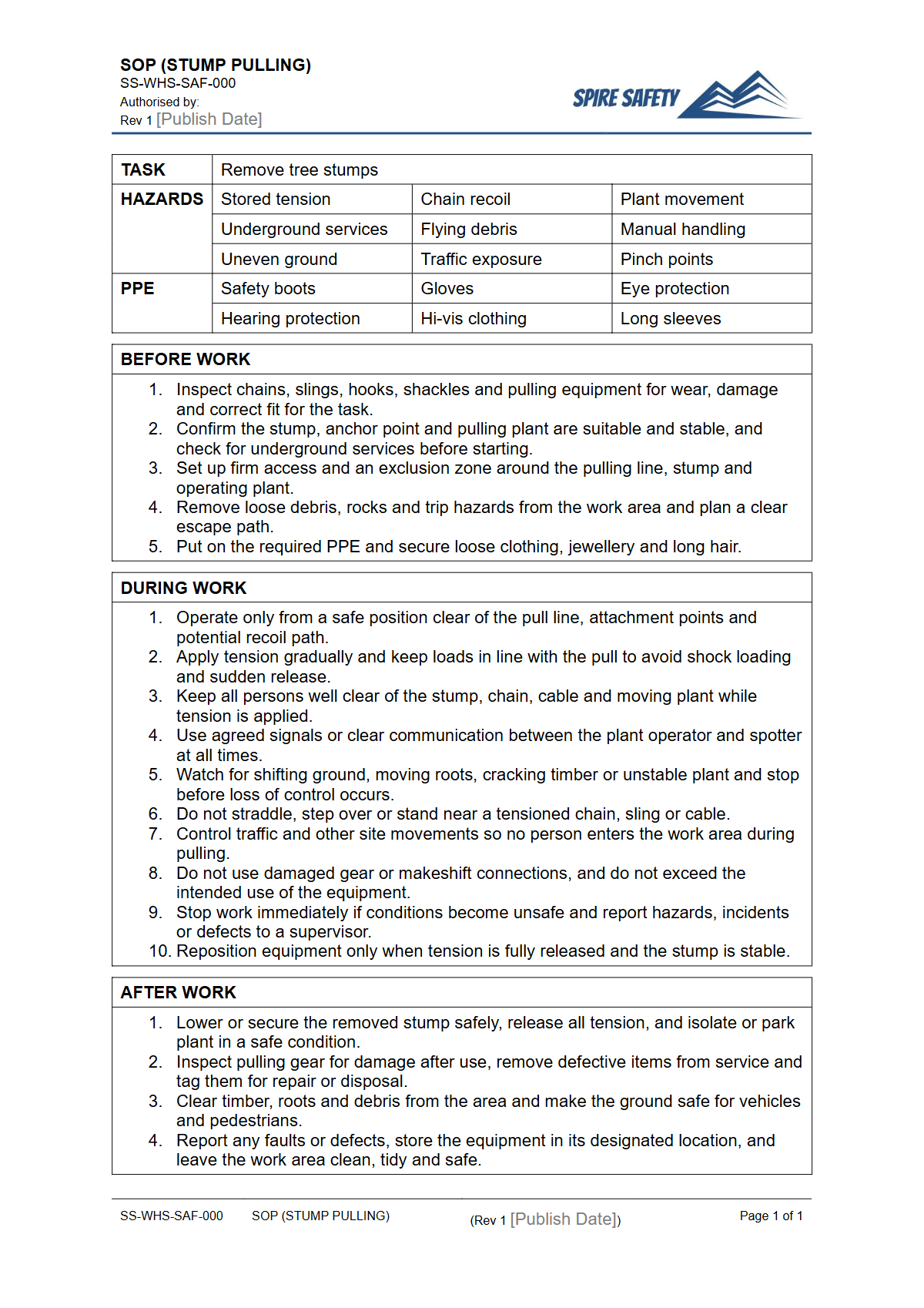
Download our free Safe Operating Procedure for stump pulling to formalise your safety processes. This customisable template helps you manage risks effectively.
Free Safe Operating Procedure (Stump Pulling) Template
DOCX • 126 KB + PDF
Updated Oct 2026
No signup required
Purpose of the Free Safe Operating Procedure (Stump Pulling) Template
Stump pulling is a high-risk activity that involves significant forces and potentially unstable ground. This Free Safe Operating Procedure (Stump Pulling) Template provides a structured framework for documenting the required safety measures before, during, and after the task.
It guides you through identifying hazards, assessing risks, and implementing robust control measures to prevent incidents. Using a formal SOP helps ensure that all personnel understand the risks—such as equipment failure, chain or strap snap-back, and ground collapse—and follow a consistent, safe method of work every time.
A well-documented SOP is a key component of a safe system of work. It demonstrates a commitment to workplace health and safety and assists in meeting your duties under WHS legislation.
This template is designed as a starting point, aligned with Australian WHS principles, to help you formalise your procedures for pulling stumps with machinery like tractors, excavators, or winches. For tasks involving different types of ground disturbance, you might also find our free Trencher SOP template useful for outlining specific operational risks.
Video walkthrough
How to use the Free Safe Operating Procedure (Stump Pulling) Template
This document is provided in both DOCX and PDF formats for your convenience. To effectively use this template, you should download the file and thoroughly customise it to reflect the specific conditions of your workplace.
This includes detailing the exact type of machinery being used, the qualifications of the operators, the site-specific environmental conditions, and the emergency procedures relevant to your location.
Important: This is a template, not a finished document. It is crucial that you adapt its contents to your unique operational context.
We have provided a framework based on common industry practice, but you must complete the site-specific risk assessments and procedural steps to ensure it is relevant and effective for protecting your workers. Integrating this SOP into a comprehensive WHS management system ensures it is used as part of a broader safety strategy rather than in isolation.
When to use it
A Safe Operating Procedure for stump pulling should be used consistently as part of your operational safety protocol. It should be consulted:
- Before commencing work: As a planning tool to ensure all controls are in place, including equipment checks, establishment of exclusion zones, and communication protocols.
- During worker training: To induct new operators or refresh the knowledge of experienced staff on the approved procedure for the task.
- For toolbox talks: As a reference document to discuss specific hazards and controls immediately before the work begins.
- During safety audits and reviews: To verify that the documented procedures are being followed in practice and remain effective.
- After an incident or near-miss: As a basis for investigation and to identify areas for improvement in the procedure.
For operations involving other types of specialised machinery, it is best practice to have dedicated SOPs for each. For example, if your work involves lifting and moving materials on-site, our free Telehandler SOP template provides a specific framework for that task.
Who should use it
This Safe Operating Procedure is intended for use by all personnel involved in the planning, supervision, and execution of stump pulling tasks. This includes:
- Persons Conducting a Business or Undertaking (PCBUs): To ensure they are providing and maintaining a safe system of work.
- Site Supervisors and Managers: To direct and oversee the work, ensuring procedures are followed correctly.
- Plant and Machinery Operators: As a direct guide on how to perform the task safely and manage associated risks.
- Safety Officers and WHS Representatives: To assist with risk assessments, training, and monitoring compliance with safety procedures.
Ultimately, anyone with a responsibility for health and safety on a site where stump pulling occurs should be familiar with this SOP. Regular reviews, often as part of a formal WHS compliance auditing process, help confirm the procedure is understood and implemented correctly by all relevant parties.
Developing SOPs for all critical tasks is a fundamental part of managing workplace risk. If you require further assistance in creating customised safety documentation or reviewing your current systems, our expert WHS consulting services can provide tailored support.
Similarly, for other common equipment, you might reference our free Air Compressor SOP to ensure consistency across your documentation. If you are looking for more templates, check out our entire free WHS resources library.
Common mistakes
Common mistakes to avoid
- Using an inappropriate vehicle (e.g., a car or light utility vehicle) that lacks the weight and power, increasing rollover risk.
- Failing to establish and enforce a sufficiently large exclusion zone for all persons not directly involved in the task.
- Using worn, knotted, or improperly rated chains, slings, or cables that are prone to failure under load.
- Neglecting to check for underground services before starting, leading to costly and dangerous utility strikes.
Legal references
Legal considerations
The following legal requirements may be relevant to this type of work.
- Work Health and Safety Act (Harmonised) — Provides the primary duties for protecting workers and other people from work health and safety risks.
- Work Health and Safety Regulations (Harmonised) — Sets out requirements supporting the management of workplace hazards and risks.
The following codes may be relevant to this type of work.
- Managing WHS Risks Code of Practice — Provides practical guidance on identifying hazards, assessing risks and applying effective controls.
- Work Health and Safety Consultation, Cooperation and Coordination Code of Practice — Provides practical guidance on consulting workers and coordinating with other duty holders.
- Managing the Work Environment and Facilities Code of Practice — Provides practical guidance on safe work environments, workplace facilities and related controls.
Did you know
Hidden Forces
The force exerted during stump pulling can be several times the weight of the pulling vehicle. If a chain or strap fails under this tension, it can release energy equivalent to a small explosion.
Underground Dangers
Striking underground utilities like gas lines, water mains, or electrical cables is a major risk. In Australia, the 'Dial Before You Dig' service is a free and essential first step before any excavation, including stump removal.
FAQ
Frequently asked questions
01What are the main hazards of stump pulling?
02Is a Safe Operating Procedure legally required for stump pulling?
03What personal protective equipment (PPE) is needed for stump pulling?
04How often should a stump pulling SOP be reviewed?
Share this resource
Free Safe Operating Procedure (Stump Pulling) Template
Browse Categories
How To Use It
- 1Download and open in Word or PDF.
- 2Replace the placeholders with your business details.
- 3Get it reviewed by a WHS specialist before rollout.
Need it customised?
Our WHS consultants can adapt this template to your site, run a gap analysis, or audit what you already have in place.
Book a Free Consultation WHS consulting servicesor call 1300 156 382
Related templates
- Free Safe Operating Procedure (Submersible Pump) Template
- Free Safe Operating Procedure (Substation Access) Template
- Free Safe Operating Procedure (Substation Cleaning) Template
- Free Safe Operating Procedure (Suction Unit) Template
- Free Safe Operating Procedure (Sump Pump) Template
- Free Safe Operating Procedure (Surface Degreasing) Template