
Free Safe Operating Procedure (Submersible Pump) Template
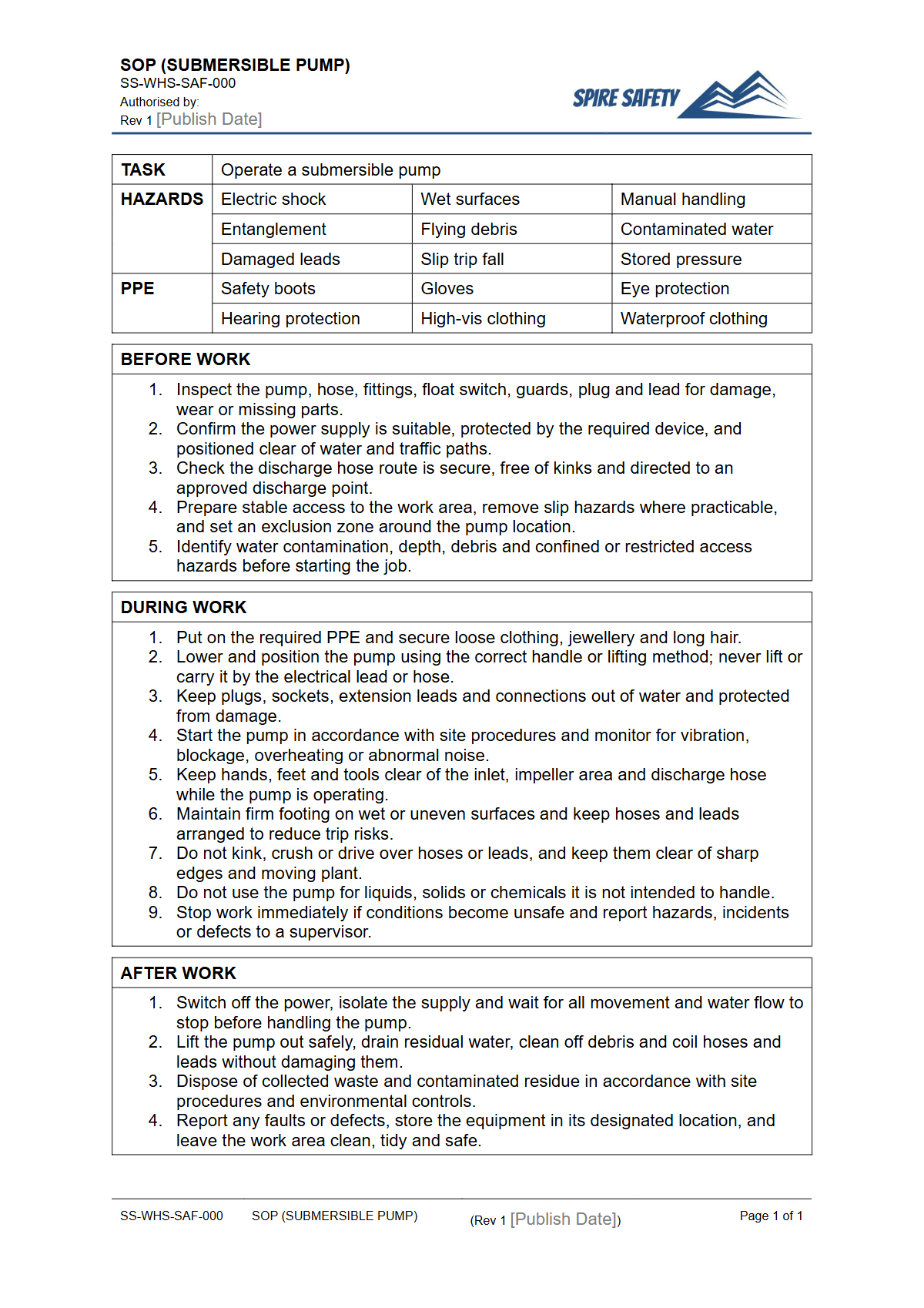
Effectively manage the risks of using submersible pumps with our comprehensive template. Download this free Safe Operating Procedure to get started.
Free Safe Operating Procedure (Submersible Pump) Template
DOCX • 126 KB + PDF
Updated Oct 2026
No signup required
Purpose of the Free Safe Operating Procedure (Submersible Pump) Template
Operating submersible pumps involves significant risks, including electrocution, drowning, and manual handling injuries. This Free Safe Operating Procedure (Submersible Pump) Template provides a structured framework to help you identify these hazards and implement effective control measures.
A well-drafted SOP is a critical tool for any person conducting a business or undertaking (PCBU) to ensure tasks are performed safely and consistently. It outlines step-by-step instructions for pre-operational checks, operation, and shutdown, forming a vital part of your overall safety management.
Using this template helps formalise your safety processes, providing clear guidance to workers and demonstrating a commitment to workplace health and safety. It serves as an excellent foundation document that can be integrated into your broader robust WHS management systems, ensuring a systematic approach to risk management across your organisation.
Key hazards addressed include:
- Electrical hazards from damaged cords, improper connections, or water ingress.
- Drowning risks when working near open water, pits, or trenches.
- Manual handling injuries from lifting and moving heavy pumps.
- Entanglement with moving parts or suction hazards.
- Slips, trips, and falls on wet or uneven surfaces.
Video walkthrough
How to use the Free Safe Operating Procedure (Submersible Pump) Template
This template is available for download as a DOCX file for easy editing, as well as a PDF for quick reference. The goal is to provide a comprehensive starting point, not a final, universal document.
It is crucial to adapt the content to the specific models of submersible pumps used at your site, the environment they are used in, and your organisation's unique procedures.
Important: You must customise this document to reflect your specific workplace. We recommend a consultation process involving the workers who will be using the equipment.
Their direct experience is invaluable for identifying practical risks and effective controls. Once customised, the SOP should be used as part of worker training and induction. When dewatering excavated areas, this SOP can support documents like a free Trencher SOP.
When to use a Safe Operating Procedure for a Submersible Pump
An SOP for a submersible pump should be developed and implemented before the equipment is ever used on site. It is a key reference document for any task involving the transfer or removal of water and other non-flammable liquids. Common applications include:
- Dewatering construction sites, trenches, and foundations.
- Managing floodwater or significant water accumulation.
- Emptying pits, tanks, swimming pools, or sumps.
- Agricultural and horticultural irrigation.
- General water transfer duties in workshops or industrial facilities.
For high-risk construction work, the details within this SOP should be used to inform the development of a site-specific Safe Work Method Statement (SWMS). It can also complement procedures for other site machinery, such as an Air Compressor SOP template, which is often used concurrently on job sites.
Who should use this template
This resource is designed for anyone responsible for health and safety in a workplace where submersible pumps are used. This includes WHS advisors, site supervisors, project managers, construction managers, and business owners.
It provides the necessary structure and key considerations to help you draft a procedure that is aligned with Australian WHS principles.
Operators should use the final, customised document as a practical guide for their day-to-day tasks. Regular reviews of its effectiveness can be supported by formal WHS compliance auditing to ensure the controls remain relevant and effective over time. This process helps maintain a safe working environment when using various types of plant, such as those covered in our free Boom Pump SOP. For more templates, you can browse our complete free WHS resources library.
Common mistakes
Common mistakes to avoid
- Lifting or lowering the pump by its electrical cord instead of the designated handle or rope.
- Failing to inspect the pump, cord, and plug for damage before each use.
- Using a standard pump in an environment with flammable liquids or vapours.
- Neglecting to regularly test the function of the connected Residual Current Device (RCD).
Legal references
Legal considerations
The following legal requirements may be relevant to this type of work.
- Work Health and Safety Act (Harmonised) — Provides the primary duties for protecting workers and other people from work health and safety risks.
- Work Health and Safety Regulations (Harmonised) — Sets out requirements supporting the management of workplace hazards and risks.
The following codes may be relevant to this type of work.
- Managing WHS Risks Code of Practice — Provides practical guidance on identifying hazards, assessing risks and applying effective controls.
- Work Health and Safety Consultation, Cooperation and Coordination Code of Practice — Provides practical guidance on consulting workers and coordinating with other duty holders.
- Managing the Work Environment and Facilities Code of Practice — Provides practical guidance on safe work environments, workplace facilities and related controls.
Did you know
An Electrifying Invention
The first submersible pump was invented in 1928 by Russian-Armenian engineer Armais Arutunoff, who created a portable and efficient way to pump water from oil wells.
RCDs Save Lives
Using a portable Residual Current Device (RCD) is a critical safety measure when operating electrical equipment in wet conditions. RCDs are designed to quickly shut off the power supply if they detect a fault, preventing a potentially fatal electric shock.
FAQ
Frequently asked questions
01What are the main hazards of using a submersible pump?
02Does a Safe Operating Procedure for a submersible pump replace a SWMS?
03How often should I review my submersible pump SOP?
04Is training required to operate a submersible pump?
Share this resource
Free Safe Operating Procedure (Submersible Pump) Template
Browse Categories
How To Use It
- 1Download and open in Word or PDF.
- 2Replace the placeholders with your business details.
- 3Get it reviewed by a WHS specialist before rollout.
Need it customised?
Our WHS consultants can adapt this template to your site, run a gap analysis, or audit what you already have in place.
Book a Free Consultation WHS consulting servicesor call 1300 156 382
Related templates
- Free Safe Operating Procedure (Substation Access) Template
- Free Safe Operating Procedure (Substation Cleaning) Template
- Free Safe Operating Procedure (Suction Unit) Template
- Free Safe Operating Procedure (Sump Pump) Template
- Free Safe Operating Procedure (Surface Degreasing) Template
- Free Safe Operating Procedure (Surface Disinfection) Template